Showing posts with label violence. Show all posts

Friday, March 25, 2016

The Disabled Child Body as Object

A teacher in this video knocks a child with "special needs" over with her knee, because he was pausing at the door to the classroom and she wanted him to get inside. It was probably an accident, she just wanted to prod him along. When he gets up, she talks above his head to the adult in the room as she keeps pushing the child in the back.

She's resigned and been arrested. Video at the link. It's distressing in its casual violence, but not graphic.

The child's body here is just treated like an object. He's a non person.

I have become a pro-surveillance partisan in "special education" classrooms. I just can't see any other way to stop the abuse.

Good tweet here:

Monday, November 9, 2015

Wall of Shame: 11Alive News Atlanta refers to murder as "Mercy Killing

A woman murdered her disabled son in Georgia. It's a tragic story. His father discovered when he came to pick up his son for a visitation. This is just brutal:
The boy’s father came to pick him up for regular visitation but when he got there, no one came to the door. And that wasn’t typical.
The sheriff described how the father said those routine visits normally started.
“When he comes to visit, the kid comes to the door and is excited to see him,” Sheriff Tony Wooten said.
Feeling that something was wrong, the father called 911. But once inside, deputies found a devastating scene.
I can't tell you any more about the boy - his likes, his dislikes, his needs, his desires - because the news report focuses on the mother. Worst of all, the headline writer speculated that this murder might be a "mercy killing."

Here's a screenshot from 11:30 AM CST on 11/09/15 (link to the article - UPDATE 6:34 11/9 The news station has removed all references to "mercy killing" but not acknowledged corrections)


The headline reads: Dawsonville mother shoots disabled son, self in possible mercy killing. On the video, it reads, "Police: Mom kills disabled son, then herself." One DEK (a subheadline) read - "Murder-suicide or mercy killing?" Such rhetoric suggests that if she did it to spare the boy suffering, it's not murder.

There was a certain amount of twitter outrage, including from me. 

In fact, I had just spoken about this on Tuesday at Access Living Chicago, when, at a workshop sponsored by Poynter on disability journalism, I talked about the need to write victim-centered stories in these tragic cases. I wrote about that for CNN a year ago after London McCabe was murdered.
Stories about lack of support services position children with disabilities as burdens to their families. They portray the crime as understandable. Such stories perpetuate the idea that it's better to be dead than to be disabled, that life with disability is life without meaning, and that tired, stressed, caregivers have no hope. No wonder, in such a narrative, the parents do such terrible things. The children, or at least their disabilities, become responsible for their death.
Such stories do not just erase the victims, they are also generally inaccurate. In fact, this kind of killing is typically driven not by a lack of services, but by a warped understanding of disability itself.
London McCabe did not want to die. London liked big hats. He liked fuzzy stuffed animals. He made a wish on his cupcake for his sixth birthday. In September, his father wrote, "London is pleased as punch. He lays on our laps and puts our hands together. Last night he made the 'mmmwha!' sound and gave his Mommy a kiss. Then he made the same sound and pushed our faces together. He's all smiles."
I was thinking about that last paragraph, a paragraph that crushed me to write and still hurts to read, as in the description of this latest victim's enthusiasm to see his father. He was a real person. He's been murdered.

And this news station called it a mercy killing. 

Fortunately, the headline has changed. It now reads - "Police: Dawsonville mother shoots disabled son, self."


I'm glad they listened. I've called the station asking for comment and will let you know if I hear anything.

Update 2:58 CST 11/9: It's pointed out in the comments below that the piece still leads with "murder-suicide or mercy killing?" Contact them here.


Monday, November 2, 2015

Cult of Compliance: Bus Driver Attacks Student with Disabilities for not Obeying.

This is a video of a school bus driver attacking a child with disabilities. It's hard to watch, but worth watching for the following reasons (and maybe more):
  1. The other kids are standing up for their classmate, telling the bus driver he can't do it.
  2. One child was holding the cell phone that caught this video and led to the arrest of the driver. Another child, at about 28 seconds, can be seen pulling out his phone to record the driver.
  3. It's the "cult of compliance" embodied, yet again. The driver gives a command, the student disobeys, and the driver then uses that to justify (to himself and in the aftermath) his use of force. It's the same phenomenon as Spring Valley High and thousands of other incidents (use the tags to track them, though I'm still implementing tags consistently in the first 500 post on the blog). From the local news report:
Johnston police said the driver approached 15-year-old Christian, a student with special needs, after he failed to follow the bus driver’s instructions regarding a seat assignment.

Police said the student directed an inflammatory comment toward the bus driver who grabbed the student's coat, hit the boy in the face and pushed him to the floor.
Here's the video. Obvious warnings apply, though it's more disturbing than graphic.

Friday, October 30, 2015

Disability, Trauma, and the Assault at Spring Valley High

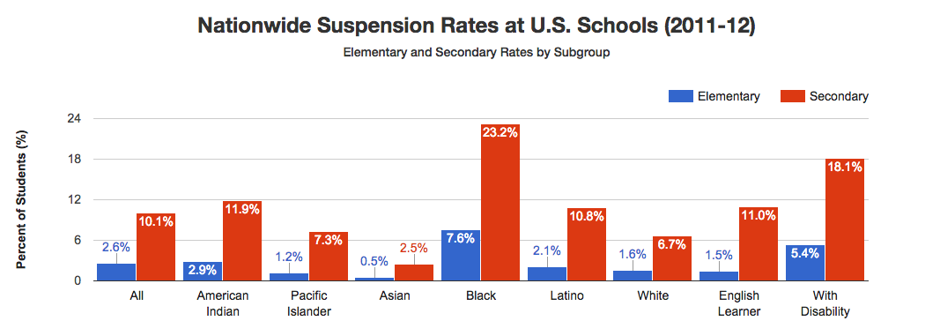
Ever since watching the terrible video of a student being pulled from her desk and thrown to the ground, I've been waiting to learn how disability intersected with this case. I assumed it would, because the data shows that the two groups most vulnerable to violence at the hands of school authorities are people of color and students with disabilities. Disabled people of color are multiply marginalized, and thus highly at risk - see my pieces here and here

Chart from http://www.citylab.com/crime/2015/10/why-disabled-students-suffer-at-the-hands-of-classroom-cops/412723/
It shows 22.3% of all suspensions are black students. 18.1% are disabled.
Once we learned that school resource officer Ben Fields was known as "Officer Slam," I knew that if we dug into this officer's background, we'd find disabled victims of his bullying. That's just what happened. Here's a story that describes his violent encounter with an autistic student [my emphasis]:
Richland School District Two Superintendent Debbie Hamm admits that "clearly something did not go right," calling it the most upsetting incident she has seen in her 40 years with the district.
"We will be working with the Richland County Sheriff's Office to clarify our expectations about screening and training for school resource officers," said Hamm.
But one parent had a slightly different reaction.
"I saw his face and my first thought was 'Oh my god, that's the same guy,'" said Wendy Johnson, who says her autistic son was in a physical struggle with Fields when he was a freshman.
Photos she took of her son after the altercation reveal his shirt torn and marks on his arms and shoulder.
Notice how the Superintendent characterizes the assault on the video as out of the norm. My guess is that "Officer Slam" does this all the time, it's just now he's being held accountable. The violence is structural. The violence is systemic. This is not an isolated incident.  

Then there's the question of trauma. There's a major class-action lawsuit in California arguing that victims of trauma should be covered under disability law. It has enormous implications for American education, because up to a quarter of all children, according to Susan Ko of the National Center for Child Traumatic Stress, will be victims of trauma. If trauma is so common and if should be treated as a disability (both givens that I believe to be true), it may indeed force us to stop treating disability as a deviation from the norm, as a case of "special" needs, but just as needs. We'll have to move to a system of universal design that requires all interactions with students take the possibility of disability into account.

I don't know whether the student dragged out of her desk was a victim of trauma. I don't need to know. Initial reports was that she was a recent orphan, more recent information is that she is estranged from her mother and living in foster care, and now that narrative has been questioned too. We, as a nation, are overly fond of litigating the character of the victim of state violence as a way of determining whether or not they deserved to be brutalized. Such violence is not determined by whether she was a "good victim" or not, but instead whether she was in fact engaged in threatening behavior that merited escalating use of force. Judging by the videotape, she was not. Case closed.

Her lawyer does say that she's a victim of trauma now, in considerable emotional distress. I believe it. The assault looks traumatizing. Having millions of people view your assault, likewise.

In that classroom, the statistics suggest, there surely were people who had experienced trauma, and who had to observe the violence. That's only going to make matters worse.
Many traumatized students live in a state of constant alarm. Innocent interactions like a bump in the hallway or a request from a teacher can stir anger and bad behavior 
The lawsuit alleges that, in Compton, the schools' reaction to traumatized students was too often punishment — not help. 
"They were repeatedly either sent to another school, expelled or suspended — and this went back to kindergarten," says Marleen Wong, who teaches at the USC School of Social Work and has spent decades studying kids and trauma. "I think we're really doing a terrible disservice to these children." 
The suit argues that trauma is a disability and that schools are required — by federal law — to make accommodations for traumatized students, not expel them. The plaintiffs want Compton Unified to provide teacher training, mental health support for students and to use conflict-mediation before resorting to suspension.
We must get these SROs - School Resource Officers - out of the schools. We cannot respond to the prevalence of trauma with more police officers, more violence, or zero tolerance policies. It's counter-productive. Hopefully, the courts will also decide that it violates the ADA.


Saturday, February 28, 2015

Day of Mourning - 3/1/2015

Every year on March 1st, the disability community gathers to mourn people killed by their parents and caregivers. We mourn all untimely deaths, of course, and there are far too many deaths by accident, stranger violence, police violence, and more.

But there is something specific to the disability community in which caregivers kill and then are forgiven in the media. The media rhetoric explains away the violence by making disability itself the culprit.

We reject that narrative.

Here is a statement by Autistic Self-Advocacy Network president Ari Ne'eman
Memory is an important part of how we define our communities. When we think about the history of the disability rights movement, there are so many moments at which we stop and think to ourselves, “But for the actions of those who came before me, I might not be here with the chances and opportunities I have today.” From the heroes of the 504 Sit-In to the modern day struggles to free our people from institutions and nursing homes, we stand on the shoulders of those who came before us. We are bound together by the memory of those who fought on our behalf.
But the memories that tie us together as a community aren’t just the happy moments, the victories where our cause takes a great step forward. We bond over our sorrows as well. Today, we are gathered together to remember members of our community who had their very lives taken from them, for no other reason than because they were one of us. Because they were disabled.
For George Hodgins, for Melissa Stoddard, for Daniel Corby, for Nancy Fitzmaurice, for London McCabe, for Katie McCarron and Tracy Latimer and Alex Spourdalakis and countless, countless others, there will be no opportunity to share in our community’s moments of celebration. There will be no chance to experience the sweet sense of belonging that we’ve each come to together after long years of fear in our time apart. There will be no chance even for the everyday joys of existence itself.
Here is a list of vigil sites for 2015. I do not know whether I will be able to attend the Chicago event, but I hope to do so.

I wrote an article on the death of London McCabe, quoting Ari, on this issue. My motto is that we should write victim-centered narratives, not killer-centered narratives. This was, I think, the hardest piece I've ever written in terms of its emotional effect on me. And I received criticism on it for not talking about the killer's mental health issues in an appropriately sympathetic way. It's not my goal to demonize the killer, it is my goal to remember London. This is the paragraph that gutted me.
London McCabe did not want to die. London liked big hats. He liked fuzzy stuffed animals. He made a wish on his cupcake for his sixth birthday. In September, his father wrote, "London is pleased as punch. He lays on our laps and puts our hands together. Last night he made the 'mmmwha!' sound and gave his Mommy a kiss. Then he made the same sound and pushed our faces together. He's all smiles."
Wherever your body is tomorrow, spend a few minutes remembering those we've lost. Vow to remember them. Try to tell their stories.

I will continue to use my blog and, to the extent I can land pieces, my contacts in journalism, to tell victim-centered stories and to call out those reporters who do otherwise. That's my promise.


Thursday, February 26, 2015

Christian Holy War - Next on FOX

All the news lately on Bill O'Reilly has focused on his chronic exaggeration of his records as a reporter on war. The short story is that while has has seen violent things here and there, he's not a war reporter, but it's not likely Fox News or their audience will care.

What I don't want is to let O'Reilly and his producers/writers off the hook for this.


After the Graeme Wood ISIS piece came out, O'Reilly used it to declare that we are in a Holy War. Now I know something about Holy Wars, and it's always possible for one side or another to decree that they are in a sanctified battle. Things get really nasty, though, when both sides adopt such rhetoric, and that's exactly what O'Reilly did here.
Fox News host Bill O'Reilly boosted his idea that the U.S. is in a holy war against the Islamic State (also known as ISIS or ISIL), demanding the Obama administration "take the holy war seriously" and urging American clerics to lead the fight.
After the Islamic State's beheading of 21 Egyptian Christians in Libya, O'Reilly claimed that "the holy war is here" on the February 17 edition of his show. O'Reilly later called on "all Christians, Jews, and secularists who love their country" to call the White House and "say enough."
On the February 18 edition of his show, O'Reilly again claimed it is "appropriate to define the worldwide conflict between Muslim fanatics and nearly everybody else" as a "holy war" and demanded President Obama "take the holy war seriously." O'Reilly asserted that the West must come together to eliminate the Islamic State, adding that "if the politicians won't do it, the clergy must lead the way."
What's ironic is that for days before this the right-wing was insisting that Christianity was fundamentally peaceful, while Islam was fundamentally violent.  And yet here he calls on clergy to lead the way.

This is dangerous talk. It's going to lead to further intensification of anti-Islamic sentiment and activity among radical right-wing Christians, it's going to serve ISIS very well in their recruitment efforts, and it wouldn't surprise me if it creates more domestic violence against Muslims.

I care about this much more than whether O'Reilly invented a fantasy of himself as a war correspondent. The fantasy of salvific violence is much more dangerous.

Friday, February 20, 2015

How Not to Report on Violence against Disabled Children

In Spokane, a woman stabbed her autistic son in the neck. Here is 100% of the information on the victim (link here):
Court documents say the 17-year-old son had several cut marks on his neck and throat, but officials say his wounds were not life threatening.
The rest of the piece is about how hard life must have been on the mother, building sympathy for her. It perpetuates the idea that autism is so terrible that it must be cured, eradicated, vanished. That violence against autistic people is reasonable. That (to cross news stories for a minute), it's better not to get vaccinated than to risk autism (NOTE: Vaccines do not cause autism. END NOTE). This kind of little news piece is part of the problem.

I wrote about this after the death of London McCabe.
London had autism. Media coverage of his death has widely focused on the stresses and challenges of raising a child with autism. In other words, the stories are about his mother and her problems finding help, not the dead boy.
This is a mistake. In all cases of violent crime, but especially those involving people with disabilities and their caregivers, we need to mourn the victims, rather than explain away their deaths. Unfortunately, whenever these terrible kinds of tragedies take place, which they do far too often, we do just the opposite.
Here, then, is a perfect example of what not to do.

And here's the thing, even if the mother's story is in fact tragic and filled with difficulty, even if she's struggling with all sorts of issues, even if she needed support that she didn't get, that's not the story we should be telling after an event like this. I want to tell stories about parents needing and getting more help, while advocating for policies that change lives. I tell these stories all the time, highlighting individuals and organizations, arguing for or against laws, and so forth.

But after an act of violence, we need to tell the boy's story. We tell about his life. We make sure that he's represented as a full person who didn't want to get stabbed in the neck. We must not blame the disability.

This story does exactly the opposite, going to a local parent at the Northwest Autism Center who ALSO talks about how hard her life is, not how meaningful her child's life is.

Disability community - we need to call this out, give better models to journalists, write to the NW Autism Center, and otherwise change this mode of journalism.