Showing posts with label cult of compliance. Show all posts

Wednesday, March 7, 2018

Suspensions and Minnesota Schools

Yesterday, I wrote about a series of incidents in which disabled children, mostly non-white, whose stories of arrest and abuse in Florida schools have become national news. These stories pair with policies from DC that increase the criminalization in our schools, drive parents to private schools, where they have to surrender their rights. I made it clear it was a national issue, but focused on Florida because lawmakers were pushing more guns into schools and adding more mental health services. The latter are great, in theory, but doing so in the context of mass violence continues the false association of violence with mental illness. It's a tough read, I found (as did some readers), but I tried to make some connections visible around the #CultOfCompliance.

Late in the afternoon, then, I came across a similar story from Minnesota.
Students of color and those with disabilities are twice as likely to be suspended or expelled from Minnesota schools than their white peers or students without disabilities, a new study reveals.
The statewide analysis, released Friday by the state's Department of Human Rights, showed that students of color accounted for 66 percent of all school suspensions and expulsions in the 2015-16 school year, even though they make up only 31 percent of Minnesota's student population.
Disabled students were involved in 43 percent of all suspensions and expulsions, but make up only 14 percent of the student population.
"For some schools, this information was somewhat surprising; they hadn't examined this before," Human Rights Commissioner Kevin Lindsey said. "I'm hoping, by us raising the awareness, it does stay front and center for people in Minnesota. I think there are a lot of folks in the state who want kids to succeed. Hopefully we'll see the disparities drop."
If this is a surprise to schools, they haven't been paying attention to both state and national trends. 


Monday, November 20, 2017

Florida and Criminalizing Autism

Last April I wrote about the arrest of John Haywood, a ten year old autistic boy, who sobs as he's taken to the police career, his mother filming it. The video went viral, as well it should, because it's awful. I wrote:
If the video shocks you, and it should, imagine how often children with autism or other disabilities are being arrested in situations where there's no video, no parent present and no viral outrage. If teachers, administrators, and cops continue to criminalize children for violating what I have come to call a "cult of compliance," punishing them for acting in ways that come naturally, how can we decriminalize disability?
Seven months later, despite the media outcry, the boy still faces charges, isn't in school, and nothing has changed.

Viral videos aren't enough.

Monday, October 9, 2017

Patrick Harmon - #CultOfCompliance

There is no de-escalation training that can build better policing. There is no video monitoring that can hold police accountable. So long as cops can say, "I was afraid," even when video evidence shows that they are lying, they are legally entitled to commit murder.

Patrick Harmon, a black man with, according to his sister, psychiatric disabilities, was pulled over for biking without a light. As the encounter escalated, he ran away and the police shot him in the back. Later, they said it was a terrifying encounter ... but video demonstrates that this was not the case. No weapon, no threats, just a scared man being non-compliant.

There is no reason to expect justice here, because our system doesn't promote justice. It promotes compliance.

Do not share the video. No one needs to watch it. We know what it shows.

Tuesday, August 1, 2017

"How Can I Help?" - Canada Ponders Mental Health and Policing

Four years ago, a police officer in Ontario shot Michael MacIsaac, who was running naked through his suburban neighborhood. He was allegedly holding a metal chair leg of some sort, and when he didn't drop it, Constable Brian Taylor shot and killed him.

An inquest into the shooting has just wrapped. One of the participants emphasized not just specialized training, but a general approach based on de-escalation.
Jennifer Chambers, one of 18 witnesses who testified at the inquest, is executive director of the Centre for Addiction and Mental Health-funded Empowerment Council. The organization has long advocated for improved training for frontline officers who may encounter many different shades of mental illness on the job.

Chambers has made her case at more than 10 different police shooting inquests, including the one for 45-year-old Andrew Loku earlier this month, and says she's noticed some common themes.
"The police see somebody holding something they find threatening and they give the police challenge … When the person doesn't drop it, they just keep yelling," Chambers told CBC Toronto ahead of the release of the jury's recommendations.
Instead, she would like to see officers first ask: "What's going on? Can I help you? Is there something we can do? Let's talk."
I like this framing. It's pretty clear that a case of a naked man running through a suburb in winter might be in mental health crisis, but too many cases are less clear. Specialized training and resources are necessary, but just generally de-emphasizing reliance on instant compliance, absent other threat indicators, will save lives.


Friday, May 19, 2017

#CultOfCompliance: Tasing and Handcuffing Fails to Stop Meltdown

Yosio Lopez is a 7 year old boy with ADHD and other emotional disabilities in a Dallas school. Sometimes he has behavioral meltdowns when overstimulated and an aide helps him through the process. 

As reported on CNN:
Yosio Lopez was handcuffed, Tased and bruised by Dallas Independent School District (DISD) Police after the boy started banging his head against a wall in class, the Lopez family lawyer, David Ramirez, told CNN.

He has experienced similar outbursts in the past but has always had a trained school aide nearby to help calm him down.

Last Tuesday, the aide wasn't there and Yosio didn't have his "safe place," Ramirez said.

The boy told his mother, April Odis, that he was put on a desk with his arms cuffed behind his back while the school principal put her elbow on his neck and choked him to restrain him, the family lawyer said.
He was taken to a mental health facility and forcibly institutionalized. He and his mother were kept separated for two days under the claim that he was a danger to himself and others.

So here we have a child who becomes distressed and bangs his head against a wall. That is, indeed, a moment for intervention and then post-incident assessment of the triggering behavior - so as to fix the context, not the child. Instead, the school (allegedly) creates a traumatizing situation, then intensifies the trauma through temporary medical incarceration.

Friday, March 24, 2017

Shock and Law: Tasers and the Cult of Compliance

The State of CT mandates the tracking of taser use by law enforcement, which is fairly rare across the country. We've got the 2015 numbers. From Connecticut Magazine:

A total of 650 reported Taser incidents involved 610 people. Of those subjected to Taser use in 2015:

83 percent were unarmed
53 percent were people of color
49 percent were under the influence of drugs or alcohol
33 percent were described as “emotionally disturbed”
13 percent were suicidal
Two died
When involved in Taser incidents, including instances when a Taser is drawn but a shock is not delivered, people of color were more likely to be shocked and less likely to be given a warning before being shocked than whites.

The state of CT found that 100% of these taser uses were justified, and that's where the problem lies. Such weapons are an important tool for law enforcement, but too often they are used not in lieu of lethal force (it's better to tase than shoot!), but in lieu of patience and conversation. The people who suffer from this the most are people of color, disabled individuals, and especially disabled people of color.
Policing the Police
McGuire says, in Connecticut, all the Taser investigations “have vindicated the officers and found no police misconduct.” But there are cases in which justification of Taser use is unclear, he says. “A few years back, in Middletown, a person who was in mental health crisis was [shocked] 34 times by three different officers, and that was deemed a justifiable use of force and ultimately the officers were exonerated.”
Accountability must be part of reform. Data serves accountability, so I'm glad they are counting.

Thursday, December 15, 2016

RESOURCE: Elderly Individuals and Police

I'm working on a piece on elderly individuals killed or beaten by police. Here's four stories from NY, IL, CA, and AL - which is to say spanning the country.

  • Francisco Serna: Dementia, 73, Latino, carrying a crucifix, out for a walk. 
  • Deborah Danner: Schizophrenia, 66, Black, naked and armed with a knife, in her apartment.
  • Sureshbhai Patel: Didn't speak English, 57, Indian, unarmed but deemed noncompliant, in front of his son's house.
  • John Wrana: Dementia, 95, White, allegedly holding a knife, in a nursing home.
These cases follow the same patterns as the shootings of many other disabled people, but due to their age, allow for different kinds of persuasive arguments.

More to come. What cases should be added to this set?

Thursday, December 8, 2016

Bradley King - Alone, in Crisis, Contained, Armed with a Small Knife

We see this story too often. I don't have all the details on this case yet, and sometimes the details better explain the decision to use lethal force.

But this was a person alone in his home with a knife, who had called 911 for help, and ended up killed by the reserve deputies who arrived to check on his welfare.

I'm struck by local media. The reserved "officer-involved" to characterize the police actions, but "lunging" and "brandishing" to describe the victim.

Again, I can't say that this killing was or wasn't avoidable. I just know I see it far too often.

Tuesday, October 4, 2016

Cult Of Compliance: Child Criminalized over Stolen Milk that Wasn't Stolen

Ryan Turk, then 14, gets free lunches at his Virginia school. One day, he forgot to grab milk, so went back to grab a 65 cent carton. The School Resource Officer assigned to the lunchroom accused of him of stealing and Turk, alas, did not instantly comply with the SROs orders. He might have talked back. He didn't meekly go to the principal's office. After all, he was supposed to be able to have a carton of milk.

Now he's facing criminal charges. Disorderly conduct and petit larceny.

From the News & Observer:
The Virginia teenager says he had forgotten to grab the drink the first time through the line at the Graham Park Middle School cafeteria, so he headed back. A recipient of free lunches at the school, Ryan felt he was just doing what he did every day.
But a school resource officer said he spotted the teen cutting in line and accused him of stealing the 65-cent milk. When Ryan didn’t cooperate with a trip to see the principal, authorities say, he was arrested and charged with disorderly conduct and petit larceny. Ryan turned down an offer of non-judicial punishment and, this week, a Prince William County judge set a trial date in November for the Dumfries teen, who is now a freshman in high school.
He will face the criminal charges just days after his 15th birthday.
Ryan and his mother, Shamise Turk, acknowledge that he did take a carton of milk on that day last school year, but they say he was entitled to it and did nothing wrong. They, and their lawyer, allege that Ryan was discriminated against, targeted because he is a black teenager who didn’t want to go along with a police officer who they believe was being unfair.
I, of course, see this as a classic case of the Cult of Compliance. The SRO doesn't get compliance, so escalates.
  • We need to get cops out of school.
  • Until then we need to forbid SROs from intervening in issues like this.
  • Until then we need to train our SROs to have common sense and not criminalize a child over milk.
  • But we need to get cops out of schools.


Saturday, September 17, 2016

School to Prison and Disability: Black Hard of Hearing 7 Year Old Was Crying about being Bullied. Cops Handcuffed Him

The story of Kaylb Primm got a lot of attention last week. It's yet another story of a non-white child being handcuffed (I've written about such cases  regularly. See below for links) in school for behavioral reasons. The MO ACLU is suing. Rebecca Klein, from Huffington Post, wrote a widely shared story.
Kaylb Wiley Primm was in second grade in Kansas City when he started crying in class because he was being bullied. Within minutes, the child found himself in handcuffs. Two years later, his life is just getting back to normal.
The incident began when a school-based police officer happened to walk by Kaylb’s classroom and hear him crying and disrupting other students, according to a lawsuit filed last week by the American Civil Liberties Union on behalf of Kaylb’s family. When Kaylb continued to cry and yell in the hallway, against the officer’s requests, the officer put the child in handcuffs and brought him to the main office, where he sat until a parent arrived.
Klein didn't mention it, but I thought - we're going to find out he's got a disability.

A lawyer friend, this morning, sent me the complaint, and sure enough:
15. At the time of the incident giving rise to this complaint, Plaintiff was seven years old and was finishing his second-grade year at George Melcher Elementary School in Kansas City, Missouri, which is part of the KCPS system.
16. Plaintiff has a hearing impairment in one ear and was bullied and taunted by classmates from time to time. 
In other words, the disability aspect of this incident was directly causal, perhaps in more way than one. First, the bullying emerged from ableism. Second, it's not improbable that the officer shouting at the boy (which caused him to cry more, which then led to more shouting, grabbing painfully, and then the handcuffing) was not an effective means to communicate with a distraught boy who is hard of hearing. 

Not all the media coverage even mentions Primm's disability, which troubles me. I don't see any coverage that actually cites the disability issues and the high rate of such encounters for disabled non-white children  in particular. I don't see any coverage that talks to people from the Deaf/HoH community or other experts in disability discrimination in schools. We can't erase the disability component of Primm's identity from this story, or any story.

My published writing on the abuse of disabled children by law enforcement in schools.
And recent blog posts on this manifestation of the Cult of Compliance

Monday, September 12, 2016

#CultOfCompliance: Off-Duty Chicago Cop Beats Disabled Teen for Trespassing

A lawsuit alleges the following (courtesy of the Chicago Tribune):
[Matthew] Jackson, a 21-year veteran of the force, became enraged after Nathaniel Taylor, 18, crossed onto his lawn on his way home from school, according to the lawsuit, which was filed Friday. Jackson beat the boy with his fists and shoved his service revolver into Taylor's mouth, causing multiple lacerations, according to the suit.
Taylor, who has an IQ of 44, was treated at Mount Sinai Hospital and then sent to Cook County Jail on charges of assaulting a police officer and resisting arrest, the lawsuit alleged. He spent a week behind bars before being placed on electronic monitoring, an experience that caused severe emotional trauma, according to the suit.
Note - Taylor, not Jackson, went to jail as a result of this. Taylor was charged with felonies when Jackson, according to the lawsuit, constructed an elaborate fight scene to justify his use of force.
According to the report, Taylor tried to flee, but Jackson caught up to him and a "struggle ensued," during which Taylor tried to grab Jackson's gun from the holster. As they wrestled for control of the gun, the weapon "made contact with (Taylor's) face and mouth area," the report stated.
Jackson also said he repeatedly yelled, "Chicago police! Stop resisting!" but Taylor continued to fight, according to the report. The officer was treated at a nearby hospital for minor scrapes.
"He went for my gun" and "Stop resisting" are, of course, real things that happen. They - and the word "erratic"- are also used as key phrases to conceal unlawful or merely improper escalation in the use of force. Parsing the differences among justified, unjustified but legal, and illegal, is the big challenge for reformers, since the officers all use the same language in their descriptions of events (as they are trained to do).

Criminal charges may follow. I'll be following the case as it moves forward.

Thursday, September 1, 2016

Disability and Policing: Leroy Duffie (double amputee, black) and the #CultOfCompliance

A double amputee (legs) not matching the description of a robbery suspect was told by police to get out of the car with his hands up. 8th Circuit Court has reversed a district court granting "qualified immunity" to the police in question.

I'm going to be referring to this case a lot as it embodies the dangers of the compliance-based policing to disabled civilians. Key summary:
  • The officer was looking for a young black man with braided hair. A van was involved.
  • The driver, Leroy Duffie, was in his 50s and bald. The officer couldn't see well though so decided he had probable cause to stop, "Based on the match of the driver's race and gender and the similarity of the van description."
  • The officer (and backup) were concerned the civilian had a firearm, so approached the van with their own weapons drawn and demanded the driver exit immediately.
The officers exited their vehicles with their sidearms drawn and remained shielded behind their opened doors. Officer Kaiser ordered the driver "to turn off the vehicle, place his hands in the air, open the door, and slowly step out of vehicle." The driver did not immediately comply. The officers began cautiously approaching the vehicle with their sidearms drawn toward the van, while continuing to shout commands for the driver to exit the vehicle. The driver explained his apparent noncompliance. He attempted to inform the officers that he was physically unable to exit his vehicle with his hands in the air. The officers responded by ordering him to put his head back in the vehicle and get out with his hands in the air. Eventually, the driver opened his door and turned his body to exit the vehicle but immediately fell face-first to the pavement.
I feel for Duffie, here, who must have been terrified he was about to be killed for noncompliance, even though he couldn't comply.
  • So far, it's problematic, but hard to legally fault the officers. They mis-ID'd the van, they forced the driver to humiliate himself and fall to the ground out of the vehicle or risk being shot. But at this point they discover instead of an abled teen with braids, it's a bald man in his 50s with two prosthetic legs. So what do they do? Handcuff him, search him, search the van, find no one else in the fan, but leave him face down on the pavement for five to ten minutes.
The driver, later identified as Duffie, is a double amputee with two prosthetic legs. He could not safely exit the vehicle in the manner that the officers commanded. The fall caused one of Duffie's prostheses to become detached. Duffie's prosthetic legs were ill-fitting due to weight loss from cancer treatments. Duffie remained on the ground for the remainder of the traffic stop. After finding no one else in the van, the officers handcuffed Duffie, still face down on the pavement, searched him for a weapon, and then removed the handcuffs after five to ten minutes at Duffie's request. The officers told Duffie that they stopped him because his vehicle matched the description of the van from the incident at the convenience store. By this point, the officers knew that Duffie did not match the description of the young man at the convenience store. Duffie was not a young man in a tank top with braids; at the time, he was a bald, 58 year-old double-amputee.
It's one thing for police to not expect the presence of disability - that's normal, if problematic. It's another thing for continuing to treat Duffie as a potential suspect even though there's no reasonable evidence that he was involved. The courts, as I read the decision, agreed.
 Darkness limited Officer Kaiser's vision; nonetheless, an objectively reasonable police officer would not mistake a 58-year-old bald man for a young adult with hair. Officers may not turn a blind eye to facts that undermine reasonable suspicion. 
Yes, the irony of the disability metaphor is not lost on me.

You can find the decision here.

Update: Leroy Moore, a major activist on policing and disability, sent me this link of local coverage, including a picture of Duffie.

Monday, August 22, 2016

#CultOfCompliance: Disabled/Deaf People Killed for Non-Compliance and Disability Erasure

Two disabled men were killed by law enforcement over the last few days. Details are still emerging. 

Both seem to be relatively young white men. Daniel Harris, in Charlotte NC, was Deaf and communicated via sign language. Joseph Weber, in Hays KA, has not been identified by diagnosis, but a local source tells me he was autistic.

A few weeks before that, a Deaf black man, Darnell Wicker, was killed in Kentucky.

All the news coverage of Harris and Weber seem to mention disability in the headlines and ledes. Almost none of the coverage of Wicker mentions disability, and certainly none of the headlines/ledes

So there are two issues: 
  • One - police killing disabled people for not complying. 
  • Two - media coverage of police killing disabled people for not complying. Disability is often erased, and especially so in cases of people of color (who are most likely to be the victims of police misuse of force). 
On the language issue, I spoke to Vilissa Thompson, creator of the #DisabilityTooWhite hashtag and an essential writer in the disability community. Strongly recommend making her RampYourVoice a regular read. Vilissa told me:
The erasure of Wicker's disability in media coverage doesn't surprise me because it occurs not only within journalism/reporting, but also within the Black Lives Matter movement when the police incidences involving Black disabled people fail to provide this important aspect when discussing the injustice committed.
The disability status of Black disabled people, from Korryn Gaines to Sandra Bland, are omitted for reasons tied to racism and ableism, and it must be addressed. To erase someone's disability status is both oppressive and offensive. To see it constantly portrayed regarding the lives and deaths of Black disabled people shows that we as a society do not value Black disabled lives, or the disparities they endure from having multiple marginalized identities.
There is work being done between Black disabled/deaf advocates to call out and demand that the experiences of Black disabled people who are victimized and murdered by the police receive the proper coverage that does not ignore their disabilities. This also calls for the experiences of Black disabled people to be fully included within activism conducted among Black liberation groups, disability advocacy groups, and other entities that seek to eradicate oppression and violence. We cannot continue to bury our heads in the sand about the experiences Black disabled people endure when it comes to the police - that purposeful exclusion is harming and damning to those of us who hold these identities.
When it comes to the police use-of-force issues, my overall position on the issue of policing remains: disability-specific training is not the answer to these tragedies, only the implementation of police tactics that do not respond to noncompliance, on its own, as a threat justifying the use of lethal force. While new details may emerge, in each case police approached the situations in ways that did not take into account the likely presence of disability. Presuming the possibility of disability has to be built into the standard approach.

Here are links - 

On Harris:
Detectives say Trooper Saunders and Harris got into "an encounter" before he fired his weapon. Neighbors say Harris' car spun out of control and was shot almost immediately after exiting the vehicle.
They say Harris was likely trying to communicate with the trooper using sign language before he was killed.
On Twitter, there was speculation that Harris may well have been trying to get to his home where someone could support him with communication, which seems reasonable to me. I'm waiting on a formal comment from experts within the Deaf community and will update here.

UPDATE: Talila "TL" Lewis, co-founder HEARD, wrote to me in an email:
The trooper wreaked havoc on Daniel Harris' car, as evidenced by the videos taken in front of Daniel Harris' home immediately following the encounter. Regardless of whether someone is Deaf, there is good reason to be fearful of police encounters, especially when they begin with this kind of violence. Relatedly, people with disabilities and Deaf people have a heightened awareness of just how easy miscommunication can occur with police officers who are enraged or in a rush.
In the past, Deaf and disabled people have been known to call family members, friends, interpreters to the scene of a traffic stop or other encounter to facilitate communication. This is Deaf and disabled people's way of compensating for police officers' lack of fluency in American Sign Language and lack of Deaf/Disability cultural competency. And so, it is not difficult to imagine that if Daniel Harris was in fear for his life, that he was trying to get to the one place where he knew there was effective communication access--his home--which really was just a few very short minutes away.
For more on Deafness and police use of force specifically, see this joint ACLU/HEARD project. The inability to hear shouted commands places Deaf people especially at risk. The Cult of Compliance, generally, is a cross-disability approach to thinking about policing (and our culture more generally), but it's worth pausing as well to consider each diagnostic profile and set of risks. Police must - under Title II of the ADA - be prepared for all of them.

On Weber:
According to a release late Thursday by the Ellis County Attorney’s Office, Weber was stopped for a traffic infraction and failed to obey the officer’s commands. As additional officers were called, he sped off from Plaza Avenue and made his way to Timber Drive.
There, the release said, he got out of his vehicle and again failed to obey commands of the officer. The officer fired a shot, hitting the 36-year-old. He died at the scene.
On Darnell Wicker, killed on August 8th. Wicker was carrying a knife and a saw. He did yard work in the area, so perhaps that's why he was armed, but there are also reports that he kicked in his girlfriend's door and they called the police. Either way, police must offer reasonable accommodations to disabled people they want to arrest. 
Malone and Proctor said the graphic body camera footage was difficult to watch. They said it was difficult to understand what happened because Wicker is not seen in the video until he collapses on the pavement after being shot multiple times.
“I don't know about anybody else but it didn't tell me nothing,” said Malone. “From my perspective he shouldn’t have been gunned down like that.”
“I looked at it a while ago and it just hurt me. My heart is full of tears right now for him,” said Proctor. “When they hollered 'put the knives down' I know he didn't hear them so I know that was a tragic mistake, killing Lawnmower Man and Bicycle Man like that." 
Family and friends have said Wicker was deaf in one ear and suffered from hearing loss in the other. Proctor said Wicker often relied on reading lips, adding that she was concerned that he might not have understood the officers' commands.
During a news conference Monday evening Chief Conrad responded to the concerns saying, "The officers were in very close proximity at the time and they were very loud and very clear in their commands to drop it.”
I have not done a thorough survey, but here are some headlines on Wicker that I've found:
Disability, when present (and it's so often present), needs to be part of our standard narrative - not just for media, but also for the professionals tracking police data, for the activists working on reform, for the policy makers, and just generally in our conversations around policing and society.

Thanks again to Vilissa for her contribution and work on this subject.

Wednesday, August 10, 2016

#CultOfCompliance Kills: LA County SWAT Kills Innocent Disabled Black Man

This is a particular bad version of the kind of story we see far too often. LA law enforcement was pursuing a carjacker, found a different black man in a yard, and ordered him to comply.

He didn't comply. So they killed him.
The armored vehicles — and the heavily armed deputies inside them — were there to find and capture the armed carjacker.
Instead, they found a different black man, Donnell Thompson.
As the carjacker hid in a house several blocks away, Thompson slept in a stranger’s yard.
He was 27 years old but possessed the mental faculties of a much younger man. He loved Uno, Michael Jackson and the Lakers. He was so gentle and shy he went by the nickname Little Bo Peep, his family told the Los Angeles Times. He had a clean record and was unarmed.
From inside one of the armored vehicles, however, Los Angeles County Sheriff’s deputies knew none of this. When Thompson didn’t respond to commands, the deputies detonated flash-bangs. When he still didn’t move, they hit him with foam bullets.
And when he allegedly ran toward them, a deputy atop the armored vehicle opened fire with an assault rifle, striking Thompson twice in the torso.
The journalism from the Washington Post on these incidents tends to be exemplary. They tell the victim's story. They don't simply reprint PD press releases.

There will be a lawsuit. A few officers may be held accountable. But it also shows that disability-specific training is not going to solve this kind of incident. Better response has to be built into the baseline.

Friday, July 22, 2016

911 Call and Charles Kinsey

I have a new piece up at CNN on the shooting of Charles Kinsey, protected a Latino autistic man named Arnaldo Rios [Edit: See below for correction information] and the intersections of racism, ableism, and the #CultOfCompliance.
Kinsey later told reporters, "I was really more worried about him than myself. I was thinking as long as I have my hands up ... they're not going to shoot me."
Then they shot him.
While the specifics of this case are unusual, the general pattern is not. Compliance-based policing -- when police treat noncompliance with their instructions, on its own, as a threat -- puts everyone at some risk.
The piece is about racism and ableism, compliance-based policing like ask-tell-make, and exploring the broader pattern that led to the inexplicable specifics of the incident.

Two things are missing from my CNN essay. First, after I filed, the officer, through his union, has claimed he was shooting at Arnaldo to protect Kinsey. I do not think this is credible, but is rather an attempt to create an "objectively reasonable" standard from which to defend his actions. It's astoundingly brazen but again plays on the ableist idea that people with disabilities, especially non-white individuals, are erratic and prone to violence.

Look at this picture. It's just not objectively reasonable to conclude there was imminent danger and I hope both the department and the legal system agree with me.
Second, though, why did the police arrive at the scene believing there was danger? That's the 911 call which, according to our best information, claimed there was a person armed with a gun contemplating suicide.
  • We don't know who made the call, but we do know that Arnaldo is relatively non-verbal and was holding a toy truck when he wandered off from his home. 
  • Given those facts, how did someone decide he was suicidal and dangerous?
  • I'm guessing - and that's why I couldn't put it on CNN - that this 911 caller was afraid of a Latino acting "odd" who was holding something in his hand, so made the call. 
  • It's possible of course that they were maliciously trying to get someone killed
I don't know how we build systems to prevent this kind of 911 call. There's got to be protections so that callers are safe to phone in suspicions without fear of reprisal, but we've also got to protect civilians from being targeted like this because their race, disability, or other markers of identity make someone uncomfortable.

Reminder: Both John Crawford and Tamir Rice, to pick two names you know, were killed after 911 calls indicated threats where none existed (though Rice's called said 'probably fake').

Correction: The individual's name was widely reported as Rinaldo, but is now reported as Arnaldo Rios. Changed in this and previous posts. 

Thursday, July 21, 2016

Charles Kinsey: Cops shoot Black Therapist Protecting Latino Autistic Client

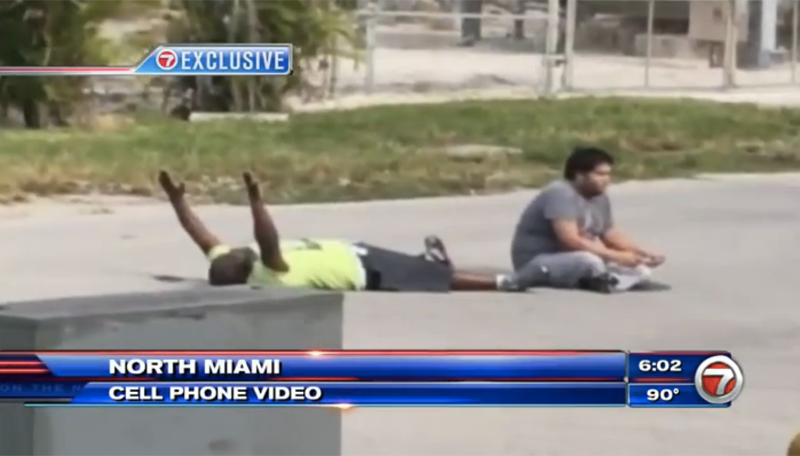
Last night, a new story in the ever evolving evidence for the #CultOfCompliance and the dangers it poses to marginalized people when they encounter police went viral. A police officer in the Miami area shot a black man lying on his back with his hands in the air. The man, Charles Kinsey, is a mental health professional who was trying to keep his client, a Latino autistic man (Arnaldo), from being shot. There's both audio and video. Kinsey is going to be ok.

Note that Arnaldo's ethnicity has not been identified and I am making assumptions.

News coverage with video, from the local station (ABC 7) that broke it:

My tweetstorm starts here:
Here's how I parse this incident.

1. "Someone" calls police because there's a big Latino guy with a gun contemplating suicide.

But the man was in fact just out in the street with a toy train.

2. Kinsey, a mental health professional, knows this is potentially a deadly situation for the autistic man, because a) police are likely to perceive brown-skinned people (especially but not exclusively) with disabilities as not complying properly in the face of police commands* and b) police are trained to take non-compliance as a threat.  So he goes to his client and lays down on his back, raising his arms in the air, both as a signal to the officer AND as a way to show Arnaldo** what to do to survive this.

*Sentence edited lightly for clarity that this is about police perceptions. 7/21 8:20 PM CST.
** Correction: The individual's name was widely reported as Rinaldo, but is now reported as Arnaldo Rios. Changed in this and previous posts. 

But also the officer comes in loaded with stigma that people with disabilities are unpredictable and dangerous, likely to lash out. 

3. And then the officer shoots Kinsey. Kinsey asks why and the officer says he didn't know, and that's likely to provide some legal accountability in this rare case, as the officer won't be able to retroactively claim he felt reasonably threatened (esp with video and audio).

And then what lessons will we learn? Unless this is a pathway to reconsider compliance-based policing as a norm, nothing will change except for getting one officer off the street.

4. After shooting him, Kinsey was put in handcuffs. Why? I have no idea - is it policy to put people you accidentally shoot in handcuffs to see if later you can construct a scenario in which shooting him was reasonable? Here's where the "threat" argument will go:
Police said the autistic man had something in his hand, but Kinsey's lawyer said it was a toy fire truck and could not be mistaken for a gun.
"It is not silver. It is not shiny. It is not black. It doesn't look like a gun," Napoleon said. "In fact, you can see the autistic guy playing with it."
5. The language around autism itself in this is pretty indicative of the ways that Arnaldo was pre-emptively constructed as a dangerous threat:
Clint Bower, who runs the group home, told Local 10 News that Kinsey was shot three times in the leg and that the man he was caring for is non-verbal and has "relatively low function."
Function-discourse is a problem. But also this from the cops:
“Arriving officers attempted to negotiate with two men on the scene, one of whom was later identified as suffering from autism,” said North Miami Police in a statement. “At some point during the on-scene negotiation, one of the responding officers discharged his weapon, striking the employee.”
Arnaldo does not "suffer" from autism. He was suffering from police officers threatening him.

From Gawker's coverage, here's a still of the video. It shows a black man lying on his back with his arms in the air next to a man dressed in grey clothing, sitting cross-legged. Critically, no one is near them. As near as I can tell, there's no reason for the officers to even have their weapons drawn, though clearly I don't have a sense of the whole tactical situation.

See above for image description

This is not like any case I've seen before in its specifics. I've never read about police shooting the mental health professional who was clearly identifying himself AND telling the officers that the client didn't have a gun. But the generalities, the ways in which the #CultOfCompliance feeds into this incident, those I read about every day. 

Follow the "cult of compliance" tag at the bottom of the post for more.


Monday, July 18, 2016

#CultOfCompliance - Autistic Boy Tasered by Police

The White House is hosting a forum today on disability and criminal justice. They are announcing the "AVID prison project." Here's a press release with live-streaming information. Here's a useful summary from the Center for American Progress. I'll write more tomorrow, plan to watch the stream as much as possible, and will be engaged on Twitter.

Over the weekend, I've been following the case of an autistic teen who was tasered in Burbank, CA. His mother was pulled over in a traffic stop (no reason for the stop has been announced, to my knowledge) when the officer noticed the teen wasn't wearing a seatbelt. The officer demanded compliance and the situation escalated. Here's coverage from the LA Times and an interview with Tawnya Nevarez, the boy's mother.

Lots to unpack. Overall, my take remains: Compliance-based policing endangers people with disabilities.  People of color are at much higher risk of encountering police and being forced to comply. The #1 reform I propose for policing is to teach officers NOT to take non-compliance as justifying escalation absent other threat indicators (and to hold them accountable when they ignore this training).

Here are the details:
In an interview earlier this week, the boy’s mother Tawnya Nevarez said through tears that she repeatedly warned the officer that her son was autistic while apologizing for his unresponsiveness.
“How is it that this routine seatbelt traffic stop turns into a parent’s worst nightmare?” said attorney and autism advocate Areva Martin. “Son on the ground, pepper-sprayed and tased, despite her consistent pleas about his developmental disorder.”
So let's start here: This is a Mexican family. An officer noticed there was a teen in the car not wearing a seatbelt, so pulled them over. Would this happen to a white family? It's hard to prove the counterfactual, but I instantly engage such incidents through the lens of the routine use of traffic stops to over police minority families. As we saw in the Philando Castile killing, such moments of contact can easily escalate into violence. When disability is involved, moreover, the demands for compliance rapidly become incredibly dangerous. I'm glad the boy wasn't shot.

Moreover, I'm struck by the seatbelt issues. My son has had a hard time with seatbelts at various stages of his development, often - we suspected - related to sensory discomfort of the belt pressing against his chest. I don't know whether that's in play here, but it could be.
According to Burbank police, the officer stopped Nevarez just before 4:30 p.m. near Burbank Boulevard and Hollywood Way after noticing the front passenger, the teenage boy, was not wearing a seatbelt.
The teen told the officer that he forgot to put it on, while his mother, the driver, said she was in a rush to get somewhere, police said.
During the stop, the teen began to argue with his mother and the officer, at one point indicating that he wanted to fight the officer "hand-to-hand," said Burbank Police Sgt. Claudio Losacco.
Nevarez said Wednesday that during the stop, she asked the officer to step back so she could calm her son down, but the officer would not move.
According to police, the officer, who's been with the department for four years, explained that everyone is required to wear a seatbelt.
We need to hear the audio recording. I'd like to know when the mother said "autism" and how the officer reacted.
After the boy interrupted him with “inflammatory dialogue,” the officer decided to "deescalate" the situation by returning the driver's license to the mother with a warning instead of a citation, Losacco said.
The officer then asked the teenager to put his seatbelt on. He reportedly responded that he would only do so when the officer walked away. When the officer stepped back, the boy put on his seatbelt.
According to police, sometime after the boy put his seatbelt on, he removed it and told the officer he was going to "fight him right now," kicking the car door open into the officer's knees. He then reportedly dared the officer to call for backup while his mother tried to keep him in the car.
Things get out of control.
Eventually he got out of the car, police said, took off his sweatshirt and approached the officer in a fighting stance, telling the officer to pepper spray him.
The officer used pepper spray, but it didn't have an effect on the teenager, who then punched the officer multiple times, knocking off his glasses, Losacco said. At that point, the officer shot him with a Taser and handcuffed him.
Nevarez, a single mother of three, said that her 14-year-old daughter was also pepper-sprayed, and her 3-year-old niece was also in the car. Police said the teenage girl got out of the car during her brother’s confrontation with police and was struck by residual pepper spray.
After the incident, we have the following:
After the boy was medically cleared at a local hospital, he was admitted to a mental health facility, police said. Police said they have not independently verified the boy’s disorder.
On Friday, the teen was reportedly booked on suspicion of assaulting a peace officer, fighting in public, obstructing a peace officer and battery of a police officer.
“The goal with the charges is not to prosecute this child, it is not to incarcerate him, it is not to cause him further grief,” Losacco said. “It is to actually to get him some services.”
"Was admitted" is a very euphemistic way of saying the child was incarcerated in a mental health facility.  It's not a jail, but it's still incarceration. And then this "get him some services" line - Is there any reason to think he's not receiving all the services he needs, and that absent this police officer, he'd be fine?

Bottom Line: We need the audio recording. There's likely going to be a lawsuit, so it'll come out. Often, police escalate in the face of non-compliance, which doesn't seem to be the case here. Instead, it seems that the officer made a stop (for legal reasons) and, even when informed of the child's diagnosis, ordered compliance. When the child got belligerent, the officer did try to disengage, but by then it was too late. I suspect he'll be exonerated in any suit.

But even without knowing the details, we can know this: Compliance-based policing endangers people with disabilities.

Tuesday, July 5, 2016

TSA and the #CultOfCompliance - an ongoing project

I'm interested in all the ways the "Cult of Compliance," my term for the collective way that our society promotes and rewards compliance to authority, protects authority figures who treat compliance as sacred, and criminalizes noncompliance, emerges in our society. Disability, in particular, exposes the manifestations of the cult of compliance, while people with disabilities become radically endangered when assumptions about typical minds and bodies shape the rules with which one must comply.

Over the weekend, this horrible story alleging violence at the Memphis airport (based on a new lawsuit) went viral:
Hannah Cohen set off the metal detector at a security checkpoint at the Memphis International Airport, and she was led away for additional screening, reported WREG-TV.
“They wanted to do further scanning, (but) she was reluctant — she didn’t understand what they were about to do,” said her mother, Shirley Cohen.
Cohen said she tried to tell agents with the Transportation Security Administration that her 19-year-old daughter is partially deaf, blind in one eye, paralyzed and easily confused — but she said police kept her away from the security agents.
The confused and terrified young woman tried to run away, her mother said, and agents violently took her to the ground.
“She’s trying to get away from them, but in the next instant, one of them had her down on the ground and hit her head on the floor,” Cohen said. “There was blood everywhere.”
Two things:

The TSAs response was that disabled individuals or their families/caregivers can call ahead. I've spoken to a lot of folks who have called ahead, but it hasn't worked especially well for them. More importantly, no one should have to call ahead to be guaranteed their fundamental civil rights (more on that here and here).

Second, when the mother started talking about disability, that should start an immediate process to provide reasonable accommodations. It might not be reasonable to just let her through, sure, but it's damn well reasonable to let her mother approach, to back up, to de-escalate, to create space.

I am actively seeking more stories about the TSA and disability, positive or negative. Feel free to post in comments or email me.

Friday, May 20, 2016

Christopher Bauer: Tasered while Not Hearing (Ear Buds)

I generally start my presentations on police use of force and disability by talking about a deaf man shot in the back. I like to end (or at least end the section), by talking about non-white men killed while wearing ear buds, talking on cell phones, or not speaking English. It's a way to point out that one major issue - the issue that endangers people with disabilities more than any other - is when police decide to escalate based solely on non-compliance, absent any threat indicators.

I call it, when it comes to policing, the #CultOfCompliance.

Here's the case of Christopher Bauer:
On January 22, 2008, then Officer Mitchell responded to a false burglary alarm and assumed the first person he saw was the suspect. But Christopher Bauer was just an innocent bystander walking home with his hands in his pockets and listening to his iPod. From his moving vehicle, without warning or provocation, Mitchell tased the oblivious teen in the back of the head, causing him to fall forward onto his face. Mitchell then cycled the TASER a second time on the unconscious victim. Bauer suffers permanent neurological complications from the incident, including memory loss. Mitchell told Bauer he tased him because he refused to comply with his command to stop.
Mitchell’s statements at his disciplinary hearing offer a window into his highly prejudicial, preemptive thinking. Note the hypothetical thinking (emphasis mine):
Officer Mitchell stated that if the hold up alarm was in fact a “good alarm” this personwould be a likely suspect or witness. Officer Mitchell felt it imperative to stop this person and identify him in case the alarm turned out to be a real robbery.

Officer Mitchell further stated that if the hold up alarm was “good,” in his experience, hethought the suspect would most likely be armed with a weapon, probably a handgun. Officer Mitchell stated that he decided to use the Taser to stop Mr. Bauer without warning him because Bauer might be armed and might try to avoid apprehension. Officer Mitchell also stated that he wanted to stop Mr. Bauer before he reached a position in the parking lot that might endanger the lives of other civilian pedestrians.
Captain Stephen Luebbe found Mitchell used excessive force and did not give Bauer the opportunity to submit to arrest. But his statements went beyond the issue of force to challenge Mitchell’s logic. He found Mitchell’s extreme application of the precautionary principle to be in dereliction of his primary responsibility to investigate the alleged crime:

Police Officer Andrew Mitchell used more force that was reasonably necessary to stop and detain Christopher Bauer Jr. Whether or not Mr. Bauer was wearing earphones and listening to an IPOD is not important to this hearing. Officer Mitchell was not justified in the use of force to stop anyone. There was no confirmed crime to investigate. Officer Mitchell’s primary responsibility, as first car on the scene, was to respond directly to Jersey Mike’s Restaurant to investigate and determine the validity of the alarm. In doing so he would have discovered the alarm was false and no other action was necessary. Had the alarm been “good” as Officer Mitchell feared, he would have been in a position to render aid to victims, obtain and broadcast a description of the suspect, protect the crime scene, and collect evidence.
The page goes on to collect a news report and some documents on the case. It's a classic example of, as I see it, the worst kind of decision-making and threat-assessment that endangers people.

Bauer's case is collected here on a page dedicated to the death of David "Bones" Herbert, who was told by one police officer to bring over his knife, and shot by another officer for showing a knife.

Friday, April 22, 2016

Two Deaths and the Cult of Compliance

Two deaths of disabled men at the hands of law enforcement have been in the news lately.

One was black, a veteran, and a mental health crisis spun him into custody, where an officer (allegedly) broke his neck. The other was white, nonverbal, autistic, and walked away from his group at a park, where an officer (allegedly) slammed him to the ground and caused his death.

Here are the stories.

Elliot Williams died in 2011, but a new lawsuit and released surveillance video have made it news.
Elliott Williams spent the last five days of his life in a Tulsa County jail, paralyzed and lying on the cold concrete floor. But despite the 37-year-old Oklahoma man’s pleas for help, guards did nothing to save him, a lawsuit claims.

At one point, jailers dumped Williams’s limp body into a shower and left him there for an hour. The dying inmate “would not stand up but we did give him a shower anyway,” a captain later testified, according to a sheriff’s office internal report.

Another officer saw Williams face down in the shower, screaming, “Help me!” according to the internal report.

“He’s acting like he’s paralyzed, but we know he’s not,” a mental health worker told Williams’s dad, court papers allege.

Detention officers, nurses, and even a jail psychiatrist accused Williams of “faking” an illness. His family says they declined to administer medical care or transport Williams to a hospital—until it was too late.
Williams died in a pool of his own saliva and vomit. Notice that although he had psychiatric disabilities, what killed him was an officer deciding that a threatening step required slamming him to the ground, during which he suffered the neck injury.

Meanwhile, just Wednesday, Paul Gianelos walked away from his group at a park, so his caregivers called the police to help find him. For reasons that aren't clear, when Gianelos wouldn't quickly comply with orders to get in the car, the officers - at least one of whom had Crisis Intervention Team training - decided to escalate the situation (instead of, for example, calling for help from the professionals who cared for Gianelos). From WUSA9 in DC:
Fairfax police say a 20-year veteran officer with crisis intervention training, spotted
Gianelos along Annandale Road, about a mile from the park. Police say the officer tried to talk him into coming back to the group home outing. Gianelos apparently refused, and police say he became combative and began to struggle with the officer. Gianelos was handcuffed, and fell, hitting his head. Rescue crews were called and police say when Gianelos was being transported, he went into cardiac arrest and died.
We don't have more details yet, but I've read a lot of these reports, and I suspect we'll find out that the officer simply decided that compliance, rather than patience, was mandatory.

For new readers, here's some information on the cult of compliance and law enforcement.


 And many more.