Showing posts with label school. Show all posts

Thursday, December 10, 2015

Minneapolis Hires Superintendent Who Oversaw Systematic Abuse of Disabled Children

Explosive new report of abuse from the Massachusetts Disability Law Center. UPDATE: You can see the whole report here.

1. The Cult of Compliance (from Boston Globe):
The investigation uncovered a school culture in which aggressive discipline of students had become ingrained, Eichner said. Many students suffered injuries, including scratches and bruises, and one student was given a hospital exam for a bump on the head...
One 67-pound student was restrained 50 times, including about a dozen times when the pupil was held prone on the floor, according to Eichner and the report. The child complained to a parent of being unable to breathe, and that some of the restraints had been painful, the center said.
“Prone restraints can lead to serious injuries or even death,” Eichner said. Some restraints lasted for longer than 20 minutes, the investigation found.
Children were thrown to the floor for not moving, pulled out of chairs for refusing to get up, tackled to the ground, and restrained for refusing to change into a uniform, investigators were told.
2. Accountability

It's unclear to me what's happened to the people who did these terrible things. The Superintendent has been fired. More on him in a second.

Update: The people at the DLC tell me that the principal was fired and some staff were reassigned. That's about it.

3. Intersectionality - Race and Disability
Eichner, of the Disability Law Center, said a combination of factors appears to have led to the abuse.
“Holyoke is an underserved district, obviously,” he said. “We think there wasn’t enough resources and not enough training, and this population is predominantly students of color. You combine that with students with emotional issues, and without adequate resources and training it becomes a power fight between the teachers and students.”
4. Welcome to Minneapolis!
The allegations surfaced during the tenure of former Holyoke superintendent Sergio Paez, who lost his job after Massachusetts education officials voted in April to place the district under state control.
On Monday, the Minneapolis school board voted to appoint Paez as that city’s next school superintendent. Members of the board did not respond to requests from the Globe to comment on whether the allegations would affect his hiring.
You can contact the Minneapolis School Board here.

UPDATE: Sergio Paez has denied all allegations. The School Board is investigating. Get involved!

More details from the full report (updated 3:30 CST 12/10)

5. A child locked in a closet!!
The most egregious seclusion reported was that on at least three occasions, a teacher put children in a locked closet and turned out the lights.When we interviewed the teacher in question about these incidents, she denied it, stating that another student had locked the door. However, her version is not supported by the record. When discussing this practice with the administration, we were told that the teacher is still employed at the school, but her job responsibilities have changed and she no longer has any direct contact with students.
Note - the teacher wasn't fired.

6. School to Prison Pipeline starts here
One teacher stated that "[a] lack of training and tools to address behaviors is hurting students." In Ms. Hirsch's letter she describes this negative culture and provides an example of public shaming of a student when a teacher asked the whole class to write down another students "bad behavior." We also heard that the school will routinely call the police to resolve issues when children are in crisis and in need of mental health supports. One teacher stated that he wanted to call the local mental health crisis
team but the administration called the police instead. This pattern perpetuates the cycle of children transitioning from a schoolhouse to jailhouse instead of receiving appropriate disability related services.

Monday, November 2, 2015

Cult of Compliance: Bus Driver Attacks Student with Disabilities for not Obeying.

This is a video of a school bus driver attacking a child with disabilities. It's hard to watch, but worth watching for the following reasons (and maybe more):
  1. The other kids are standing up for their classmate, telling the bus driver he can't do it.
  2. One child was holding the cell phone that caught this video and led to the arrest of the driver. Another child, at about 28 seconds, can be seen pulling out his phone to record the driver.
  3. It's the "cult of compliance" embodied, yet again. The driver gives a command, the student disobeys, and the driver then uses that to justify (to himself and in the aftermath) his use of force. It's the same phenomenon as Spring Valley High and thousands of other incidents (use the tags to track them, though I'm still implementing tags consistently in the first 500 post on the blog). From the local news report:
Johnston police said the driver approached 15-year-old Christian, a student with special needs, after he failed to follow the bus driver’s instructions regarding a seat assignment.

Police said the student directed an inflammatory comment toward the bus driver who grabbed the student's coat, hit the boy in the face and pushed him to the floor.
Here's the video. Obvious warnings apply, though it's more disturbing than graphic.

Friday, October 30, 2015

Disability, Trauma, and the Assault at Spring Valley High

Ever since watching the terrible video of a student being pulled from her desk and thrown to the ground, I've been waiting to learn how disability intersected with this case. I assumed it would, because the data shows that the two groups most vulnerable to violence at the hands of school authorities are people of color and students with disabilities. Disabled people of color are multiply marginalized, and thus highly at risk - see my pieces here and here

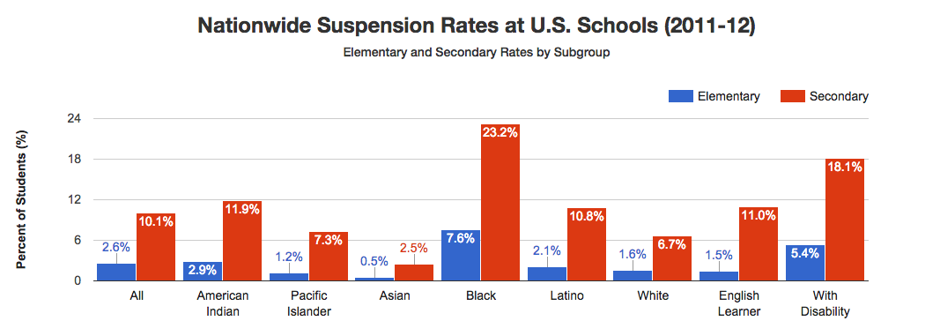
Chart from http://www.citylab.com/crime/2015/10/why-disabled-students-suffer-at-the-hands-of-classroom-cops/412723/
It shows 22.3% of all suspensions are black students. 18.1% are disabled.
Once we learned that school resource officer Ben Fields was known as "Officer Slam," I knew that if we dug into this officer's background, we'd find disabled victims of his bullying. That's just what happened. Here's a story that describes his violent encounter with an autistic student [my emphasis]:
Richland School District Two Superintendent Debbie Hamm admits that "clearly something did not go right," calling it the most upsetting incident she has seen in her 40 years with the district.
"We will be working with the Richland County Sheriff's Office to clarify our expectations about screening and training for school resource officers," said Hamm.
But one parent had a slightly different reaction.
"I saw his face and my first thought was 'Oh my god, that's the same guy,'" said Wendy Johnson, who says her autistic son was in a physical struggle with Fields when he was a freshman.
Photos she took of her son after the altercation reveal his shirt torn and marks on his arms and shoulder.
Notice how the Superintendent characterizes the assault on the video as out of the norm. My guess is that "Officer Slam" does this all the time, it's just now he's being held accountable. The violence is structural. The violence is systemic. This is not an isolated incident.  

Then there's the question of trauma. There's a major class-action lawsuit in California arguing that victims of trauma should be covered under disability law. It has enormous implications for American education, because up to a quarter of all children, according to Susan Ko of the National Center for Child Traumatic Stress, will be victims of trauma. If trauma is so common and if should be treated as a disability (both givens that I believe to be true), it may indeed force us to stop treating disability as a deviation from the norm, as a case of "special" needs, but just as needs. We'll have to move to a system of universal design that requires all interactions with students take the possibility of disability into account.

I don't know whether the student dragged out of her desk was a victim of trauma. I don't need to know. Initial reports was that she was a recent orphan, more recent information is that she is estranged from her mother and living in foster care, and now that narrative has been questioned too. We, as a nation, are overly fond of litigating the character of the victim of state violence as a way of determining whether or not they deserved to be brutalized. Such violence is not determined by whether she was a "good victim" or not, but instead whether she was in fact engaged in threatening behavior that merited escalating use of force. Judging by the videotape, she was not. Case closed.

Her lawyer does say that she's a victim of trauma now, in considerable emotional distress. I believe it. The assault looks traumatizing. Having millions of people view your assault, likewise.

In that classroom, the statistics suggest, there surely were people who had experienced trauma, and who had to observe the violence. That's only going to make matters worse.
Many traumatized students live in a state of constant alarm. Innocent interactions like a bump in the hallway or a request from a teacher can stir anger and bad behavior 
The lawsuit alleges that, in Compton, the schools' reaction to traumatized students was too often punishment — not help. 
"They were repeatedly either sent to another school, expelled or suspended — and this went back to kindergarten," says Marleen Wong, who teaches at the USC School of Social Work and has spent decades studying kids and trauma. "I think we're really doing a terrible disservice to these children." 
The suit argues that trauma is a disability and that schools are required — by federal law — to make accommodations for traumatized students, not expel them. The plaintiffs want Compton Unified to provide teacher training, mental health support for students and to use conflict-mediation before resorting to suspension.
We must get these SROs - School Resource Officers - out of the schools. We cannot respond to the prevalence of trauma with more police officers, more violence, or zero tolerance policies. It's counter-productive. Hopefully, the courts will also decide that it violates the ADA.


Tuesday, August 4, 2015

Sit Down Like I Asked You Too: 8 Year Old with ADHD Handcuffed

In Kentucky, from the NYT:
The A.C.L.U. released what it called a “disturbing video” showing the boy, who it said weighs about 52 pounds, crying as the resource officer handcuffed his arms at the biceps behind his back. In the video, the officer tells the boy, “You don’t get to swing at me like that.”
The boy has Attention Deficit Hyperactivity Disorder; the girl has the disorder and other “special needs,” according to the lawsuit. It says both children are protected by the Americans With Disabilities Act, and alleges that the school resource officer, who it says shackled the boy once and the girl twice in 2014, violated both the disabilities act and the children’s constitutional rights.
Mother Jones adds:
Two videos accompanying the lawsuit show a November 2014 incident in which Sumner tells an 8-year-old Latino student, identified as S.R. in the lawsuit, to "Sit down like I asked you to" while handcuffing him as the child cries and expresses that he's in pain. Earlier that year, Sumner allegedly detained L.G., a 9-year-old African American student, in the back of his cruiser, after she disrupted the classroom and was requested to be escorted to an in-school suspension room. The lawsuit also details two subsequent incidents in which Sumner handcuffed L.G., one of which resulted in L.G. going to a hospital for psychiatric assessment and treatment.
I wrote on the #cultofcompliance in our schools here, for Al Jazeera:
For those like Kayleb who live at the intersection of race and disability, these manifestations of what I call the cult of compliance can destroy lives. It threatens anyone who might fall outside the dominant norms. The cultural forces that punish diversity aren’t new. In the past, however, such perceived deviance might have met with bullying from peers or various forms of exclusion by teachers and other staffers. Today, jail beckons.

There are two major factors at work. First, the rise of zero-tolerance policies strips school officials of the ability to exercise common sense, leading security expert Bruce Schneier to call them “zero-discretion” policies. Such policies have long been criticizedas being unfair to marginalized groups of all sorts. Second, SROs have increasingly been deployed on school grounds over the last few decades, a process that keeps intensifying after high-profile school shootings such as Columbine (1999) and Sandy Hook (2012). Meanwhile, SROs are experiencing mission creep. While de-escalation is usually the optimal response to challenging behavior situations, many teachers and administrators instead respond by calling in an SRO to apply restraints and arrest the student, thereby starting the process of criminalization. That’s how the school-to-prison pipeline begins.


Thursday, April 2, 2015

When You Can't Say: "That Hurts."

There is a standard horrible argument out there that people with low IQ are protected from trauma because they don't understand what happened to them. It's used in sexual assault cases (read here if you must. It's upsetting) sometimes and must be confronted at every turn.

It's been on my mind as part of a broader phenomenon due to this case from Texas. A paraprofessional at a school was videoed (by a surveillance camera) shaking and otherwise abusing an 8-year-old boy with Down syndrome. I, too, have an 8 year old boy with Down syndrome, although it doesn't take such a proximate cause to be outraged.

The para has been fired. The DA has declined to charge the individual, though, because there's no evidence of pain. A petition has been started by the boy's mother, asking for the case to be taken to a Grand Jury. Here's a Facebook page from the local TV Station with links to the story. Here's a quote:
If it wasn't for a surveillance camera at Spring Branch ISD's Wilchester Elementary, Maggie and Raphael Suter believe they would likely never have learned their 8 year old special needs son was assaulted on February 11th by an educator responsible for his protection.
"When we saw the video and saw the para-professional grab him and start violently shaking him and choking him we were both crying, just devastated," said Maggie, a former public school educator.
"Who could ever do anything to an innocent child, let alone a child who can't speak or even tell us that something has occurred? I was heartbroken," said Raphael.
In addition to the choking, the Suters say they watched in agony as their son William was shoved violently to the ground by the same classroom aid.
So here's where we are.

1. The school waited 8 days to tell the police about the abuse. They are legally required to inform authorities within 48 hours.

2. They DA says that there's no evidence of physical or psychological harm, as the boy seems happy enough and didn't scream in pain while being shaken or thrown to the grown. So he won't charge the para.

I don't really know where we go from here, other than to share the petition and to talk about the fundamental problems with these kinds of protections and how they are executed for people with disabilities. If you can't say, "It hurts" or "I'm upset," then the law shrugs.


Friday, December 19, 2014

A Boy and a Pool Noodle - Discipline and Special Needs

A few days ago over on my Facebook page I shared the story of the school district that took away a blind child's cane and replaced it with a "pool noodle." The cane technically belongs to the school district, and when the bus attendant reported that he was waving it in the air and potentially hitting someone with it, they confiscated it. Instead, they gave him a nerf pool noodle to replace it.

The school has apologized and reversed its decision. Here's a good blog post on the story, with these vital points:
To me, this isn’t the issue. Dakota is still a young boy. It’s entirely possible that on occasion, he’s used his cane in questionable ways. It’s also possible he’s still learning how to control his cane, and not accidentally bump it into people or trip them up. The point to me is that the school should have a more thoughtful set of guidelines and procedures for how to deal with Dakota if he should misbehave, as most 8-year-olds misbehave from time to time. And a central tenet of any disciplinary plan should be to never take away an assistive device a child depends on for independence and mobility. This would apply to canes, crutches, a speech device, a wheelchair, or any other equipment that helps them with their particular disability.
I've been troubled by how many people I've seen on social media saying: "Well the kid acted up, of course the school had to take away his stick!" That is the wrong attitude. Below, I'll offer some thoughts about why.

Here are my thoughts.
  1. A cane for someone with vision impairment is a specific piece of assistive technology, designed to give maximum tactile input to the user. It is not just a stick.
  2. The school and parents have not reported on the precise incident, but the boy's parents say it was likely just a misunderstanding. That he lifted his cane in the air and the bus attendant decided it meant he was trying to hit someone.
  3. I am a critic of zero tolerance policies and I see them as a component of the #cultofcompliance. Schools have decided, as a reaction to the fear of violent incidents on their grounds, that ANY sign of violence, especially weapon-driven violence, must be met with the maximum disciplinary response (students suspended for: drawing a gun, having a picture with a gun, pointing his finger at another child).
  4. While zero tolerance can apply to anyone, it is not meted out equally (studied on black preschoolers suspended for fighting). The question is how do the discipline imposing forces interpret typical kid behavior, which includes real fighting, pretend fighting, fake weapon art and weapon play, and so forth. This kind of prejudicial interpretation also applies to kids with special needs.
  5. When kids with special needs act in unpredictable ways, too many authority figures panic. Whereas a typical child would likely get verbal discipline and verbal interventions, there's a presumed communicative wall making it harder for the usual interventions to work. Moreover, when dealing with assistive technology, there's a tangible thing you can take away. No teacher would stitch up a child's eyes. No teacher would duct tape over a child's mouth, and yet my son's "voice," his communication device, could be taken from him. I've heard from parents of older kids who wouldn't stop talking with their device, who had their device removed. That is simply not acceptable practice. Can you imagine a child in a wheelchair who won't sit still being dumped on the ground? Yes, they'd sit still, but it's a failure and it's abuse. Taking away this child's cane is abuse. 
  6. I blogged the other day about two 6-year-olds placed in restraints due to behavior issues. I acknowledged that misbehavior can be complicated. Oppositional defiant disorder can be tough (although a neuroscientists I know argued that it's often mis-diagnosed autism, but that's a different subject). Sometimes, you're going to need an intervention. Here's my mantra though - any intervention, accommodation, or response to special needs that ends up with handcuffs on a six year old is a failed intervention. The same can be said of any intervention that ends up denying access to an assistive technology device.
Here's my core question. I'm glad the school district gave back the cane, but have they actually learned anything? Next time a child with special needs requires an intervention, will they change their procedures?

And speaking of learning, the root for the word discipline comes from the Latin for teaching or instruction. So what does Dakota learn? He learns that by lifting his cane in the are, acting out in any way, authority will remove his means of navigating the world independently.

That's exactly the opposite of the lesson we want to teach.

Saturday, March 15, 2014

The Challenges of Inclusion (not same-ness): Friendship vs Help

My son rides the regular school bus, a step that we decided on this year. The system has been supportive. Nico's aide meets us at the bus stop and facilitates the ride. On the rare days when he takes the bus home, she's there (she has to take the bus anyway to get back to her car).

But there's also a girl named G. who is in Nico's class, and she's an outstanding helper. I discovered this the first time the aide wasn't able to make it (thanks to the terrible winter we've had here). So I brought Nico onto the bus and G. popped up from her seat, smiling at Nico, holding out her hands, and sitting with him. I've rarely been so deeply moved (although there was another girl, H., early in the year, who I wrote about. She's great too). Over the past month, Nico's independence on the bus has improved dramatically, and I think G. has a lot to do with it.

Lately, some behavior issues in transitions (running mostly) have been ameliorated by having peers, mostly girls, walk with Nico from place to place, holding hands, helping.

And yet, yesterday the Twitter user @think_inclusive linked to a fascinating article on inclusion called, "HELL-BENT ON HELPING: Benevolence, Friendship, and the Politics of Help." It comes from a pair of educational consultants and counselors focused on disability issues, and although the piece is from 1994, it instantly raised alarms about what I've been seeing at my son's school. It also, though, offers useful terms and categories of analysis to think about inclusion and its possibilities. In the end (spoiler alert), I think Nico and his peers are doing alright.

Here's the introduction of the article, opening with the social and policy changes that moved through schools in the 80s and early 90s (emphases mine throughout)
The move toward cooperative and inclusive education is part of a larger move out of social oppression for individuals with disabilities. It is part of a groundswell movement of social reform that holds as a central tenet the belief that all children, including those with disabilities, are capable of learning and contributing to their classrooms and communities.
This is the first generation of children with and without disabilities to grow up and be educated together. Consequently, within inclusive education we have come to entertain a cheerful optimism that the generation growing up now will be different than those of the past. We are hopeful that greater contact between children will begin to break down the barriers of misunderstanding and dispel the myths that have created society's response to disability.
It was a good hope and authors note some genuine progress:
At first glance, this change might seem to be taking place. Individuals with disabilities are more visible and increasingly involved in community life. If we believed that greater proximity led to greater acceptance, it could be argued that we are successfully participating in the creation of a new social order. Unfortunately, this is only partly true. Instead, we are finding that increased visibility and "presence" alone do not necessarily ensure that those with disabilities are fully included.
True inclusion is dependent on the development of meaningful and reciprocal relationships between children. As classrooms become increasingly diverse, new strategies are being developed to ensure that the new students are more than simply present. Friendship circles, school clubs and special buddy systems have been implemented as formalized attempts to foster interaction and develop relationships.
Meaningful and reciprocal relationships. That's such a simple but powerful phrase. I've been thinking about my son's relationships. There are typical kids who clearly like him, hang out with him, and indeed help him (like G.). Are the relationships reciprocal? That I'm not sure.

The piece then expands to thinking about agency, or lack thereof, by focusing on "help."
Our society still perceives those with disabilities as perpetual receivers of help. Descriptors like "less fortunate" and "needy," telethons, and tear-jerker journalism all continue to perpetuate this view.
Unfortunately, there is still a distressing tendency in some schools to base interactions with students on these broader societal misperceptions, despite a sincere desire to end the isolation experienced by so many children with disabilities. Friendship clubs and buddy systems based on stereotypical beliefs risk perpetuating prejudices and myths and even exacerbating the problem.
Obviously, it is essential that students be provided with opportunities to interact. Formalized friendship and support circles may be effective ways to building relationships. However, an over-emphasis on the "helper/helpee" relationship can easily skew the delicate balance of giving and receiving that is the precursor of true friendship. It is critical, then, to regularly and carefully examine the nature of the interaction we facilitate and the attitudes that inform it.
Finally, an example:
Consider the following scenario:
Four third grade children from a local elementary school have come to speak to a room full of adults. They've been invited, with their teacher, to talk about friendship. 
Three of the four children in the room can speak, one of them can't. Three of the four children in the room can walk, one of them can't. The three walking, talking children are here to tell us about their relationship with the young man in the wheelchair. 
Adults in the room begin to smile as the first classmate talks. Approving nods accompany the child's words, "He's different on the outside, but inside he's just like me." 
The conversation whirls around the boy in the wheelchair as he scans the room, looks at his communication board and sometimes watches his classmates. 
"We take turns being his buddy," offers one young girl. "Everyone has a turn."
As the children talk and answer questions, it is interesting to watch the interplay between the subject of the discussion and the girl to his left. She has one arm around his shoulders, and in the other hand holds a washcloth. She wipes his mouth repeatedly. At one point, he appears to lose patience and struggles a bit. One hand jerks forward. His friend seizes his and holds it still. He makes a noise of clear irritation, and attempts to pull his hand free. 
His classmate smiles fondly at him, continuing to restrain his hand, and wipes his mouth again. 
We heard the boy's three classmates being called "the hope for tomorrow" and "exceptional kids". All over the room, adults were beaming. After all, this relatively new phenomenon seems to hold out some hope for an end to discrimination and distance between those who have disabilities and those who do not. 
However, as the presentation continued, it became increasingly apparent that while both adults and children thought they were talking about friendship, much of the discussion taking place was really about help. While there was undeniable warmth between the children, most of the comments and non-verbal interactions reflected a "helper/helpee" relationship, not a reciprocal friendship.
The whole article is worth reading as it moves from laying out the problem to potential solutions, ways to build reciprocal relationships, and the challenge of empathy. Empathy, in fact, lays at the core of this discussion - to move from a mechanical relationship of helper - helpee / active - passive - into one of mutual understanding and reciprocity.

Is this what's going on with Nico? Warmth. Helping. But in a way that denies him agency? I don't think so, not yet, but it's a fine line to walk and one I'm going to watch.

Here's something that sounds hard: I do not think Nico has any typical friends other than his sister. He has not been invited to a birthday party (Ellie has an invite practically every weekened). He doesn't get invited to playdates. But that's only if we define friendship in a typical way as experienced between neuro-typical children

I don't. My principle is inclusion, not same-ness. Here I turn back to this useful article and think about "meaningful and reciprocal relationships." Those I see forming all around Nico, I see Nico actively shaping them. I see them occurring in his classroom, at his after-school program, and in the neighborhood. It's a long slow process. The results may or may not look like typical friendships. 

And that's ok. Reciprocity and empathy will do just fine.