Showing posts with label trauma. Show all posts

Monday, March 27, 2017

Trauma in Chicagoland

Post Traumatic Stress Disorder (PTSD) needs to be understood as disability for many reasons. First, it's a disability, requiring numerous varieties of interventions and accommodations. Second, it's incredibly common, so when we understand it as disability, it challenges our notion of normal, whole, or abled. These are lines we need to blur.

From Chicago Tribune, here's a new study on trauma and black women in Chicago.
A recent Northwestern Medicine study that examined the South Side neighborhood of Oakland found that 29 percent of the 72 African-American study participants have the disorder and an additional 7 percent exhibited a large number of signs that are part of a PTSD diagnosis. Researchers said they believe that points to a need for more mental health services and screenings in poor neighborhoods.
This isn't news, but more data is important as advocates work for better trauma-informed practices among government agents.

Of course, when Chicago got a million dollars recently to address trauma in the neighborhoods, they spent almost all of it on new cops.

Wednesday, September 14, 2016

Trauma in the Neighborhoods: The Solution Isn't Police Training

The US Department of Health and Human Services has given Chicago 1 million dollars to address "trauma" in its neighborhoods.

But it seems like most of the money will go to training cops. The grant will:
* Establish a Chicago ReCAST (Resiliency in Communities After Stress and Trauma), Institute to design and deliver trauma-informed training to staff from City agencies and partners organizations as well as residents, building greater capacity in neighborhoods most impacted by violence on how to identify, respond and support recovery from to various forms of trauma.
* Expand the Chicago Police Department's Crisis Intervention Team training, mental health awareness training for Office of Emergency Management and Communications (OEMC) call takers and dispatchers, a public awareness campaign to reduce mental health stigma and public awareness of CIT and other resources. As a result, more than 12,000 Chicago police officers and all OEMC 911 call takers and dispatchers will receive basic mental health and trauma training.
* Support, train and link leaders from communities most vulnerable to civil unrest to ensure local involvement and feedback in citywide transformation efforts.
* Implement, launch and promote Chicago Connects, a comprehensive resource directory, crisis text line and web application to improve community organizations' and residents' access to necessary services.
It may be that the ReCAST Institute and training community leaders will do good work, and CIT Team Training is fine if its accompanied with system-wide cultural change. But this is also affirming that law enforcement is the appropriate place to center mental health crisis response. In the long term, we need to do something else.

I believe that budgets control agendas. When we put money tangling up these different things, we build institutional structures that are very, very, hard to change in the future. Moreover, I just wonder where's the investment in mental health centers, which, you'll recall, Rahm Emmanuel closed years ago. I wonder how much of the million dollars is going to police training and how much to community.

I spoke to Leroy Moore - one of the absolutely most important leaders on this issue - recently about CIT Training and he said to me, "Training has been around since 1989 with the Memphis plan … it’s the same story, it’s increased. What I say, and many other people say, we have to switch the focus from police to community. Switching that money to community service, to health service, to alternative phone number [to 911 for mental health calls]."

Again, CIT is fine, but it's the medical model to solving a problem related to disability.

We need social model solutions.

Expect tens of thousands more words on that to come (i.e. my book and many future pieces).

Thursday, April 21, 2016

The Revictimization of a Transgender, Disabled, Immigrant: Oppressions Intersect

Content Note: Rape, Abuse, Violence

Intersectionality is often used in very positive ways - to affirm multiple identities, to demand voice for the multiply marginalized, and so forth. This is valid and vital, but I read the source material (Crenshaw's work) as saying something less pleasant. To me, the core message of intersectionality is that oppressive forces intersect, endangering people whose identity incorporates multiply marginalized categories.

Today, Tina Vasquez (writing for Rewire) has a piece on a disabled, trans, immigrant and the many ways her rights have been disregarded. As always, please read the whole piece.

The story discusses M, who has mental health issues, cognitive disabilities, and a seizure disorder. She is the survivor of trauma. She is transgender. She is, of course, an immigrant. She is (I assume) not white.

She's done everything right, but the system has failed her. Some quotes:
While there, Ramos said M was subjected to verbal abuse from officers who mocked her transgender identity, with one officer passing her cell and saying, “What’s the story with this one,” according to M’s attorney. Eventually, M was transferred to Immigration and Customs Enforcement (ICE) custody at San Diego’s Otay Mesa Detention Center, where M says the trauma continued, explained Ramos.
M was held in a cell with men for 12 hours as she was processed into Otay Mesa, with one detainee staring at her aggressively for the entire 12 hours, according to her attorney. After processing, M was placed in medical isolation for reasons Ramos said she could not share out of respect for M’s privacy. Later, M was brought into the shower area with men. Though she was given her own private stall, male detainees showered nearby, Ramos said.
“She began experiencing flashbacks and felt like she was going to be raped again,” Ramos said. “She felt helpless because the officers were not taking her concerns seriously. It was incredibly traumatizing.”
And:
Ebadolahi told Rewire current U.S. immigration policies only subject traumatized, vulnerable asylum seekers to more trauma—and M is one of the more “fortunate” ones. After successfully passing her credible fear interview, M was released from detention on April 11.
“We’re talking about a transgender woman who is a survivor of multiple rapes, who has post-traumatic stress disorder, who has disabilities, including a seizure disorder, who has gone through a lifetime of hurt, and for who the simple act of appearing at the port of entry and applying for asylum took an enormous effort—and despite all of these things, she is considered one of the fortunate ones because she has a pro-bono lawyer working on her behalf,” Ebadolahi said.
“How M and her attorney were treated at the port of entry and … in detention, is unconstitutional, unethical, and outrageous. We shouldn’t tolerate it. This treatment serves absolutely no legitimate, government purpose and only serves to further traumatize and marginalize very vulnerable people. No one should be subject to this kind of abuse. This has to stop.”
Our system to protect asylum seekers only magnifies trauma. We need to do better.


Friday, October 30, 2015

Disability, Trauma, and the Assault at Spring Valley High

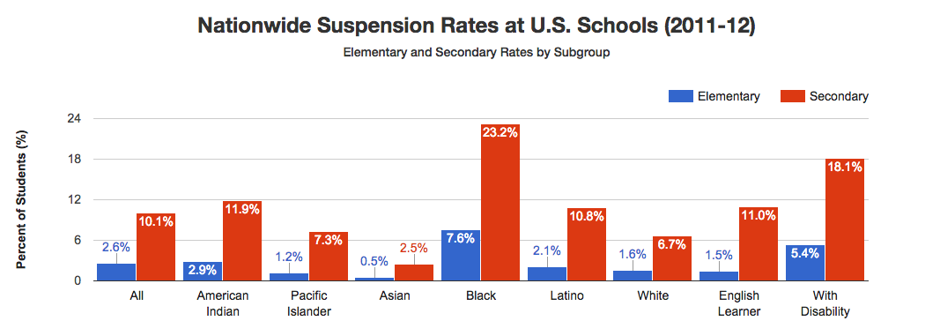
Ever since watching the terrible video of a student being pulled from her desk and thrown to the ground, I've been waiting to learn how disability intersected with this case. I assumed it would, because the data shows that the two groups most vulnerable to violence at the hands of school authorities are people of color and students with disabilities. Disabled people of color are multiply marginalized, and thus highly at risk - see my pieces here and here

Chart from http://www.citylab.com/crime/2015/10/why-disabled-students-suffer-at-the-hands-of-classroom-cops/412723/
It shows 22.3% of all suspensions are black students. 18.1% are disabled.
Once we learned that school resource officer Ben Fields was known as "Officer Slam," I knew that if we dug into this officer's background, we'd find disabled victims of his bullying. That's just what happened. Here's a story that describes his violent encounter with an autistic student [my emphasis]:
Richland School District Two Superintendent Debbie Hamm admits that "clearly something did not go right," calling it the most upsetting incident she has seen in her 40 years with the district.
"We will be working with the Richland County Sheriff's Office to clarify our expectations about screening and training for school resource officers," said Hamm.
But one parent had a slightly different reaction.
"I saw his face and my first thought was 'Oh my god, that's the same guy,'" said Wendy Johnson, who says her autistic son was in a physical struggle with Fields when he was a freshman.
Photos she took of her son after the altercation reveal his shirt torn and marks on his arms and shoulder.
Notice how the Superintendent characterizes the assault on the video as out of the norm. My guess is that "Officer Slam" does this all the time, it's just now he's being held accountable. The violence is structural. The violence is systemic. This is not an isolated incident.  

Then there's the question of trauma. There's a major class-action lawsuit in California arguing that victims of trauma should be covered under disability law. It has enormous implications for American education, because up to a quarter of all children, according to Susan Ko of the National Center for Child Traumatic Stress, will be victims of trauma. If trauma is so common and if should be treated as a disability (both givens that I believe to be true), it may indeed force us to stop treating disability as a deviation from the norm, as a case of "special" needs, but just as needs. We'll have to move to a system of universal design that requires all interactions with students take the possibility of disability into account.

I don't know whether the student dragged out of her desk was a victim of trauma. I don't need to know. Initial reports was that she was a recent orphan, more recent information is that she is estranged from her mother and living in foster care, and now that narrative has been questioned too. We, as a nation, are overly fond of litigating the character of the victim of state violence as a way of determining whether or not they deserved to be brutalized. Such violence is not determined by whether she was a "good victim" or not, but instead whether she was in fact engaged in threatening behavior that merited escalating use of force. Judging by the videotape, she was not. Case closed.

Her lawyer does say that she's a victim of trauma now, in considerable emotional distress. I believe it. The assault looks traumatizing. Having millions of people view your assault, likewise.

In that classroom, the statistics suggest, there surely were people who had experienced trauma, and who had to observe the violence. That's only going to make matters worse.
Many traumatized students live in a state of constant alarm. Innocent interactions like a bump in the hallway or a request from a teacher can stir anger and bad behavior 
The lawsuit alleges that, in Compton, the schools' reaction to traumatized students was too often punishment — not help. 
"They were repeatedly either sent to another school, expelled or suspended — and this went back to kindergarten," says Marleen Wong, who teaches at the USC School of Social Work and has spent decades studying kids and trauma. "I think we're really doing a terrible disservice to these children." 
The suit argues that trauma is a disability and that schools are required — by federal law — to make accommodations for traumatized students, not expel them. The plaintiffs want Compton Unified to provide teacher training, mental health support for students and to use conflict-mediation before resorting to suspension.
We must get these SROs - School Resource Officers - out of the schools. We cannot respond to the prevalence of trauma with more police officers, more violence, or zero tolerance policies. It's counter-productive. Hopefully, the courts will also decide that it violates the ADA.