Physical Requirements (With or Without Accommodations):I dunno. I like them saying accommodations, but they still could say communicate instead of speak, and the manual dexterity isn't really necessary.
Visual acuity to read information from computer screens, forms and other printed materials and information.
Able to speak (enunciate) clearly in conversation and general communication.
Hearing ability for verbal communication/conversation/responses via telephone, telephone systems, and face-to-face interactions.
Manual dexterity for typing, writing, standing and reaching, flexibility, body movement for bending, crouching, walking, kneeling and prolonged sitting.
Lifting and moving objects and equipment up to 10 lbs.

Showing posts with label higher education. Show all posts
Showing posts with label higher education. Show all posts
Wednesday, February 21, 2018
Ableist Job Ads
I've written a lot about ableism in job ads. Here's one from last year. I've never seen this before - I see it as a compromise move. For a disability services associate director at Texas Christian University:

Thursday, November 9, 2017
Conservative Students at Wisconsin Are Happy
Dominant Narrative: Conservative students on liberal campuses are ostracized and marginalized and it isn't fair and there should be balance.
Data: Conservative students at UW Madison are doing fine.
Data: Conservative students at UW Madison are doing fine.
Politically conservative students instead were more likely to report feeling safe, respected and like they belong than students holding other political views.Good! They should feel comfortable. But the dominant narrative must go.
Conservative students also were more likely than liberal students to say they feel comfortable approaching faculty members with their concerns, according to a report on the 2016 Campus Climate Survey released last Wednesday.
And conservative students said they felt less likely than liberal or moderate students to be expected to represent their point of view in class, but felt more positive about doing it than the others.
Tuesday, May 30, 2017
Students Are Not Customers
NEW at Pacific Standard. Please click over and share!
Betsy DeVos and the GOP more generally say that we need to treat students like customers. Three responses.
1) What's so great about being a customer if you're not a billionaire?
2) The student's relationship to their educational institutions and the people who work there cannot be characterized as simply transactional.
3) When students are treated as customers, as Tressie McMillan Cottom show in Lower Ed, the extractive nature of the industry doesn't serve them well.
Also I wrote the first draft in an airport lobby:
"Education can be an engine of social change, a vehicle toward equality. McMillan Cottom makes it clear, though, that the wrong framing, policies, and financial models can turn education into an engine for inequality. To me, DeVos' false insistence on "choice" and on students as "customers" drives us toward the latter outcome. As a billionaire, she's going to fly in a private plane or at least in first class. As a white, cis-male, middle class professor and writer, I get a cramped middle seat in the back. More vulnerable Americans, meanwhile, will be left behind entirely on the ground."
Betsy DeVos and the GOP more generally say that we need to treat students like customers. Three responses.
1) What's so great about being a customer if you're not a billionaire?
2) The student's relationship to their educational institutions and the people who work there cannot be characterized as simply transactional.
3) When students are treated as customers, as Tressie McMillan Cottom show in Lower Ed, the extractive nature of the industry doesn't serve them well.
Also I wrote the first draft in an airport lobby:
"Education can be an engine of social change, a vehicle toward equality. McMillan Cottom makes it clear, though, that the wrong framing, policies, and financial models can turn education into an engine for inequality. To me, DeVos' false insistence on "choice" and on students as "customers" drives us toward the latter outcome. As a billionaire, she's going to fly in a private plane or at least in first class. As a white, cis-male, middle class professor and writer, I get a cramped middle seat in the back. More vulnerable Americans, meanwhile, will be left behind entirely on the ground."
Tuesday, December 27, 2016
Declaring Dominican University a Sanctuary Campus
My university, Dominican University, has declared itself a sanctuary campus. We have a long history as a national leader in supporting the rights of undocumented students to access higher education, including regular fund-raising to make that possible. In 2014 I wrote:
Here's a link to the full statement of declaring Dominican a Sanctuary Campus.
Key passages:
I don't know if such declarations make a difference (though the money obviously does). What I do know is that it's the right thing to do and we all need to practice taking moral public positions, as the next few years will test us in that regard.
Over the last few years at my Roman Catholic university, we have begun to act, both admitting and financially supporting undocumented students. It may seem risky, but as Donna Carroll, our president at Dominican University, always says, "It’s the right thing to do."I saw our position around these issues as the strength of both being small (so a single act of leadership can really change course) and mission driven. I wrote:
Catholic colleges must commit to a core and challenging set of beliefs, but they do get to choose what to emphasize and where to concentrate resources. At their best, faced with the same financial pressures as all other institutions, Catholic colleges and universities have a mission that allows them to make arguments about justice, even ones that might risk alienating donors of particular political ideologies or even running counter to ideas held by some within the church. Dominican University provided health care to domestic partners for same-sex couples years ago because the universal right to health care, part of the dignity of the person, trumped other concerns. As Donna Carroll notes, "As the infrastructure of higher education become more and more like a business, it’s harder to take a stand that may compromise the business." Commitment to mission allows you to take such stands because they are right, not because they are wise.Of course, such a position is also fiscally wise. We are a majority Latinx institution. We need to listen to and serve our core community.
Here's a link to the full statement of declaring Dominican a Sanctuary Campus.
Key passages:
BE IT RESOLVED, that Dominican University commits to a campus climate and an academic experience that promote the security and well-being of all persons, especially those who are underrepresented and struggling for voice and opportunity. To that end, as directed by the Family Educational Rights and Privacy Act (FERPA), the university will not provide access to student information, including any records that identify immigration status, except as required by federal, state or local laws, and only in the presence of formal documentation.
FURTHER, we affirm and will advance, to the extent possible, the 2011 Ruling by the U.S. Immigration and Customs Enforcement (ICE), which notes that law enforcement and ICE officials should enter the campus for law enforcement purposes without the permission of the university only under the most exigent and compelling circumstances.
FURTHER STILL, the university will continue to support undocumented students --- to promote academic access and success, provide financial aid, as possible, and ensure that Dominican University is a welcoming and safe environment for all, regardless of background.
I don't know if such declarations make a difference (though the money obviously does). What I do know is that it's the right thing to do and we all need to practice taking moral public positions, as the next few years will test us in that regard.
Thursday, December 22, 2016
Books are Awesome (Returned Citizens go to Berkeley)
The New Yorker has a piece on formerly incarcerated people going to UC Berkeley. It's long and interesting, with many good tidbits about life in prison, life in college, structural obstacles, but also genuine opportunities.
But I want to quote a few bits on how awesome books are. This is Murillo.
At first, he read the kind of genre fiction that was available in the shu: Dean Koontz, James Patterson, Dan Brown. But one day when he was out in the yard—in solitary, the “yard” was a small concrete enclosure that had high walls but was open to the sky—a man on the other side of a wall told him that he should stop reading crap and get some good books from the prison library. After that, Murillo had many conversations with the man about books, although he never saw his face.
The man told him to start with Voltaire’s “Candide.” Murillo read it, and was amazed at how resonant it was—its depiction of the slave sounded very similar to what he’d heard about sweatshops. He came across a list of American novels with social-justice themes, and he read “To Kill a Mockingbird” and “The Grapes of Wrath.” He read “Don Quixote” and “Les Misérables.” He read about the Zapatistas, and about how the Spanish had pillaged Latin America.Candide! Voltaire changed this man's life.
Here's Czifra:
The one good thing about solitary in Y.A. was a big box there containing hundreds of books. He read until all that was left was a volume of Shakespeare, with four plays in it. At first, he found the language nearly impossible to understand, but he had nothing else to do, so he kept at it. He gradually realized that it was better than anything he’d read before, and he looked for more. He decided that his favorite play was “Richard II,” because of the way it forced you to confront a disagreeable man-child who ruined his life and killed people, and yet, by the end, made you feel compassion for him. When he finished with the Shakespeare, he wrote to a librarian, who sent him ancient-Greek literature in translation. He read Milton and Wordsworth and Dickens.Also interesting, if less happy, is the white supremacist read of Shakespeare.
Czifra started reading Shakespeare because it happened to be in the Y.A. book box, but adults in prison tended to read Shakespeare for a different reason. Shakespeare plays were handed around by white inmates to bolster racial pride, being a testament to European culture. “Julius Caesar” was a favorite—Caesar had many lines that they felt expressed their code, such as “I love the name of honor more than I fear death” and “A coward dies a thousand times before his death, but the valiant taste of death but once.” White inmates tended to think of themselves as imprisoned warriors, like modern-day Vikings, and they particularly liked violent epic sagas, such as the Iliad, the Odyssey, the Aeneid, and Beowulf.There's a lot here on reading, on self-reflection, on the examined life. I am struck, as I so often am in these narratives of class, race, and literature, how we're designing higher education to make sure that if you want to read Candide, you either have to be rich (and go to a rich liberal arts school), or be in jail and have nothing but time.
You shouldn't have to be in solitary to encounter Richard II. But also, for those who are in solitary, let's make sure that we keep funding educational opportunities even as we try to decarcerate America.
Tuesday, October 25, 2016
Higher Ed and Labor - 3 Ongoing Stories
Three stories.
1. #SupportTheStrike - Rosa Ines Rivera, a cook at Harvard School of Public Health, writes for the NYTimes that Harvard doesn't pay her enough to afford healthcare.
On my way to work each morning, I pass a building with the inscription: “The highest attainable standard of health is one of the fundamental rights of every human being.” If Harvard believes this, why is the administration asking dining hall workers to pay even more for our health care even though some of us pay as much as $4,000 a year in premiums alone?2. Harvard did reach an agreement with a new graduate student union organizers to allow a vote to go forward. Of course, votes don't always pass (I voted for a union at UMN twice, never won, thanks largely to a divide between the scientists and the humanities folks. The former wanted to keep getting paid a living wage, while the latter got paid stipends of around $12000 a year).
I serve the people who created Obamacare, people who treat epidemics and devise ways to make the world healthier and more humane. But I can’t afford the health care plan Harvard wants us to accept.
That’s why I have been on strike with 750 co-workers for more than two weeks. That’s why the other day, co-workers and I were arrested after we sat down in Harvard Square, blocking traffic, in an act of civil disobedience. And that’s why the medical school students, in their white coats, have been walking the picket line with us in solidarity.
3. #ContingentAcademicLabor - When OSU moved to semesters from quarters, the university promised the English department 18 additional FT lecturers to handle writing instruction. Then a few years ago, the university stopped funding them, even though the contracts kept being signed. The plan was to cut those workers mid-contract, as Travis Neal detailed.
The short version of the problem goes like this: When the university converted from quarters to semesters a few years ago, the department needed to find a way to cover first year writing courses that had been spread out over three terms and were now compressed into two. Under the quarter system, graduate students teaching one class per term were teaching three courses every year, but under semesters teaching one class per term meant that graduate students were teaching only two classes each year. So what to do for the 1/3 of classes that now had no instructors? As it has recently been explained to the department, “The Provost (three provosts ago) said he would pay the cost–about half a million dollars–for the Lecturers needed to cover those courses. That Provost did cover the cost at first, but over the past three years the funding has ceased to come from OAA. We do not know why. Each year the English Chair would make a “cash request” of the Dean for the half million during the budget process in the Spring, and each year s/he would wait with baited breath to find out shortly before Fall semester started whether the money would come through. This year, we put off hiring the cohort of Associated Faculty whose salaries depend on that money until about 10 days before the first day of classes, and then three days later we learned that we had been given only a fraction of the money requested.”No one has given an explanation for the shortfall, and no one at the College or the Division level appears ready to come up with the money to pay instructors (who let’s not forget already HAVE CONTRACTS FOR THE YEAR).Thanks to some good organizing, those layoffs have now been postponed. But what happens next? Writing is one of the things colleges are actually pretty good at teaching, but we keep underfunding it, and good writing instruction requires careful 1:1 work between professor and student. Writing instruction should be the center of a collegiate budget focused on bettering students; instead, it's a place to cut costs.
The American University was never just. Moreover, Harvard is not "the American University." But the pressures to turn universities into profit centers that intensify rather than reduce class divides are many and are cropping up nearly daily in higher education narratives around the country.
I'm not especially optimistic, except for those moments when I'm in a classroom and my students are blowing me away with their brilliance and drive. In those moments, I think, we have to build better systems.
Monday, September 26, 2016
The Rape of Lucretia: How Trigger Warnings Work
I am teaching of version of Western civilization which my
students meet in person about 75% of the time and about 25% of the time online. I love
it. I use that online time and space to build connections among the
students that in fact it might not happen in class and also to find different
ways for students to engage with and process the readings actively. They do a
little work in which they read, they do some online discussion, they listen to
me give them kind of mini podcast lectures – just 3 to 8 minutes each – on
topics to help them with the reading, then they do some primary sources and
they come back to class ready to do more active kinds of engagement.
Last week, I was preparing my podcast lecture for Rome. It's not a standalone thing that I can put on the Internet in any open kind of way, but is is the kind of material I would give them if we are meeting face-to-face when they engage with the textbook chapter. Part of the story of Rome is the story of the rape and suicide of Lucretia.
This is a post about content warning, so let me give you a content warning. In the the next paragraph I'm going to describe a story of rape and suicide, but you can just skip ahead and get to the point if that's not something you want to read.
Lucretia was noblewoman in the city of Rome who died around 510 BCE, or at least so the story goes as preserved in Roman memory. She was raped by Sextus Tarquinus, the son of the king of Rome, an event that led to the fall of the kingdom and the establishment of the republic. Lucretia told her husband or father, depending on which legend we're discussing, then killed herself to preserve her honor. The nobles rose up overthrew the Kings, and established an oligarchical republican system.
On the recording, I said: So I'm gonna tell a story now about rape and suicide, it's also in your textbook. You don't have to read it there and if you want to just skip ahead 30 seconds or so in the recording that's no problem. I'm going to tell you that this story, which quite possibly did happen, led to an uprising, the early establishment of their Republic and the general Roman loathing of kings. Then I told the story more or less as I did above.
I don't know if any of my students are going to skipped that 30 seconds. I do know that in a class of 25 students, some of them have almost certainly experienced sexual assault. I'm sad to say that some may have even experienced it on my campus, because I know the statistics about sexual assault on college campuses. It feels to me like a pretty basic best practice to put this in my recording.
At no time did I feel my speech was any less free. At no time did I feel like I am betraying my students by not exposing every one of them to this story. They do need to know there is a myth involving sexual assault that shapes mythography of the Roman Republic. They do not really need to know any details.
There are a lot of problems on a college campus these days. The greatest of them emerge from corporatization and the control the state legislators and governors seem to want to exert over curriculum and employment. But yeah, sometimes students make speech demands that I think might be counterproductive. I'm concerned about the tendency to try to stop controversial speakers from appearing on campuses, for example, even as I sympathize with not wanting to use student fees to pay for hatemongers.
But it strikes me that people who are angry about trigger warnings in the classroom have little idea how they are actually used to create an environment in which we can have the conversation matters – myths about the origins of Rome and their hatred of kings in my example – without needlessly traumatizing someone.
That's not a violation of free speech. It's just, I think, I hope, good teaching.
Last week, I was preparing my podcast lecture for Rome. It's not a standalone thing that I can put on the Internet in any open kind of way, but is is the kind of material I would give them if we are meeting face-to-face when they engage with the textbook chapter. Part of the story of Rome is the story of the rape and suicide of Lucretia.
This is a post about content warning, so let me give you a content warning. In the the next paragraph I'm going to describe a story of rape and suicide, but you can just skip ahead and get to the point if that's not something you want to read.
Lucretia was noblewoman in the city of Rome who died around 510 BCE, or at least so the story goes as preserved in Roman memory. She was raped by Sextus Tarquinus, the son of the king of Rome, an event that led to the fall of the kingdom and the establishment of the republic. Lucretia told her husband or father, depending on which legend we're discussing, then killed herself to preserve her honor. The nobles rose up overthrew the Kings, and established an oligarchical republican system.
On the recording, I said: So I'm gonna tell a story now about rape and suicide, it's also in your textbook. You don't have to read it there and if you want to just skip ahead 30 seconds or so in the recording that's no problem. I'm going to tell you that this story, which quite possibly did happen, led to an uprising, the early establishment of their Republic and the general Roman loathing of kings. Then I told the story more or less as I did above.
I don't know if any of my students are going to skipped that 30 seconds. I do know that in a class of 25 students, some of them have almost certainly experienced sexual assault. I'm sad to say that some may have even experienced it on my campus, because I know the statistics about sexual assault on college campuses. It feels to me like a pretty basic best practice to put this in my recording.
At no time did I feel my speech was any less free. At no time did I feel like I am betraying my students by not exposing every one of them to this story. They do need to know there is a myth involving sexual assault that shapes mythography of the Roman Republic. They do not really need to know any details.
There are a lot of problems on a college campus these days. The greatest of them emerge from corporatization and the control the state legislators and governors seem to want to exert over curriculum and employment. But yeah, sometimes students make speech demands that I think might be counterproductive. I'm concerned about the tendency to try to stop controversial speakers from appearing on campuses, for example, even as I sympathize with not wanting to use student fees to pay for hatemongers.
But it strikes me that people who are angry about trigger warnings in the classroom have little idea how they are actually used to create an environment in which we can have the conversation matters – myths about the origins of Rome and their hatred of kings in my example – without needlessly traumatizing someone.
That's not a violation of free speech. It's just, I think, I hope, good teaching.
Wednesday, June 29, 2016
Business Majors and the Liberal Arts
Yoni Appelbaum, who has a PhD in history and is Politics editor for The Atlantic, has a new piece on the importance of liberal arts education for people who want to thrive in business.
I don't know how to fix this, but I wonder if the direct focus on what job you get after graduation permits the wild escalation of costs, which in turn requires us to directly focus on jobs. The better approach might be to push for (as the Sanders campaign did, though in general I was not a Sanders supporter due to its failures on disability policy) wholesale transformation of the funding system for higher education.
Because rich business leaders or brilliant intellectuals promising young folks that, really, a liberal arts education will serve you best both in life hasn't worked.
American undergraduates are flocking to business programs, and finding plenty of entry-level opportunities. But when businesses go hunting for CEOs or managers, “they will say, a couple of decades out, that I’m looking for a liberal arts grad,” said Judy Samuelson, executive director of the Aspen Institute’s Business and Society Program.
That presents a growing challenge to colleges and universities. Students are clamoring for degrees that will help them secure jobs in a shifting economy, but to succeed in the long term, they’ll require an education that allows them to grow, adapt, and contribute as citizens—and to build successful careers. And it’s why many schools are shaking up their curricula to ensure that undergraduate business majors receive something they may not even know they need—a rigorous liberal-arts education.It's a good piece and you should read it! What's frustrating to me here is that Samuelson isn't saying anything especially new. We've had a generation of attacks on liberal learning from the anti-intellectual segments of American society and a generation of responses from educators and the otherwise venerated corporate leaders who point to all the evidence that liberal education works.
I don't know how to fix this, but I wonder if the direct focus on what job you get after graduation permits the wild escalation of costs, which in turn requires us to directly focus on jobs. The better approach might be to push for (as the Sanders campaign did, though in general I was not a Sanders supporter due to its failures on disability policy) wholesale transformation of the funding system for higher education.
Because rich business leaders or brilliant intellectuals promising young folks that, really, a liberal arts education will serve you best both in life hasn't worked.
Wednesday, June 8, 2016
Diversity and Disability - The Case of Pomona College
I have a new Storify on disability and diversity at Pomona college. Pomona passed a new "diversity and inclusion" initiative for tenure and promotion, which has received a lot of press. Disability has not, to my knowledge, been mentioned.
I'm interested in the general lack of overlap between diversity initiatives and disability services. I think it stems from a few different factors.
1) Lots of people don't see disability as a form of diversity
2) More importantly, though, disability comes with a whole mandatory legal apparatus that places it, administratively, in a "student services" context (and under a Dean of Students). Diversity initiatives often operate as their own administrative tier, looking at students - staff - faculty, and not within the student framework.
I'm not sure about this though and hope to do more research over the next year (post book).
Finally, I'm interested in the iconography. How does one represented disability in pictures? I think it means visible disability, rather than invisible, which is of course its own set of problems.
More to come!
Read the storify here.
Follow the tweet below for the thread on Twitter.
I'm interested in the general lack of overlap between diversity initiatives and disability services. I think it stems from a few different factors.
1) Lots of people don't see disability as a form of diversity
2) More importantly, though, disability comes with a whole mandatory legal apparatus that places it, administratively, in a "student services" context (and under a Dean of Students). Diversity initiatives often operate as their own administrative tier, looking at students - staff - faculty, and not within the student framework.
I'm not sure about this though and hope to do more research over the next year (post book).
Finally, I'm interested in the iconography. How does one represented disability in pictures? I think it means visible disability, rather than invisible, which is of course its own set of problems.
More to come!
Read the storify here.
Follow the tweet below for the thread on Twitter.
1) Interesting piece by @conor64 on new "diversity and inclusion" tenure policy at Pomona, where he is an alumnus. https://t.co/GxUCiNBzo4— David M. Perry (@Lollardfish) June 6, 2016
Monday, March 21, 2016
Accommodations in Academia - Some positive models
As I wrote about the job discrimination ads last month for Al Jazeera America, I kept thinking about the hashtag #ILookLikeAProfessor and Kelly J. Baker's work. My thesis is that the inadvertent part of this was based, at least in part, on people who had just never considered that a disabled person might be able to be a professor. So I put out a call for disabled professors who would be willing to speak to me about their accommodations and tried to write a positive piece about potential, even as I also pointed out the structural issues. I concluded:
With thanks to Stephanie Kerschbaum Joe Stramondo Heide Estes and Brian Kruse for their kind assistance, as well as the many other people who kindly contributed their experiences but who I didn't quote directly.
"As long as our common image of the professor remains white, male, straight, well-off, and abled, people outside that circle will encounter both structural and direct discrimination. It’s an image that’s increasingly inaccurate. Disabled academics — like academics from so many other diverse communities and claiming so many types of intersecting identities — are here. They're working hard. And when they receive institutional support, they’re thriving. Let's work on making that the new normal."
With thanks to Stephanie Kerschbaum Joe Stramondo Heide Estes and Brian Kruse for their kind assistance, as well as the many other people who kindly contributed their experiences but who I didn't quote directly.
Tuesday, March 1, 2016
Bunnies with Teeth: Newman resigns
This was good news:
President Simon Newman of Mount St. Mary's University resigns. More shortly. https://t.co/PvBNnGYxqe— David M. Perry (@Lollardfish) March 1, 2016
My piece on the illegality of his plan under Section 504 of the 1973 Rehabilitation act was here, for The Establishment.
One underreported angle: Accreditation. From Inside Higher Ed:
Welcome to the Trumpification of higher ed.Both the Faculty members who stood up to Newman (prompting the now infamous bunny comment) and the student newspaper that reported on it deserve a lot of credit, followed by the general uprising from more students, faculty, parents, and beyond.
There are many reasons to be concerned about the bunny-drowning president. He’s trying to discard at-risk students, ignore the best traditions of Catholic higher education, and attack core principles of academic freedom and the meaning of tenure. What’s gotten less attention is this: the tool Newman’s administration hoped to utilize involved identifying mentally disabled students and driving them from the university. That’s not just ableist; it’s also probably illegal.
One underreported angle: Accreditation. From Inside Higher Ed:
In June, Mount St. Mary's University received reaffirmation of its accreditation, with strong reviews, from the Middle States Commission on Higher Education.Alas, he's not alone. See the University of Iowa and beyond. Swaggering CEOs who think they can fix higher ed, or lower ed, for that matter. Turns out swaggering CEOs are generally fairly ignorant about education.
But after a month of controversy at the Maryland institution, Middle States may be having second thoughts. It has told the university that it must provide answers by March 15 to questions about how “recent developments” may “have implications for continued compliance” with one requirement and four standards that are crucial to being accredited. And the standards in question aren’t minor technical issues, but core requirements on issues such as integrity, admissions and the way faculty members are treated.
At any rate. this is good for the Mount, and best of luck to them going forward. And watch out for killer rabbits that jump about and have sharp teeth.Let's be clear, Newman represents only the egregious example of a widespread higher ed problem of the CEO president. #MountStMarys— David M. Perry (@Lollardfish) March 1, 2016
Tuesday, February 23, 2016
Threats to Academic Freedom: Guns vs Political Correctness Run Amok
Thesis: The idea that your students have guns will have a vastly more chilling effect on academic freedom than people asking for trigger warnings, less offensive language, or to be thoughtful about microaggressions. Coming soon from CNN.
(Update for new readers. Hi new readers! Here are some of my writing about Trigger Warnings and PC Culture - I've been writing about trigger warnings, political correctness, and safe space issues for almost two years now (starting with this CNN piece, but extending throughout my blog, including 'trigger warnings are your friends.').
NOTE: Revised for clarity and confirmation of authenticity. 2:00 CST, 2/23
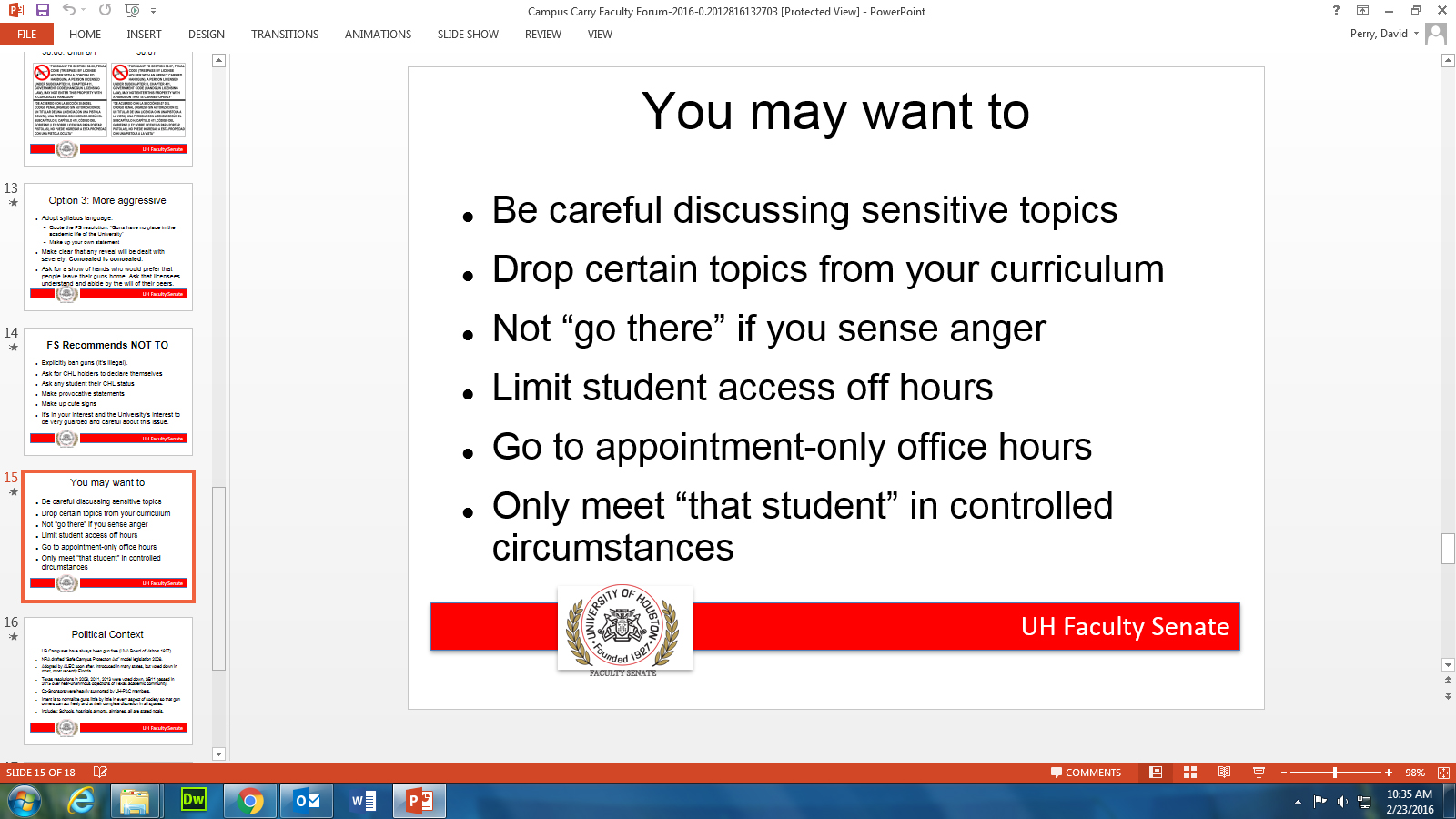
This is from powerpoint slide with a bullet pointed list of advice for faculty members now that University of Houston students can carry concealed firearms. It reads:
"You may want to
(Update for new readers. Hi new readers! Here are some of my writing about Trigger Warnings and PC Culture - I've been writing about trigger warnings, political correctness, and safe space issues for almost two years now (starting with this CNN piece, but extending throughout my blog, including 'trigger warnings are your friends.').
NOTE: Revised for clarity and confirmation of authenticity. 2:00 CST, 2/23
This is from powerpoint slide with a bullet pointed list of advice for faculty members now that University of Houston students can carry concealed firearms. It reads:
"You may want to
- Be careful discussing sensitive topics.
- Drop certain topics from your curriculum
- Not "go there" if you sense anger.
- Limit student access off hours.
- Go to appointment-only office hours
- Only meet 'that student' in controlled circumstances"
UH has confirmed the slide's authenticity. Here's the meeting page with attachments. Download the whole powerpoint. Here's an image:
Original source was this tweet. Bug me, not the tweeter. My sources were unclear why this post and the official slide were different, but I have had it confirmed that the above is the official slide that was shown at the most recent meeting.
 |
| Description:" Red and white slide. Black text. |
Original source was this tweet. Bug me, not the tweeter. My sources were unclear why this post and the official slide were different, but I have had it confirmed that the above is the official slide that was shown at the most recent meeting.
Friday, February 12, 2016
Resource: Mount St. Mary's Survey for New Students
Mount St. Mary's University gave a survey to its incoming class that allegedly was used as a tool to identify the most at-risk members in order to try to drive them from the school. I will have a piece on this with The Establishment soon.
Here's the survey via Scribd. Given its alleged purpose, I find the introduction Orwellian in its rhetoric.
This year, we are going to start the Veritas Symposium by providing you with a very valuable tool that will help you discover more about yourself. This survey has been developed by a leadership team here at The Mount, and it is based on some of the leading thinking in the area of personal motivation and key factors that determine motivation, success, and happiness. We will ask you some questions about yourself that we would like you to answer as honestly as possible. There are no wrong answers.More to come on the disability aspects of this survey.
In a few weeks, we will provide you with some insights into what your responses show about the person you are and could become. We believe everyone here has potential to become someone way beyond what you may think possible right now. We will provide some thoughts on the types of activities, courses, and experiences you should seek at The Mount, as well as some areas you should think about working on in order to be happy and successful. Self-discovery is one of the most important aspects of a college education, as Aristotle said: "knowing yourself is the beginning of all wisdom."
Monday, January 18, 2016
The Chocolate Milk Mustache of the Corporatization of the University
From Vox, Julia Belluz has quite a story.
Don't forget to drink your Ovaltine?
The University of Maryland issued a press release about a new study on the effects of a single brand of chocolate milk on cognitive and motor skill tests in high school athletes.The story, as she documents, is that Fifth Quaker Fresh funded research, the scientists did some shoddy research and didn't even bother to submit it for peer review, the university made a splashy press release, and everyone goes home happy. Well, except for Integrity.
So here we have a milk manufacturer working in partnership with the University of Maryland to fund a sloppy study, and the university then blasts the results, persuading schools and the press that this milk works wonders on students' brains.I see this (as Belluz does too) as a consequence of the university as a profit-center. When said institution is a public university, the science is especially suspect, and the corporate sponsorship especially visible, then it's easy to mock. Most university scientists seem to spend their careers lurching from funding source to funding source, their jobs (and the jobs of their staff) contingent on outside money. It's structural and leads to ... well ... being told that a specific brand of chocolate milk is good for athletes.
It's everything wrong with modern-day science-by-press-release in one anecdote.
Don't forget to drink your Ovaltine?
Friday, January 8, 2016
Coddling By Design - Wheaton College
Last year was the year in which white liberal pundits ranted about PC Run Amok. Hua Hsu covered it very well in his piece for The New Yorker, "The Year of the Imaginary Student." It's a piece worth reading in its entirety. (Michael Roth, president of Wesleyan, has also written two good essays critiquing this discourse)
Here's my rebuttal: If coddling is a problem, if we care about the need for young minds to be exposed to diverse, divergent, even offensive ideas, it's not happening at, say, Oberlin and Wesleyan.
It's happening at Wheaton College, where a professor is being fired for suggesting that Muslims and Christians might believe in the same god.
We can talk about the case of Larycia Hawkins along many lines, appropriately focusing on her freedom and her rights (few, legally, in this case), her bravery, and more. But just for a moment I'd like to cast the "coddling" rubric at Wheaton, a school that, by design, says that students may not encounter a single professor who deviates significantly from strict theological principles.
In fact, American evangelical colleges are built around the idea that student must be coddled, that the world is a corrupting Satanic space, that American culture is deviant, and college should be a protected enclave. Wheaton's mandatory allegiance to its profession of faith is what real coddling looks like.
Wheaton is a lovely university. Its students are bright and its teachers dedicated. I know many Wheaton graduates. They tend to be smart, ecumenically minded, fascinating people, who in fact managed to avoid being coddled.
But for all I concede that many universities trend towards liberal cultural values, I know countless conservative professors with great careers, great comfort in their institutions, and the protected ability to speak freely about their beliefs.
At Wheaton, you will not find a single professor or student who can dissent from the profession of faith in public, as they'll be expelled.
Now that's coddling.
It was a rich year for even the casual observer of campus life. There were tales of students seeking “trigger warnings” before being exposed to potentially upsetting class materials. There was a new interest in “microaggressions,” or hurtful, everyday slights rarely uttered with the intention to offend. There was the Northwestern professor whose editorial against “sexual paranoia” resulted in students filing a Title IX suit against her, and the University of Missouri students who sought to bar journalists from a public plaza, which they claimed to be a “safe space” protected from the media. There were the students at Yale who demanded that a residential adviser be reprimanded after she prevailed upon them to be more open-minded about offensive Halloween costumes. And there was the item in the Oberlin school paper about sketchy Asian food, a piece that the New York Times described as evidence of the new “culture war.” Every week seemed to bring additional evidence for the emerging archetype of the hypersensitive college student, spotlighted at the beginning of the school year by the Atlantic, in a cover story about the “Coddling of the American Mind,” and just last weekend, in a Times Op-Ed about the “culture of victimhood.”This phrase, the "coddling of the American Mind," which The Atlantic gave such top billing to (a good financial decision. It got huge clicks), serves both older liberals, conservative on the non-political sense, who believe they are the arbiters of what kinds of dissent are good or bad, and actual conservatives who want to attack the whole notion of liberal learning as some kind of commie plot. But beyond the wisdom of giving fuel to the other side in the culture war, the attack on "coddling" has always struck me as aimed at the wrong target. Haidt and Lukianoff, authors of the Atlantic piece, write:
But vindictive protectiveness teaches students to think in a very different way. It prepares them poorly for professional life, which often demands intellectual engagement with people and ideas one might find uncongenial or wrong. The harm may be more immediate, too. A campus culture devoted to policing speech and punishing speakers is likely to engender patterns of thought that are surprisingly similar to those long identified by cognitive behavioral therapists as causes of depression and anxiety. The new protectiveness may be teaching students to think pathologically.So "coddling" is bad for students, they say, and it's happening almost at epidemic rates on presumed liberal college campuses.
Here's my rebuttal: If coddling is a problem, if we care about the need for young minds to be exposed to diverse, divergent, even offensive ideas, it's not happening at, say, Oberlin and Wesleyan.
It's happening at Wheaton College, where a professor is being fired for suggesting that Muslims and Christians might believe in the same god.
We can talk about the case of Larycia Hawkins along many lines, appropriately focusing on her freedom and her rights (few, legally, in this case), her bravery, and more. But just for a moment I'd like to cast the "coddling" rubric at Wheaton, a school that, by design, says that students may not encounter a single professor who deviates significantly from strict theological principles.
In fact, American evangelical colleges are built around the idea that student must be coddled, that the world is a corrupting Satanic space, that American culture is deviant, and college should be a protected enclave. Wheaton's mandatory allegiance to its profession of faith is what real coddling looks like.
Wheaton is a lovely university. Its students are bright and its teachers dedicated. I know many Wheaton graduates. They tend to be smart, ecumenically minded, fascinating people, who in fact managed to avoid being coddled.
But for all I concede that many universities trend towards liberal cultural values, I know countless conservative professors with great careers, great comfort in their institutions, and the protected ability to speak freely about their beliefs.
At Wheaton, you will not find a single professor or student who can dissent from the profession of faith in public, as they'll be expelled.
Now that's coddling.
Wednesday, January 6, 2016
The Giant Lecture Course and the Big University
Over on Chronicle Vitae, a group of students at the University of Illinois - Urbana Champaign, have written a spectacular piece - "A lecture from the lectured."
They open by citing pieces that sneer at students today for being distracted, boring, and un-intellectually curious, then respond with appropriate scorn.
They also recognize the economics
We know it's the worst acceptable way to teach.
We know students learn less in giant lecture classes.
We know a few profs who can pull it off, because they are good performers.
But we know that most profs can't.
We know that reward structures at the giant university focus almost entirely on research productivity (and the elusive outside offer).
And maybe this was ok when the giant publics were cheap but good. They still can be good, despite these big classes, but they aren't cheap any more.
I don't know how to fix this, but I do know that the recent spate of essays spitting scorn at students who check Facebook during a lecture aren't going to help.
They open by citing pieces that sneer at students today for being distracted, boring, and un-intellectually curious, then respond with appropriate scorn.
At a university like ours, where thousands of students compete to fulfill their general-education requirements, it is lecture after lecture after lecture. For three to four hours of our day, we sit in cavernous rooms — with up to 800 strangers — where the professor doesn't know our name, let alone ask us to speak.They then describe their experiences, including some good ones with great lecturers, but far too often they complete their gen eds through these massive lectures in which they feel anonymous. Of course they don't pay attention.
They also recognize the economics
We will admit that the problem is not that the lecture is inherently a horrendous format. We've had bad small discussion-based classes where no one has done the required reading. We've sat through awkward silences when no one wants to add to the discussion.That's the key to me. This class format persists not because anyone can defend it pedagogically. We all know that even in a class based on what Derek Bruff calls "continuous exposition,"such exposition is better delivered to 25 students, bored as they might be, than to 250. At the giant university, though, that's not really affordable. The whole enterprise depends on the economics of the giant intro class for undergraduates.
But for us, the lecture seems too much the default option for educating a lot of us at the cheapest price.
We know it's the worst acceptable way to teach.
We know students learn less in giant lecture classes.
We know a few profs who can pull it off, because they are good performers.
But we know that most profs can't.
We know that reward structures at the giant university focus almost entirely on research productivity (and the elusive outside offer).
And maybe this was ok when the giant publics were cheap but good. They still can be good, despite these big classes, but they aren't cheap any more.
I don't know how to fix this, but I do know that the recent spate of essays spitting scorn at students who check Facebook during a lecture aren't going to help.
Monday, January 4, 2016
What Is The Good Life? - Scenes from a Dystopian Job Market
The lucky winner of this job will be in an excellent position to opine on the Good Life.
The Good Life has a student-professor ratio of 600:1
The Good Life does come with benefits
All grading in The Good Life is done by graduate students who, upon completion of their PhD, will also be in an excellent position to opine on The Good Life (without tenure, with benefits).
Who comes up with this stuff?
The College of Liberal Arts and Sciences at the University of Florida invites applications for the position of lecturer to teach the Humanities Common Course, IUF 1000: What is the Good Life?, to begin August 16, 2016. As part of the UF Core Curriculum, IUF 1000 is a multi-disciplinary humanities course, taught in collaboration by the faculties of the College of Liberal Arts and Sciences, the College of the Arts, and the College of Design, Construction, and Planning.
This is a full-time, renewable, nine-month, non-tenure accruing position. Duties include teaching two sections and up to six hundred students per semester while supervising up to ten graduate teaching assistants, and contributing to development of course content and assessment of course delivery. Minimum qualifications: experience teaching multi-disciplinary humanities core courses, and a Ph.D. in a humanities discipline in hand by the time of appointment. Preferred qualifications: experience teaching large lecture courses with comparable course content, and supervising graduate teaching assistants in such a course. Salary will be commensurate with qualifications and experience and include a full benefits package.The Good Life does not have tenure.
The Good Life has a student-professor ratio of 600:1
The Good Life does come with benefits
All grading in The Good Life is done by graduate students who, upon completion of their PhD, will also be in an excellent position to opine on The Good Life (without tenure, with benefits).
Who comes up with this stuff?
Monday, December 21, 2015
Book(s) Review - Higher Education Doomsaying
I have a book review out with postemedieval on a collection of recent books about the state and future of higher education.
"Where are we going? Why are we in this handbasket?" is open access.
"Where are we going? Why are we in this handbasket?" is open access.
You never want a serious crisis to go to waste.– Rahm Emmanuel, Mayor of ChicagoEvery week, another cry of crisis reverberates through the virtual and tangible spaces in which academics congregate. The pundits and publishers who cater to higher education know that crisis narratives find readers, not to mention re-tweeters, re-posters, online sharers and bloggers who will confirm or deny (often deploying their own rhetoric of crisis) a given analysis. In most cases, crisis narratives are claustrophobic. They shine a spotlight on the constraints and urgencies of the present situation in order to push their audience toward one particular course of action.
This review essay takes up and examines some recent cries of crisis (as well as refusals of the term), but it also attends to different imagery for describing the contemporary status of colleges and universities – that of entanglement. Entanglements, knots, mutual entailments, ongoing involvements, co-implications, networks, jumbles, meshes, messes and complex structures can challenge the monologic solutions so often offered in response to crisis. Entanglements can be constraining, but interweaving is just as likely to provide strength and resiliency. One way to understand the purpose of this volume is as an exploration of the entanglements among the arts and liberal arts. Entanglements of various sorts dominate the recent literature on the nature and future of higher education, but in this arena there’s no consensus about what the optimal bundle of entwined ideas, fields, peoples and places might be. For some, we need to build thicker bonds among the various components, making it harder to tear us apart. Others, though, want to slice through the whole mess, scattering the university into its components, claiming that through destruction we’ll all be made whole.
I address:
- Robert B. Archibald and David H. Feldman - Why Does College Cost So Much? Oxford, Oxford University Press, 2011, xii+289pp., $36.95. ISBN: 978-0199744503
- Kevin Carey - The End of College: Creating the Future of Learning and the University of Everywhere. New York, Penguin, 2015, 288pp., $27.95. ISBN: 978-1594632051
- Daniel F. Chambliss and Christopher G. Takacs - How College Works. Cambridge, MA, Harvard University Press, 2014, 224pp., $29.95. ISBN: 978-0674049024
- Michael M. Crow and William B. Dabars - Designing the New American University. Baltimore, MD, Johns Hopkins University Press, 2015, xiii+344pp., $34.95. ISBN: 978-1421417233
- Michael Kennedy - Globalizing Knowledge: Intellectuals, Universities, and Publics in Transformation. Stanford, CA, Stanford University Press, 2014, xviii+406pp., $34.95. ISBN: 978-0804793438
I suspect folks in higher education will find the variety of crisis narratives and solutions interesting.
Wednesday, December 2, 2015
Post-Book Academia: Save Ashgate
The Chronicle for Higher Education covered the "Save Ashgate" petition and movement, now with over 7000 signatures (which is a huge number for an academic publishing issue).
The company has not yet responded to the petitioners, according to Kathleen E. Kennedy, an associate professor of English at Pennsylvania State University-Brandywine. That silence speaks volumes, she says. "We hear that the neoliberal corporation will roll on profitably with us or without us," she wrote in an online essay. "We are not part of their equation."Go read Kennedy's essay for more.
What can we do, we who are silenced? We can organize. Unlike the campaign to restore University of Missouri’s press, a petition wasn’t enough to attract the attention of Taylor & Francis or Informa. But we can reach out to those university presses who continue to battle ever increasing austerity. We can encourage the brilliant presses at Ohio State, Minnesota, Penn State, and Yale, among others, to hire our beloved editors, and offer them space to nurture their series and their networks. We who are Ashgate (and that is clearly a lot of us) may flourish elsewhere, but only if we work hard to leverage our networks to make these rehomings possible. Our networks are what make a press valuable to us, and those we carry with us.
I've been thinking a lot about the ways in which academic can change in response to the shrinking options for book publishing. Books won't go away. Elites will still publish in elite presses which are tied into elite institutions. But the lower tier universities will need to begin to think about redefining what "the book" means to their tenure and promotion structures. Open Access is fine, but the costs to the researcher is often intense. In Europe, large grant groups can build those into their grants. That doesn't work for the American model.
Another model, of course, is to replace tenured teacher-scholars with adjuncts and lecturers. They don't "need" to write books anyway. This is, I fear, how neoliberal America will continue to go. Our students will suffer, as we are better teachers when we participate in our disciplines as scholars.
So ... much to watch here. I'll be writing on these issues under my general heading, "Post-book academia."
Wednesday, November 18, 2015
Complicity - #ComplicitNoMore
Last Wednesday, a group of African-American students staged a public protest against racism on our campus. You can see video and read about it here. They chanted, "Silence no more," vowing to call out the racism that they saw.
As of yesterday, faculty response coalesced around the phrase "Complicit no more." There will be an in-person show of support today, posters to sign publicly, buttons, social media, and more.
I like this phrase very much, as it's aspirational and confessional. It acknowledges that each of us may be complicit in structural racism. It looks past specific incidents - a one student asked in class if they were talking to their drug dealer when on the phone (to use the calculator); a student in a suit asked if they had a court date; intimidation by security services - and pushes each one of us to get to work changing our campus climate. We are accountable.
Microaggressions matter. They compound. They exclude. And the fact that so many people think they don't matter is just a sign of the work we have to do.
Still more to come.
As of yesterday, faculty response coalesced around the phrase "Complicit no more." There will be an in-person show of support today, posters to sign publicly, buttons, social media, and more.
I like this phrase very much, as it's aspirational and confessional. It acknowledges that each of us may be complicit in structural racism. It looks past specific incidents - a one student asked in class if they were talking to their drug dealer when on the phone (to use the calculator); a student in a suit asked if they had a court date; intimidation by security services - and pushes each one of us to get to work changing our campus climate. We are accountable.
Microaggressions matter. They compound. They exclude. And the fact that so many people think they don't matter is just a sign of the work we have to do.
Still more to come.
Subscribe to:
Posts (Atom)