Showing posts with label academic freedom. Show all posts

Tuesday, January 30, 2018

Reason never Defeats Hate

Steve Bannon is coming to University of Chicago to perform "reasoned debate." John Warner writes:
Zingales says, “Hate cannot be defeated by hate, but only by reason.”
Huh? Perhaps hate cannot defeat hate, but does this mean our only alternative is “reason?”
I’m trying to think of a single instance in recorded history where hate was defeated by reason and I’m coming up short. Did the reason of Lincoln’s Emancipation Proclamation end the Civil War?
Did Martin Luther King Jr. reason the cattle prod out of Selma sheriff Jim Clark’s hands?
The faith Zingales puts in the power of “reasoned debate” is essentially magical, an all-powerful remedy for whatever ails you.
That's a good point. 
I believe in this case, the University of Chicago’s commitment to the free exchange of ideas is more symbolic and performative than substantive. Inviting Steve Bannon is an attention-grabbing symbol that says, “Hey, open-minded people over here!” but it’s an inch-deep commitment to the values they claim to hold dear. Meanwhile, they've got some academic messy academic freedom issues where they seem less reverent of full and free reasoned debate.
Performative.
As a second example, Bannon’s invite also led to the ultimate resignation of Samantha Eyler-Driscoll as a member of the University of Chicago Stigler Center publication ProMarket. After her objections to the Bannon invitation were overruled by the board and her request to be personally recused from promoting the event was not fully respected, she was informed by human resources that as staff, unlike Zingales and Bannon, she was not “protected under the University’s stated principles of freedom of expression…and perceived insubordination could be grounds for termination of my employment.”

In her resignation from the board, Eyler-Driscoll observes, “My situation is only the latest example of the ubiquitous reality in this country whereby the de jure notion of an absolute right to freedom of expression conceals a de facto reality in which the right to free expression of the powerful is enforced at the expense of that of their subordinates.”
This is a point I'm interested in -  staff don't have academic freedom, even when they operate in intellectual capacities.

Watching carefully.

- An academic staffer.

Friday, November 3, 2017

Mandatory First-Year Classes and Orientations: Flags and Guns vs Kindness

In my latest Pacific Standard essay, I talk about the ways that some right-wing schools enforce indoctrination and homogeneity, even as our free speech on campus discourse focuses on left-wing schools.
In response to National Football League players protesting state violence against African Americans, the College of the Ozarks, a small, Christian liberal arts institution in Missouri, is ordering its students to pick up a gun. The 93 percent white school now makes all first-year students take a Patriotic Education Fitness class. According to the Miami Herald, the course includes, "lessons on American politics, the military, and flag norms." Through their studies, "students will learn rifle marksmanship, map reading, land navigation, and rope knotting. Students also must be able to run a mile and will engage in other physical education activities." It's unclear how such activities will foster the college's mission of making students more "Christ-like."
This course is pure indoctrination. In fact, schools such as the College of the Ozarks explicitly demand homogeneity and fealty to religious and nationalistic ideologies. They punish divergence, and they aren't alone. There's a whole class of schools, some wealthy and influential, that demand obedience and conformity. And we are in a national moment when far too many influential voices are characterizing liberal arts institutions as hotbeds of politically correct intolerance. It's true that many schools do push students to think about diversity, but the "Patriotic Education Fitness Class" ought to give us a little perspective.
I, of course, had mandatory orientations at Wesleyan as an undergrad. I write:
As an undergraduate, I went to Wesleyan University. It was lampooned in the 1990s, when I attended, as PCU. There was no single core class that everyone took, per se, but I've never forgotten the early mandatory orientations. We were pushed to talk about diversity. Within a few days, new friends came out to me as queer. I learned about what we now call affirmative consent. We had long discussions about culture and power. In many ways, my ongoing work of self-improvement that still pushes me today began during those opening weeks. I'm told that these efforts continue. Last August, Vanessa Grigoriadis, a fellow Wesleyan alum from the '90s, returned to campus to find out what students are saying now; she subsequently wrote a reassuring report in the New York Times about the way today's "'P.C.' students" have an "overwhelming urge to be kind to each other." It doesn't mean they always get it right, but the driving force is to pay attention to vulnerabilities and then do no harm. If this is the scourge of political correctness on campus, sign me up.
PLEASE READ THE WHOLE THING!


Wednesday, November 1, 2017

Drawing Speech Lines

This letter from the English faculty does a nice job of parsing how to talk about free speech while considering how to protect the vulnerable.

They write:
We wish to reaffirm that our role as scholars and educators centrally includes the fostering of a culture of inclusiveness and mutual respect that prizes our diversity rather than seeing it as a threat. Such a culture depends on a willingness to listen carefully to other viewpoints, and to engage critically with them, in ways that respect norms of reasoned argument and the use of evidence. Particularly in the context of emotionally and politically charged issues, it is crucial to respect the right to freely express and argue for one’s views, especially when they are controversial or run counter to popular opinion.
This is good and necessary. They continue:
But when disagreement takes such forms as bullying, racially charged attacks, and the glorification of violence against those with whom one differs, then speech is no longer primarily a matter of the expression of ideas, viewpoints, or opinions, and an invocation of the right to free speech is a distraction from the real issue. There is a crucial difference between speech that makes claims and articulates ideas, and speech that demeans, intimidates, or harms others.
We all know this. Even the free speech absolutists know this, they just feel the trade-offs of abusing the vulnerable is an acceptable price to pay for absolute free speech. Most people, whether they admit it or not, are free speech relativists, debating where to draw the lines.

This is a good place to draw such lines.

Friday, September 22, 2017

Free Speech is Messy

For Pacific Standard, I write about the free speech complexities of the upcoming "free speech week." First, the organizers didn't even ask the speakers or book the spaces before they started crying oppression. Second, "security concerns" forced the Anthropology department to cancel a long-planned talk.

I write:
"Thanks to "safety concerns," the annual distinguished lecture of the Department of Anthropology at Berkeley was canceled. Dr. Anna Tsing, a leading anthropologist, was going to speak at the Morrison Library. Then administrators told the department that although this lecture had been scheduled many months in advance, the presence of Yiannopoulos on campus at the same time as this lecture would either need extra security (paid for by the department) or else a new venue at the last minute; failing that, they would have to reschedule.. In other words, Yiannopoulos' potentially phony "Free Speech Week" abrogated the very real speech rights of a brilliant scholar. In a joint letter, Berkeley faculty wrote, "If this 'Year of Free Speech' is about giving an equal platform to all speakers, it would seem that it has already failed. Hate speech has taken precedence over academic discourse."

Free speech is messy. One person yells. Another is silenced. These situations require deep thinking and careful investigation of how to defend a core American freedom. What we can't do is promote simplistic, absolutist fealty to abstract rights without exception because that creates the potential for Yiannopoulos' mischief."
READ THE WHOLE THING.

Wednesday, July 26, 2017

Academic Freedom: Dr. Jonathan Higgins

Yesterday, I wrote about the adjunct prof fired by the School of the Art Institute of Chicago for alleged homophobia. I wrote that we have to pay attention when people with less power are punished for speech, even if their views might be objectionable.

Today, I turn to the case of Dr. Jonathan Higgins, the director of Claremont Colleges' Queer Resource Center. He was fired for tweeting about white supremacy after a right-wing website latched on to three of his tweets and started campaigning for him to get fired. The college caved.

  1. Colleges need to realize that they cannot appease right-wing media by firing individuals.
  2. Professional staff (I'm about to be one) should be afforded the same rights for "extramural utterances" (i.e. Twitter) as faculty. We want our professional staff engaged in public conversations, not terrified of being fired.
  3. College PR depts should learn to write this statement: "We do not let right-wing media influence our hiring or firing decisions. That will be our only comment on the matter." 
There is an industry dedicated to finding people in higher education saying liberal things on social media and concentrating attention on them until they lose their jobs. As Tressie McMillan Cottom was quoted in The Chronicle of Higher Education the other day - "If there’s an organized outrage machine, we need an organized response."

Part of that response must involve the high profile Free Speech Warriors shifting their attention away from leftwing protests of rightwing speakers, and working collaboratively with us to protect people like Bonesteel and Higgins. 

Thursday, June 29, 2017

PC Run Amok: Take 98

The American right-wing has a cultural theory, or at least a cudgel: America is being destroyed by political correctness. College professors and liberal students, especially those of color, are to blame. 

It's not a new theory, but in this age of multi-million (billion, for Fox?) dollar media companies and the magnifying effect of social media, it has intensified in its consequences.  On the one hand, Donald Trump ran for president against PC, which is pretty high stakes I guess, but I'm more focused on the academic context. There are well funded conservative anti-academia sites promoting comments, often social media off-the-cuff stuff, sometimes formal writing, and sometimes gross distortions, by professors that will inflame their readers. There are editors at Daily Caller, Fox, Breitbart, trolling those anti-academia sites for a professor-of-the-day to target. And then there are the consumers, who have learned that they can start calling and threatening and being loud, and get professors suspended or fired in some cases. In other cases, they can issue threats and harassment campaigns, and drive academics out of their homes, into spirals of anxiety, and otherwise perform Gamergate-like campaigns on academics (mostly women and PoC).

So here's my question: What are the centrist writers who have spent years criticizing PC run amok going to do about it?

I wrote a bit for Pacific Standard about this problem.

Mostly, when centrist writers acknowledge the threat from the right, the approach is to suggest the left talk less about racism, identity, the need for safety, for the left to make visible their openness to diversity. To argue that when the left says, "safe space," it opens up room for the right to say, "safe space." There's a lot of "both sides are equally bad" talk.

But although attacks on free speech are, in abstract principle, equally bad, on a practical basis, power matters. I'd like to see a shift to the practicalities in terms of how we spend our media power.

I always think back to Melissa Click, the professor at Missouri. She behaved badly to a student journalist. It was bad, and it received massive scolding coverage from across the media landscape.

Then the legislators got her fired. To me, state legislators interfering in hiring/firing decisions in public universities is WAY MORE SERIOUS A THREAT than a single professor behaving badly.

We need to focus whatever command we have of the attention economy on the more serious threats, rather than feed Tucker Carlson his lines with our own "PC run amok" confirmations.


Thursday, March 9, 2017

Peter Singer, Milo, and Murray - The Slippery Slope Fallacy

Friends, we've been hacked.
In the ensuing debates about platforms and protests, which will be extremely complex and often uncomfortable, forcing us to choose between abstract principles, tactical effectiveness, and protecting ourselves and others. We're gonna need good tools, rhetorical as well as organizational, as we stumble forward.

One thing that I want to make sure is excised from the debates is the simple notion that slopes are slippery, that one thing naturally leads to another. We cannot assume that denying a platform to Milo, or Murray, or Peter Singer must naturally lead to denying a platform to others. It might! But we can't assume.

Therefore, I want to remind readers who will be thick in the trenches of these debates that the slippery slope fallacy IS A FORMAL LOGICAL FALLACY. Not all assertions that a slope is slippery are fallacious, as one can make a well-reasoned argument, but the simple assertion is a fallacy.

Don't fall for it, so to speak.


Monday, March 6, 2017

Middlebury: Disruption is not Violence

Below you will find a letter from the president of Middlebury on the recent protests around the presence of Charles Murray. My basic take is that giggling GOP student groups have hacked the free-speech pieties of my generation. Those pieties were based on a pre-internet information culture, and perhaps still hold true, but they should be engaged rigorously not merely repeated as truths.

What troubles me about the president's letter is the loose conflation of disruption with violence. Here's a key quote:
I want to state that peaceful, non-disruptive protest is not only allowed at Middlebury, it is encouraged.
There's been a lot of disruptive protests over the past few years, from people shouting at Trump events to Black Lives Matter blocking highways. True protest is disruptive. To limit protest to polite non-disruptive action is to to take a position opposed to protest. Protest cannot be civil.

Protest can be non-violent though. To threaten people's bodies (I care less about threatening, say, Starbucks, as happened in Berkeley when Milo was blocked from speaking) is a good place to draw a line, and at Middlebury a professor felt very afraid, and that's a problem.

But disruption is necessary.

Here's the letter:

------------------------------------------------

Dear Middlebury Community Members,

This is the first of what is likely to be a series of communications from me in the days and weeks ahead.

Many of us still are processing what happened inside and outside Wilson Hall and McCullough Student Center last Thursday. The protests and confrontations in response to Charles Murray’s appearance laid bare deep divisions in our community. The campus feels different than it did before. It will take time and much effort to come together, and what the future ultimately looks like may not be anyone’s ideal—at least not for a while.

Today I write on the topics of accountability and community.

Let me turn first to accountability. Because of the complexity of the events and actions that took place, we have initiated an independent investigation to establish a baseline of information. Once that work is completed, the College will follow a process of determining a course of action for each individual understood to be involved in some way in the events of last Thursday.  This will take some time.  Our process must be fair and just.  To be clear, I want to state that peaceful, non-disruptive protest is not only allowed at Middlebury, it is encouraged.  We all have the right to make our voices heard, both in support of and in opposition to people and ideas.  Our concern is acts of disruption and violence, where available means of peaceful protest were declined.

Separately, the Middlebury Police Department will investigate the confrontation that took place outside McCullough following the event, which we believe involved individuals from both on and off campus. We will cooperate fully in that investigation and encourage all members of our community to do the same.

Let me turn next to community.   Creating true community is hard work, and yet that work is essential and is our collective responsibility.  This week, we will mark the beginning of opportunities for reflection and engagement.  We have already heard from many community members on all sides of the issues and that has been deeply encouraging. Existing groups on campus have written to help us understand what the community is feeling and might need going forward.  We have much to discuss—our differences on the question of free speech and on the role of protest being two of the most pressing examples.

In addition, I am extending an invitation to everyone to submit community-building ideas for consideration.  These ideas may be modest or bold.  We will work with existing groups of faculty, staff, and students to collate these ideas into plans of action over the next semester and beyond.  Katy Smith Abbott, Susan Baldridge, Miguel Fernandez, and Andi Lloyd will provide information about how to share your ideas in a subsequent message.

This was an extremely difficult episode, especially because in the last year we have worked so hard to affirm that Middlebury is committed to unlocking the potential and brilliance of every student, no matter their race, class, sexual orientation, religion, disability status, or any other personal characteristic. If you are here, it is because you earned your way here, and you belong.   We are also committed to upholding the right to speech, even unpopular speech, especially in times of division or uncertainty. If colleges and universities cannot serve this role, who can?

I urge us all to keep listening and connecting, and am myself in active communication with students and faculty on all sides of the issue. I want to acknowledge the anger and frustration that many people feel. There is hard work ahead for all of us:  learning to be accountable to one another, and learning to stand in community with one another.  We must affirm our shared values and goals and hold each other to them, and we must listen differently, helping others to be fully heard and seen.

My faith in our collective ability to grow into a better place is unshaken.  I look forward to the many conversations we can and must have over the coming months.

Laurie Patton
President

Wednesday, February 22, 2017

Milo and the University of Chicago Medievalists

There's been a lot of coverage (in my little slice of the world) of a medievalist at the University of Chicago who has been writing quite outrageous things about Milo the Professional Bigot. There's more to say about Milo, but lots of folks are already saying it. Here's my thread on the context surrounding Fulton.
I am pretty much an absolutist when it comes to protecting "extramural utterances," like tweets and blog posts, by academics. We've got to protect the right of academics like Fulton to compare Milo to Jesus (really!!!) without threatening their jobs. That said, it troubled me to see someone using their academic status to craft a nonsensical defense of Milo as a Christian visionary.

Julie Orlemanski, a brilliant medievalist (in English) at the University of Chicago, sent a letter on Sunday, February 19 (so post-Maher but before the pedophilia scandal went viral) criticizing a publication decision by Sightings, a University of Chicago Divinity School online publication focusing on "religion in public life from an academic perspective." Sightings published an essay by Fulton, "Why Milo Scares Students," praising his truth-telling and Christian virtue.

Orlemanski emphasizes that this essay is not  extramural, but is rather a university publication with a set of standards, and publishing this material there has consequences.

I re-post the letter here, in full, with permission:

--------------------------------------------------------------------------
Letter to Dean of the Divinity School, to the Director of the Martin E Marty Center, and to the editor of Sightings:

I am writing as a colleague in the English department disturbed by the decision to publish Professor Rachel Fulton Brown’s article on Mr. Milo Yiannopoulos, as the Divinity School's “Sightings” platform did on February 16, 2017 (now partially republished on Breitbart with the lede “An article published by the University of Chicago’s Divinity School....”) My objections are twofold. First, the piece falls short of the editorial standards laid out on the “Sightings” website; it fails to live up to the basic tenets of academic integrity that make our university a meaningful intellectual community. Second, the manner of publication shows no sensitivity to the inflammatory content of the article and the effects of this content on the university committee.

On this second point: It is a statement of fact that Mr. Yiannopoulos expresses xenophobic, racist, and transphobic ideas and carries out discursive violence by doxing (intimidating individuals by dumping personal information into the public domain) his critics as well as persons he identifies as undocumented immigrants or trans. The Anti-Defamation League refers to him as “a misogynistic, racist, xenophobic, transphobic troll”

Faced with publishing an article in support of Mr. Yiannopoulos, what are the responsibilities of a University of Chicago platform? 

My claim is that it – is that you – have a responsibility to the university community of current students, faculty, and alumni and to our broader political world to reflect on the likely effects of publication. There are not only two options here. This is not a stark decision between so-called “free speech” and censorship. For instance: observing the controversial and obviously offensive nature of the contents (an offensiveness thematized in the article itself), those responsible for this publication might have decided to solicit a couple of other faculty members’ responses to Mr. Yiannopoulos, or to our campus climate in the current political moment; these articles might have been framed with an editorial introduction, to aid the university community in grappling with your decision to publish the piece. Instead, as a junior faculty member who works in medieval studies at this university, I have spent more than a dozen hours since the article’s publication three days ago responding to appalled graduate students, faculty at other institutions, and faculty here. Speaking personally, I feel angry and disappointed that “Sightings” did not take up any of this intellectual, institutional, and affective labor in advance and instead left it to me and others.

I would add that I invested time last week reading the 2016 Climate Report and the recent report of the Diversity Advisory Council so as to participate in one of the “Campus Conversations” about diversity, inclusion, and equity. 

I assume you have read the report, so you know that among respondents who identify as Black, 40% perceive the overall institutional climate as racist, and among respondents who identify as transgenderqueer-agender, 41% perceive the overall institutional climate as sexist. 

These numbers show that, already, the university is not a space of free and equitable access to “speech.” If, as Provost Diermeier wrote on January 24, “The University of Chicago is committed to fostering a diverse and inclusive campus that enables individuals of all backgrounds to thrive,” then “Sightings” and the Divinity School have an obligation to work to ameliorate the university’s racist and sexist climate. This may mean changing policies and practices so as better to balance commitments to antiracism and antisexism with intellectual inquiry. As it is, I find it an unpleasant irony following the “Campus Conversation” to find the university’s imprimatur on an article in support of a racist transphobe and to spend hours dealing with the fall-out from that.

My first point above – that Professor Fulton Brown’s article fails to live up to the basic tenets of academic integrity that make our university a meaningful intellectual community – seems to me straightforward. The “Sightings” mission statement asserts that you publish “rigorous analysis of, and research-based opinions about, religion in the news.” The article does not meet this standard. To justify her account of who Milo Yiannopoulos is and what he stands for, she refers her readers to articles from Breitbart. But Mr. Yiannopoulos is a senior editor at Breitbart, and Professor Fulton Brown herself is listed as an author there; the site itself (as I’m sure you’re aware) is known for far-right opinion and commentary; it is not a credible source. The logic and historical basis for her claims regarding Christianity and the university are also poor. Given the straightforwardly inflammatory content of the article, “Sightings” might have insisted on a high standard of argumentation and evidentiary support, and I am disappointed that they did not. Instead, my colleagues and I are compelled to spend our time producing “more free speech” pointing out basic failures of journalistic and intellectual discourse.

To reiterate: I am writing with a sense of profound disappointment and frustration regarding how Professor Rachel Fulton Brown’s piece was published. It is my hope that “Sightings,” the Divinity School, and the university as a whole will act differently next time, by taking action to balance commitments to antiracism and antisexism with the values of intellectual exchange.

Thank you in advance for your response.

Tuesday, February 21, 2017

Right Wing Attacks on Academia Continue: Iowa Law Mandates Political Affiliation

Amidst all the furor over Milo and UC Berkeley, in which non-students staged an action to shut down a speech, the GOP keeps doing its thing - using money and access to power to try and overthrow public universities. I wrote about this most recently here for Pacific Standard and on the blog.

Latest examples:
The law in question has been proposed in Iowa, requiring "political balance" among professors. It comes shortly after another bill ending tenure was proposed.
A bill in the Iowa Senate seeks to achieve greater political diversity among professors at the state's Board of Regents universities. Senate File 288 would institute a hiring freeze until the number of registered Republicans and Democrats on the university faculty fall within 10 percent of each other.
"I’m under the understanding that right now they can hire people because of diversity," said the bill's author, Sen. Mark Chelgren, R-Ottumwa. "They want to have people of different thinking, different processes, different expertise. So this would fall right into category with what existing hiring practices are."
Three notes:

1) Using coercive power of the states to force ideology into public universities is the standard conservative move.

2) The couching of in the frame of "diversity" is relatively new (last 5 years or so). Of course they are actually opposed to diversity in all other contexts.

3) Legislators propose all kinds of ridiculous bills for the sake of political posturing, but such proposals don't happen in a vacuum. It may not make it through Iowa. It might not make it through the courts if  it was passed. But it will in some states. ALEC and the like help draft these bills and pass them around. This is a garbage law, and unworkable. But any hint of forcing people to declare party affiliation for hiring is a totalitarian move.

Meanwhile, I'm sure the high visibility writers with all the diversity of Chait, Haidt, Kristof, and Soave are super focused to see how the next big threat to free speech is coming from Oberlin students.

UPDATE: Also NC. I smell ALEC's legislation-writing folks at work.

Thursday, February 9, 2017

Humans on Campus: Washington before and after Milo

The other day I suggested that a person being shot at a Milo protest in Washington deserved at least as much coverage as, say, Oberlin students arguing about sandwiches ... or even the property damage and action at Berkeley. Because someone was shot.

Now The Chronicle of Higher Education has (paywalled, but this link might work) a detailed, humane, story by Steve Kolowich on Washington. It's exceptionally well reported, tries hard not to reveal the writer's biases (I don't really believe in objectivity, but I do believe that the objective voice is something people can achieve), and lays out the perceptions of the major individuals ON CAMPUS - not Milo - who have to live there before and after he descended.

Notes:

  • Milo is free. Breitbart pays his way. That's why the campus GOP invites him.
  • The story does not get into the Campus GOP threats post-Milo, where it promises to use violence at other protesters. That's likely a factor of when it was written and filed, not an omission.
  • The people who experienced doxxing and violence were anti-Milo protesters. 
There are lots of stories to be told. The ability of a news organization intent on profiting from division and hate to place speakers on college campuses is a complex one, and protecting free speech matters (it remains a subject for debate whether targeted harassment of vulnerable students is protected speech). But seriously, Milo's speech rights ARE BEING WELL COVERED!

I'd like every news outlet that publishes a story about Milo's speech rights to also spend at least 5 minutes considering the speech rights of his targets. I don't feel like it's too much to ask. 

Monday, January 9, 2017

Adventures in Academic Freedom

Four stories.

1) ALEC is meeting with legislators and talking about pulling funding from public colleges and universities if they don't include more conservative views.
The academic freedom PC Run Amok people don't seem to care. Note, this is a standard idea among conservatives, as evidenced by this Ben Carson interview.  If you aren't terrified by this, you aren't really concerned about academic freedom.

2) Donald Moynihan, a prof at University of Wisconsin, writes for the New York Times about these real threats. He's not focused on ALEC, but on Wisconsin lawmakers who want to censor university professors, and the threat of guns on education.
If you truly believe that a university should be a place where people are empowered to pursue a fearless sifting and winnowing of ideas and evidence that benefit us all, I have a simple request: Look at the bigger picture beyond a few elite private institutions. For those of us who teach where most American students are educated, actual triggers are a more relevant danger than trigger warnings. Safe spaces are less threatening than shutting down teaching and research spaces.
Policy makers who accuse students of weakening campus speech should lead by example. Free speech on campus has survived and will survive challenges from students and other members of civil society. Its fate is much less certain when the government decides to censor discomforting views.
3) Meanwhile, the UK is worried about PC Run Amok.  Sigh.

4) Finally, conservative academics are mostly pretty happy, rather than the besieged minority that they are alleged to be.
I should first mention that, contrary to the prevailing wisdom, conservative faculty are just as happy as their liberal counterparts, if not more so. In fact, in 2014, two-thirds of conservative faculty on a nationwide survey responded “Definitely yes,” the most positive on a five-point scale, to the question “If you were to begin your career again, would you still want to be a college professor?” Nationally, an average of 58 percent of all faculty members said they would, while 56 percent of liberal faculty responded in such a positive way -- 10 points lower than right-leaning faculty. 
Interestingly, tenure does not play a role in levels of satisfaction, either. Tenured and nontenured conservative faculty members are both highly satisfied, at 65 percent and 61 percent respectively. The numbers look different for faculty members who identify as liberal: of those, 62 percent of tenured faculty would remain a professor compared to only 49 percent of those who aren’t tenured -- a nontrivial difference.

Tuesday, February 23, 2016

Threats to Academic Freedom: Guns vs Political Correctness Run Amok

Thesis: The idea that your students have guns will have a vastly more chilling effect on academic freedom than people asking for trigger warnings, less offensive language, or to be thoughtful about microaggressions. Coming soon from CNN.

(Update for new readers. Hi new readers! Here are some of my writing about Trigger Warnings and PC Culture - I've been writing about trigger warnings, political correctness, and safe space issues for almost two years now (starting with this CNN piece, but extending throughout my blog, including 'trigger warnings are your friends.').

NOTE: Revised for clarity and confirmation of authenticity. 2:00 CST, 2/23

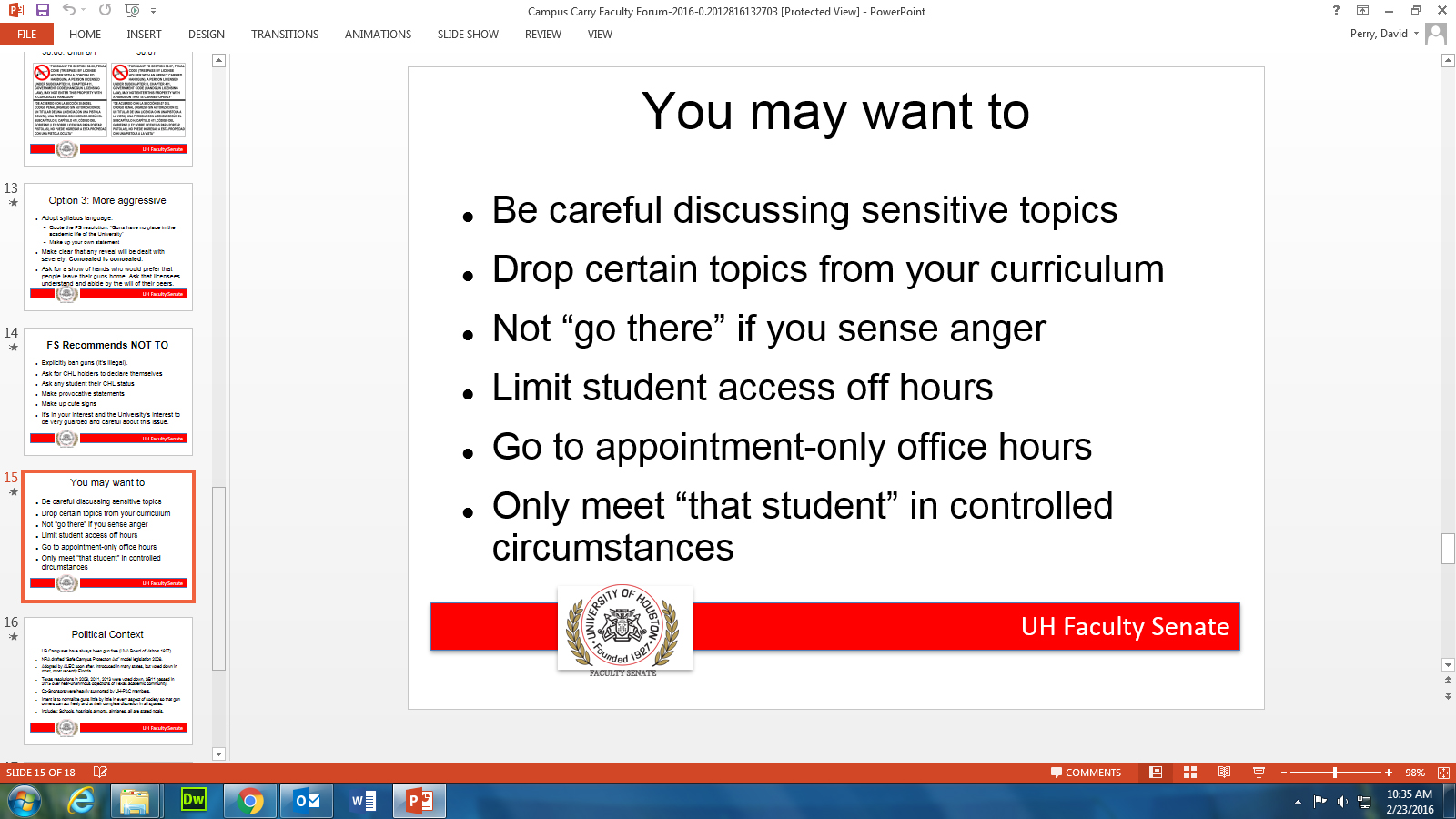
This is from powerpoint slide with a bullet pointed list of advice for faculty members now that University of Houston students can carry concealed firearms. It reads:

"You may want to
  • Be careful discussing sensitive topics.
  • Drop certain topics from your curriculum
  • Not "go there" if you sense anger.
  • Limit student access off hours.
  • Go to appointment-only office hours 
  • Only meet 'that student' in controlled circumstances"
UH has confirmed the slide's authenticity. Here's the meeting page with attachments. Download the whole powerpoint. Here's an image:

Description:" Red and white slide. Black text. 

Original source was this tweet. Bug me, not the tweeter. My sources were unclear why this post and the official slide were different, but I have had it confirmed that the above is the official slide that was shown at the most recent meeting. 

Monday, May 18, 2015

Academic Freedom: How Duke Should Respond to Jerry Hough

Being a racist is not enough to invalidate academic freedom.

Jerry Hough, a Duke Professor, left a racist comment on a New York Times page. He is now reportedly on leave. Hough has denied he's a racist. From Slate:
Hough told both the local ABC and Fox affiliates that he was on leave after his comments, in which he identified himself as a Duke professor, raised uproar on campus. In emailed statements, the political science professor defended his comments, saying “Martin Luther King was my hero” and insisting he is “strongly against the toleration of racial discrimination.” The key question, though, according to Hough, “is whether my comments were largely accurate. In writing me, no one has said I was wrong, just racist.”
For the record. Dear Mr. Hough - You are wrong. Also, yes, they are racist. What's more, he has a history of making comments on race that betray a consistent rhetoric of racial inferiority for African Americans.

And yet, of course, I'm here to talk about academic freedom. As I've said many times, academic freedom does not guarantee complete impunity for consequences of one's speech. It does, however, guarantee due process and a very, very, high bar for any speech act to be determined as actionable by one's employer.

What happens next? Here's what I wrote about a homophobic FSU professor last fall.
[O'Connor] does not seem to have been granted the kind of due process usually called for by advocates of academic freedom. Indeed, one of the most consistent criticisms of the University of Illinois was that even if one believed that Salaita’s tweets constituted grounds for rescinding his job offer, he should have been allowed to respond to accusations as part of that process. I agree with that criticism. I wonder whether O’Connor was offered a process in the event she chose not to resign (FSU will not comment on personnel issues).

We discover the limitations of free speech, academic freedom, and civil liberties by wading in the muck of the margins.
There needs to be a clear process. The bar for firing someone over speech must be VERY high. My gut says that these comments do not clear that bar, as repellent as they are. My gut reaction though is irrelevant, as what matters here is process, transparency, and not letting an attack on Hough undermine a broader defense of academic freedom.

It's probable that no black student would want to take a class with Hough, but I'm troubled by the idea that a theoretical future "feeling uncomfortable" with a professor be allowed to enable firing, whether tenured or not. Because anyone could theoretically say that in the future they might feel uncomfortable with someone over their stated public positions; indeed, in other free-speech cases (Gundy, Salaita), groups of conservatives have made just that argument. A hypothetical future discomfort cannot be proven or disproven. It doesn't clear the bar.

But you know what does clear the bar? Discrimination. Hough has a long history of Duke. I believe it is now the job of the university to look for clear evidence of discrimination by Hough against black students (or any group of students). It's not about speech. It's about actions.

Also, I hate writing these posts. I really just want to shout and rant, but here I am again, wading in the much of the margins.

Tuesday, May 12, 2015

#ISupportSaida - Here We Go Again

Here we go again. An incoming professor of color, Saida Gundy, made comments that were, at most, provocative. She said that white, college age males, were a problem population (that's the provocative one). She also said that white men are responsible for slavery and its legacy in this country (that's indisputably true).

I'm not linking to the right-wing sites organizing a systematic harassment of her on Twitter and at Boston University, where she works. It follows predictable patterns. BU said - “The University does not condone racism or bigotry in any form and we are deeply saddened when anyone makes such offensive statements."

I'm glad they are protecting her job. I'm angry that they have conceded she is racist or bigoted. The pressure will continue for awhile and it's important for academics to say publicly, if they can, that they support academic freedom. I also think it's important for historians to say that the acknowledgment of white responsibility for slavery is neither racist nor (in my case) white guilt, but simply true. The intersections of white supremacy and patriarchy are, indeed, a problem. To say so isn't racist. Furthermore, the pursuit of this professor falls into the persistent pattern of conservatives formally and informally targeting professors of color, especially women.

I do think that for all its unfortunate outcome for both the individual and institution, the Salaita affair has prepared the academic social web to respond to these incidents in ways that we might not have been a year ago. It's certainly given me practice at my rhetoric and forced me to refine my principals. In fact, I went on record defending the right of a conservative professor to due process in this essay.

When it comes to free speech and academic freedom, here's my mantra:  If we do not stand on principle for people with whom we disagree, we have no principles.

And so it is irrelevant whether or not I stand with Saida and whether or not I agree with what she says. I stand with her on principle. I also stand with her against this relentless harassment. I stand with her because the acknowledgment of the ongoing power of white supremacy is not racist. I stand with her because the targeting of vulnerable professors of color must stop.

Here's a coda from Inside Higher Ed with good points from Academe Blog and FIRE.
Robert Shibley, executive director of the Foundation for Individual Rights in Education, said he suspected Grundy’s case will end here but that “experience has taught me to fear” otherwise.
The tweets that have been made public “certainly constitute protected speech under the First Amendment,” Shibley said. But one of Boston’s computing policies, which prohibits the dissemination of “offensive, annoying or harassing material,” he added, “arguably allows the university to punish her, should she decide to tweet similar things over the university network and should someone find her opinion ‘annoying.’”
That computer-speech policy, Shibley said, “should be revised to be consistent with BU's promise of ‘an atmosphere of unfettered free inquiry and exposition’ for its professors.” Of course, since Boston is a private institution, it doesn't have to follow First Amendment standards, necessarily, just contractual ones -- even if FIRE and others think it should.
But what about the concerns that Grundy’s position may make her biased against white male students, and therefore affect her teaching? John Wilson, co-editor of the American Association of University Professors’ "Academe" blog and an independent scholar of academic freedom, called such an argument -- which he said was used against Salaita by Illinois -- “utterly wrong.”
“If you say that alleged bigotry expressed in personal remarks disqualifies a professor from teaching, then virtually all professors would need to be fired,” he said. “Faculty who oppose gay marriage would be biased against [gay, lesbian, bisexual and transgender] students. Faculty who criticize Islamic terrorism would be biased against Muslim students. Faculty who are fundamentalist Christians and believe that atheists, Jews, etc. will be condemned to eternal hell might be feared by Jewish or non-Christian students. Faculty who criticize Israel or Palestine might be biased.”
The only way to know, Wilson added, "whether Grundy's classes are taught with an illegitimate bias that violates the rights of her students is by looking at her teaching, not her tweets. But you can't assume that controversial professors are bad teachers. Quite the opposite is usually true.”
At the same time, he said, Boston should be free to criticize Grundy’s tweets, as long as it makes clear she won’t be penalized in any way for them.
We want faculty with views, opinions, and arguments. We want to defend faculty who make such arguments. Whether we agree with them or not.

And so #ISupportSaida.

Tuesday, January 20, 2015

Academic Freedom - Carol Swain, Steven Salaita, Deborah O'Connor, Susan Douglas

Carol Swain is a Vanderbilt University law professor and noted Islamophobe. In the wake of the Charlie Hebdo attacks, she wrote a thoroughly nasty column for The Tennessean. Protests and counter protests and accusations of censorship have followed.

I wrote about related issues for The Chronicle of Higher Education a few months back, in the wake of a Florida State professor (Deborah O'Connor) being fired without due process after saying despicable homophobic things. In that piece, I talked about Steven Salaita, and how support for due process in one case means there must also be support for due process in the other.

Of course, principles are hard. People who rallied to O'Connor then immediately turned around and demanded the resignation or firing of University of Michigan professor Susan Douglas, who wrote a column called, "It's ok to hate Republicans."

Of course, the next time a group of progressive students get upset at some war criminal speaking at their graduation, those same Republicans who criticized O'Connor will talk about how wimpy US college students are these days (as David Brooks did here).

Here's my take:

  1. If  you do not extend your principles to those with whom you disagree, you have no principles. I believe in academic freedom and therefore extend it to all of these professors, even the ones whose views disgust me. 
  2. Academic freedom does not mean that there are no words you can say that should come with job loss or sanction. It's just that the bar is very very high. 
  3. I don't have enough information on Douglas, Swain, or O'Connor to judge. On the Salaita case, testimony from years of teaching at Virginia Tech suggested that concerns he would be too scary to pro-Israel students were unfounded.
  4. I'm very concerned about the idea that strident opinions make the classroom inhospitable as a general rule. Having strident opinions is what we, as academics, should be doing. That doesn't mean use the classroom as a pulpit, but I am fearful of the consequences for teaching if we push teachers to be cautious. 
Free speech is hard. It means supporting the right of really nasty people, like Carol Swain, to say really nasty things. 

Here's the good news. Free speech means we get to talk back.


Tuesday, December 16, 2014

Me and Voldemort (Why Academic Freedom in Extramural Utterances Matters)

I had a new piece at the Chronicle yesterday about offensive speech and academic freedom. Deborah O'Connor, a Florida State lecturer, resigned after saying some really nasty things on a public Facebook page. In my piece, I compare her speech to the un-hiring of Steven Salaita, a case on which I've written a lot over the last few months.

Here's a passage I had to cut from the essay (as it veered off the main thread), but that I think helps raise the stakes, in the sense that we are all at risk:
I used to hang out on a Facebook page filled with interesting people from diverse political perspectives. We’d debate issues, disagree, and kept it all pretty civil. But then Voldemort, my nickname for a fanatical right-wing historian, would show up and start baiting me. I was, at the time, easily baited. Again and again, I would find myself writing profane responses, my temper flaring, my fingers slamming down on the keys. I never sent them, at least not the worst ones. I never told him to “Fuck off and die.” I never called him any offensive epithets.  But I was close, too close, too often. Eventually, I had to cut myself off from that community, just because I spent too much of my day being angry.
Had I lost my temper, what implications should that have for my job? Voldemort could have screen-captured my comments and sent them to my university or to the press. The right-wing blogosphere is always eager for example of left-wing misconduct and angry or violent rhetoric. It could easily have become an issue.
In the essay, I write:
Last week Deborah O’Connor, a senior lecturer at Florida State University, was pushed to resign after making racist and homophobic comments on a public Facebook page. She said some pretty horrible things, like blaming Europe’s troubles on “rodent Muslims.” She also told a well-known gay hairstylist to “Take your Northern fagoot [sic] elitism and shove it up your ass. ”
I am revolted by her remarks. However, I spent quite a lot of the fall arguing thatimpassioned political speech on a personal social-media account did not justify the “de-hiring” of Steven Salaita. As has been well reported, Salaita was hired for a tenured position at the University of Illinois at Urbana-Champaign when stories about his angry tweets regarding the war in Gaza reached the trustees and chancellor of the university. They canceled his appointment. Every time I encountered someone justifying Salaita’s firing by emphasizing what they considered the gross anti-Semitism of his tweets, I responded with the following: If we do not stand on principle for people with whom we disagree, we have no principles.
I stand by that analysis.

So what is owed O'Connor? The key is to remember that the principles of academic freedom do not say that all speech is protected speech; rather, it argues that there are broad protections of most kinds of conduct. If an institution thinks someone has crossed those lines, then the burden is on the institution to follow (or at least explicitly offer) an appropriate due process, as outlined in the 1964 (rev 1989) AAUP Committee A Statement on Extramural Utterances.

This should really not be controversial, but it often becomes so when we are faced with someone saying or doing awful things.

I suspect O'Connor is not, in fact, able to teach without bias. But it's possible, and I'd like the burden of proof to be on FSU to prove it.

Monday, August 11, 2014

Resources: The Firing of Steven Salaita

For my non-academic readers, over the last week there's been a big story about academic freedom in the age of Twitter. An arab-American professor lost a job, it seems, because he was rude about Israel on Twitter. There's lots to say here and I am working on several essays. Here are some resources.

 First, on the firing, then some reactions (there are lots and lots more), and then the ways that conservative media write about conservative professors who encounter, they say, prejudice for their political beliefs.

As always with these resource posts, please let me know what I missed either in comments (which work better now), facebook, twitter, or email. Thanks.

Prequel


News on Salaita Firing
Some Reactions
  • Electronic Intifada roundup.
  • Mondoweiss compares to Seeger and Robeson.
  • Change.org petition calling for reversal.
  • David Palumbo-Liu in Salon with his reaction.
  • Daily Caller hangs up its trophy.
  • Corey Robin. I don't even know where to start as he's been deeply involved in the story. Maybe here.
  • AAUP reactions from Illinois and Nationally (and former AAUP president Cary Nelson applauding Salaita's firing)
  • FIRE points out the timing between a 7/22  defense of Salaita and the pocket veto of the hiring.
Conservative Complaints about Conservative Profs being fired/discriminated against or calls for liberal profs to be fired.

Meta-article on the position of conservatives in the American university. Most important piece I've read on the topic It is written by a serious conservative. It accesses lots and lots of data. It acknowledges the divide in numbers between liberal and conservative profs, but says:
Looking at survey data from all of higher education’s primary constituencies, I began to realize that Republicans and conservatives, while vastly outnumbered in academia, were, for the most part, successful, happy, and prosperous. Fewer than 2 percent of faculty (Republican or Democratic) reported being the victims of unfair treatment based on their politics. Only 7 percent of Republican faculty believed that discrimination against those with “right-wing” views was a serious problem on their campus, compared with 8 percent of Democratic faculty who expressed concerns about discrimination against those with “left-wing” views. Asked to consider what they would do if given the opportunity to “begin your career again,” 91 percent of Democratic faculty and 93 percent of Republican faculty answered that they would “definitely” or “probably” want to be a college professor. Similarly, few rightleaning students or administrators claimed to have been the victims of political mistreatment. Like their Democratic counterparts, most were satisfied with their experience in higher education.