Guns kill more people than cars for the first time since the CDC began tracking causes of death for Americans.
Why? Cars have been regulated for safety, companies have invested in safety, individuals have been legally required to be safe, and both individuals and companies are legally liable.
Guns ... not so much. Thanks NRA!

Showing posts with label guns. Show all posts
Showing posts with label guns. Show all posts
Wednesday, January 9, 2019
Wednesday, March 28, 2018
Guns and Fox
I went on Fox Business and got yelled at a bunch, as expected. It was an interesting experience to be shouted at about demonizing "objects" by folks who treat those objects as if they were the golden calf. I'm not sure the conversation in such a format is useful. I'm also such a visual person that it's hard to fake eye contact when I'm actually in a tiny room in Minneapolis staring at a camera lens (and a clock ticking to the right of the lens).
I wrote this, in February, on guns:
Then Justice Stephens wrote a call to repeal the amendment for the New York Times and suddenly I got invites onto Tucker Carlson and this show "Kennedy," which I hadn't seen. I hadn't done this type of "people shouting at me" TV, so I thought I'd try it. A couple dozen more reps and I think I'd get pretty good at it, but I'm not sure that will happen.
You can watch the video here. I'd embed it but their video player's code is buggy.
P.S. John Paul Stephens was appointed by a Republican and identified as a moderate Republican. If he's not a Republican today, it's worth asking why. But laughing and mocking me also works.
I wrote this, in February, on guns:
I am not saying that we should criminalize all private ownership of firearms. The burden of such mass criminalization would mostly fall on non-white and poor people anyway. But we must dethrone firearms as a specially protected class of objects in our most important political documents. They should be treated like all other tools: assessed, regulated, studied, insured, and subject to legal remedy when we need to hold both owners and manufacturers responsible for their use. In fact, these moves to keep better track of firearms and hold appropriate parties liable ought to be a nice incremental consensus position. It isn't, thanks to the Second Amendment.No one read it much, but I needed to put the thoughts down. Essay writing is iterative and often prospective
Then Justice Stephens wrote a call to repeal the amendment for the New York Times and suddenly I got invites onto Tucker Carlson and this show "Kennedy," which I hadn't seen. I hadn't done this type of "people shouting at me" TV, so I thought I'd try it. A couple dozen more reps and I think I'd get pretty good at it, but I'm not sure that will happen.
You can watch the video here. I'd embed it but their video player's code is buggy.
P.S. John Paul Stephens was appointed by a Republican and identified as a moderate Republican. If he's not a Republican today, it's worth asking why. But laughing and mocking me also works.

Tuesday, February 27, 2018
Against Incremental Consensus on Firearms
I like incrementalism, but the NRA has made it impossible. Even the massacre of children, churchgoers, country music fans, and teenagers, hasn't helped. So let's change the context. I wrote against the Second Amendment for Pacific Standard:
When I say "repeal the Second Amendment," I am not saying that we should criminalize all private ownership of firearms. The burden of such mass criminalization would mostly fall on non-white and poor people anyway. But we must dethrone firearms as a specially protected class of objects in our most important political documents. They should be treated like all other tools: assessed, regulated, studied, insured, and subject to legal remedy when we need to hold both owners and manufacturers responsible for their use. In fact, these moves to keep better track of firearms and hold appropriate parties liable ought to be a nice incremental consensus position. It isn't, thanks to the Second Amendment.
Tuesday, February 20, 2018
Mental Illness and Guns
In case you missed it, the correlation between mental illness and violence towards others is not in evidence.
The belief that the mentally ill are more likely to take part in a mass shooting appears to be a misleading. There were 198,760 homicides committed by a firearm in the United States between 1999 and 2015, according to the National Center for Health Statistic. Despite the high number, the APA report from 2016 says that fewer than 1 percent of firearm homicides are committed by a person diagnosed with a mental illness.99% of of homicides on the other hand ....
Tuesday, November 7, 2017
It's the Guns
In my latest for The Nation, I zoom in on a little clause in Trump's latest comments on mental health and gun violence.
Trump’s comments on mental health are typical of Republican response to violence. He characterized the killer as a “very deranged individual” who has a “mental health problem at the highest level.” This was also his and Representative Paul Ryan’s (R-WI) response after the Las Vegas shooting. Republicans (and some Democrats) have been making comments like this for decades. On Monday in Japan, though, Trump added, “We have a lot of mental health problems in our country—as do other countries—but this isn’t a guns situation.”
That middle clause, “as do other countries,” is quite the tell. Trump regularly runs his mouth freely, revealing the subtext that lies beneath the usual GOP talking points. Trump isn’t wrong. Many countries have not adequately met the mental-health needs of its population. But linking acts of violence to people with mental health is gross stigmatization that belies the data. People with mental illness are vastly more likely to be victims of violence than perpetrators of it.
Still, let’s take Trump at his word here and agree that around the world other countries also have people with unmet mental-health needs. And yet among 171 nations of the world, the United States is the clear leader in mass shootings. It’s the guns. Of course it’s the guns.
Saturday, July 9, 2016
History: Fear, Racism, and Guns
On Friday afternoon, one of Playboy's editors asked me to write about the gun violence and policing we'd seen over the past few days. My piece is here (Warning - it's Playboy, so while there's no nudity, there's plenty of reference to sex on the site): In the piece, I tried to lay out some of the interlocking histories of racism, gun violence, and fear-mongering that come together to put us in this spot:
I'm most proud of the parts of the piece that pull out pieces of our history - just pieces, of course, given that this is a single essay - and thought I would paste a selection here:
Racism, Slavery and Gun Ownership
All three have long been inextricably linked, first in the rights of slave owners to bear arms, then by the taking away of arms from freed African-Americans after the Civil War. In the 1960s the NRA repeated this process by celebrating the disarming of black civilians. African-American men have long been presented to white American culture as dangerous, whether armed or not. Lawrence Vogelman, after the Rodney King trial, wrote about the “Big Black Man Syndrome,” the ways in which our images and language promote the idea that black men are especially scary. We saw a recent manifestation of that language in Darren Wilson’s description of Michael Brown as a “demon.” ...
In the 1980s the National Rifle Association decided to shift from promoting its cause through wholesome images of hunters and smiling (armed) children to emphasizing the use of firearms to ward of an onslaught of rapists and robbers. They weren’t alone. The Willie Horton ad–and more importantly the GOP decision to hype Horton as a way to attack Dukakis–helped George H. W. Bush become president, a message that other political hopefuls didn’t miss.
The racial aspects of the War on Drugs long promoted the idea that black communities needed to be heavily policed. “Broken Windows” policing, one aspect of the War on Drugs, leads to over-policing, criminalizing people for minor offenses and racial profiling...The whole piece is here. Here's a good piece from The Guardian that covers much of the same ground.
The War on Drugs was joined by the War on Terror, both presenting endless opportunities for merchants, pro-gun activists and politicians to sell fear...police have become increasingly militarized both in attitude and equipment. Fear ratchets up. Gun sales boom.
Friday, July 8, 2016
The NRA and Philando Castile (and Dallas): I Welcome Their Hypocrisy
Throughout the day yesterday, as people on social media mourned the death of Philando Castile and expressed their outrage at his killer, I saw one constant thread: People pointing out the hypocrisy of the NRA. Numerous articles appeared talking about the ways in which the NRA's call for the broadest view of the 2nd Amendment doesn't seem to apply to black people (including from principled libertarians). This is all true, they are hypocrites.
It made me think, though - what if the NRA did issue a statement on Castile? What if, now that black individuals bearing semi-automatic or automatic rifles (probably) shot cops in Dallas, the NRA got behind an assault weapon ban?
My response - I welcome their hypocrisy. Please stay silent.
I am a long time critic of the proliferation of firearms in our society, writing for CNN about violence on college campuses/guns on college campuses in particular. Throughout, I have recognize that there is no tragedy that could lead the NRA to support any type of gun control measure. Sandy Hook didn't. Nothing could. Therefore, I do not seek to persuade, but to marginalize.
The NRA has long deployed racist ideology to make white America afraid of black America, and thus convince white people to buy firearms. At absolute best, the NRA would seek to separate Castile from the hundreds of other black victims of state violence. To say - this man was an unjust victim. To say - this man had his second amendment rights violated. And then to ignore the broader issues.
The problem with America's police, from a policy standpoint, is not that they treat CCW holders too aggressively, but that use of force standards trains officers to treat the mere possibility of a threat as an actual threat.
It made me think, though - what if the NRA did issue a statement on Castile? What if, now that black individuals bearing semi-automatic or automatic rifles (probably) shot cops in Dallas, the NRA got behind an assault weapon ban?
My response - I welcome their hypocrisy. Please stay silent.
I am a long time critic of the proliferation of firearms in our society, writing for CNN about violence on college campuses/guns on college campuses in particular. Throughout, I have recognize that there is no tragedy that could lead the NRA to support any type of gun control measure. Sandy Hook didn't. Nothing could. Therefore, I do not seek to persuade, but to marginalize.
The NRA has long deployed racist ideology to make white America afraid of black America, and thus convince white people to buy firearms. At absolute best, the NRA would seek to separate Castile from the hundreds of other black victims of state violence. To say - this man was an unjust victim. To say - this man had his second amendment rights violated. And then to ignore the broader issues.
The problem with America's police, from a policy standpoint, is not that they treat CCW holders too aggressively, but that use of force standards trains officers to treat the mere possibility of a threat as an actual threat.
We have two overlapping problems: Police violence. Proliferation of firearms. The NRA will help with neither.
Stay silent, NRA. I welcome your hypocrisy.
Some of my essays on guns:
- Why UCLA Shooting Makes Teachers Nervous (CNN.com, 6/2/16)
- Guns on Campus Jeopardize Education (CNN.com, 2/24/16)
- The San Bernardino Massacre (CNN.com, 12/3/15)
- Professor's Killing Highlights Our Vulnerability (CNN.com, 9/15/15)
Tuesday, February 23, 2016
Threats to Academic Freedom: Guns vs Political Correctness Run Amok
Thesis: The idea that your students have guns will have a vastly more chilling effect on academic freedom than people asking for trigger warnings, less offensive language, or to be thoughtful about microaggressions. Coming soon from CNN.
(Update for new readers. Hi new readers! Here are some of my writing about Trigger Warnings and PC Culture - I've been writing about trigger warnings, political correctness, and safe space issues for almost two years now (starting with this CNN piece, but extending throughout my blog, including 'trigger warnings are your friends.').
NOTE: Revised for clarity and confirmation of authenticity. 2:00 CST, 2/23
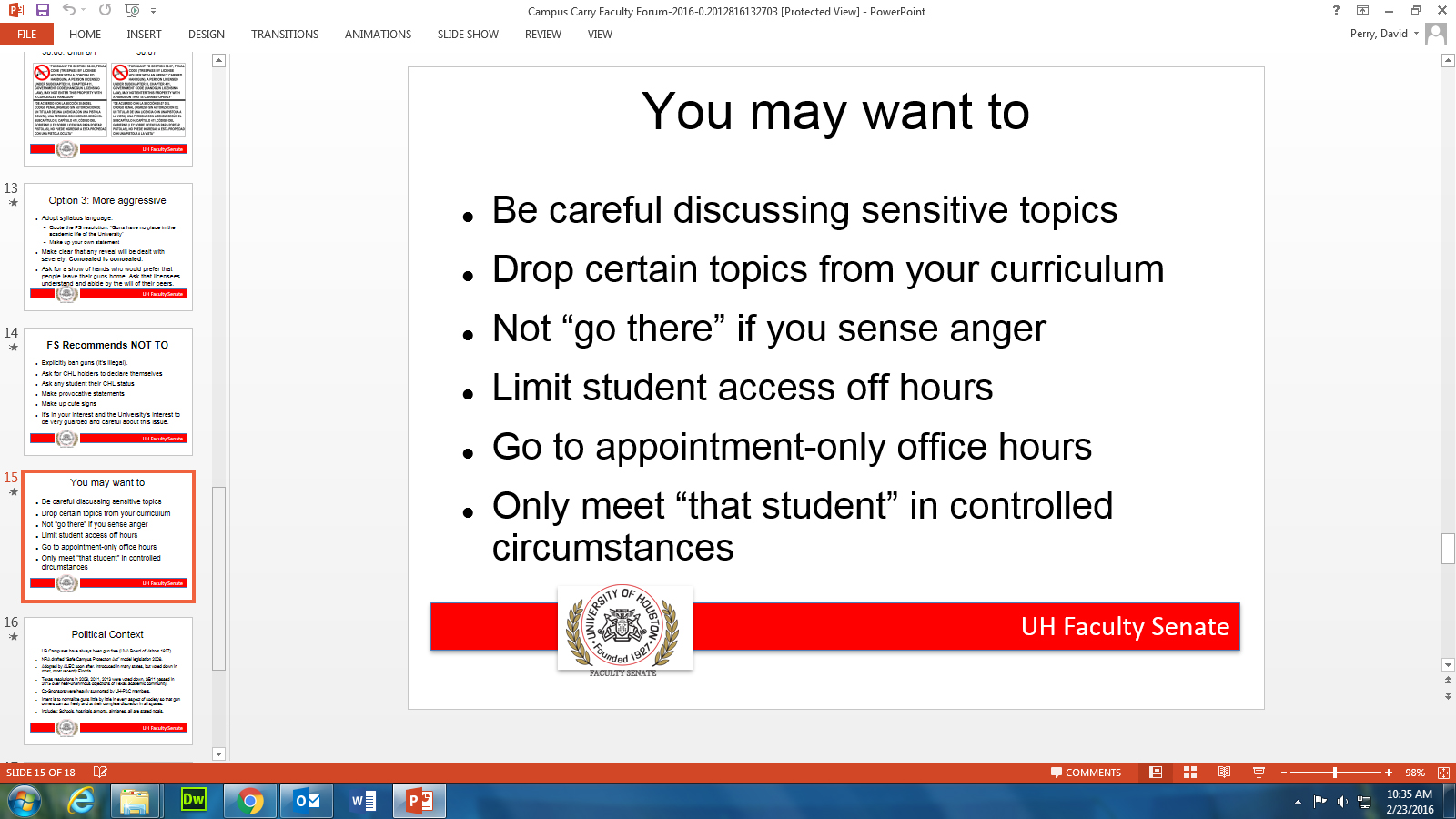
This is from powerpoint slide with a bullet pointed list of advice for faculty members now that University of Houston students can carry concealed firearms. It reads:
"You may want to
(Update for new readers. Hi new readers! Here are some of my writing about Trigger Warnings and PC Culture - I've been writing about trigger warnings, political correctness, and safe space issues for almost two years now (starting with this CNN piece, but extending throughout my blog, including 'trigger warnings are your friends.').
NOTE: Revised for clarity and confirmation of authenticity. 2:00 CST, 2/23
This is from powerpoint slide with a bullet pointed list of advice for faculty members now that University of Houston students can carry concealed firearms. It reads:
"You may want to
- Be careful discussing sensitive topics.
- Drop certain topics from your curriculum
- Not "go there" if you sense anger.
- Limit student access off hours.
- Go to appointment-only office hours
- Only meet 'that student' in controlled circumstances"
UH has confirmed the slide's authenticity. Here's the meeting page with attachments. Download the whole powerpoint. Here's an image:
Original source was this tweet. Bug me, not the tweeter. My sources were unclear why this post and the official slide were different, but I have had it confirmed that the above is the official slide that was shown at the most recent meeting.
 |
| Description:" Red and white slide. Black text. |
Original source was this tweet. Bug me, not the tweeter. My sources were unclear why this post and the official slide were different, but I have had it confirmed that the above is the official slide that was shown at the most recent meeting.
Thursday, December 3, 2015
Gun Violence and #DisabilityTwitter
I'll have a piece later today from CNN on the shooting in San Bernardino, CA. I've written about gun violence for them before.
In the meantime, though, I want to reflect a bit on watching the San Bernardino story unfold. I was sitting in my office working on a white paper on media coverage of police violence and disability (coming soon, with my favorite co-writer), when the news broke of the killing. Soon, we found out that the killing took place at a disability services center, and my personal network of disability rights activists, disabled individuals, parents, caregivers, service providers, and so much more encapsulated by #DisabilityTwitter fell apart emotionally.
We shared pictures, tweets, details, experiences with centers like that, debated whether disabled individuals would or wouldn't be present at the office, and explored the Inland Resource Center's social media feeds. We braced for the worst. We were relieved, if guiltily, when it became clear that the worst wasn't in fact the case.
I saw that on the news. The local ABC affiliate was asking relatives of survivors about their family members, then pushing them to speculate about "mental patients" who might be responsible. We now know, of course, that wasn't the case, and the target was county workers, killed by one of their own, but the stigma was deployed and ready to go.
I'm glad the target wasn't disabled children or service providers, even though that fact makes this act of violence no less tragic. But the violence against people with disabilities is ongoing. We're all too ready to be triggered. It's a learned reaction.
I'm sitting in a small square room, cluttered with books and papers, at the end of a short dead-end corridor. I'm a history professor at a small university, sitting in my office alone, hearing the news that 800 miles away, a Delta State University history professor has been shot and killed in his office. It's all too easy to picture being trapped behind my own desk, unable to escape, to dodge, to do anything but plead.Empathy is a powerful tool, and that will be very much the theme of my piece this morning.
In the meantime, though, I want to reflect a bit on watching the San Bernardino story unfold. I was sitting in my office working on a white paper on media coverage of police violence and disability (coming soon, with my favorite co-writer), when the news broke of the killing. Soon, we found out that the killing took place at a disability services center, and my personal network of disability rights activists, disabled individuals, parents, caregivers, service providers, and so much more encapsulated by #DisabilityTwitter fell apart emotionally.
We shared pictures, tweets, details, experiences with centers like that, debated whether disabled individuals would or wouldn't be present at the office, and explored the Inland Resource Center's social media feeds. We braced for the worst. We were relieved, if guiltily, when it became clear that the worst wasn't in fact the case.
You see, we're ready for someone to target disabled people with violence. We're expecting it. We're expecting it because it's constantly happening, even though most people are unaware. We see, every day, the ways in which disabled people are marginalized, dehumanized, and excluded. We see the violence everywhere - domestic, sexual, carceral, law enforcement, legal, representational, and more. And we know that although disabled people are vastly more likely to be victims of violence than non-disabled people, that the media and politicians are far too likely to treat disability as a threat, to treat mental illness as the cause of gun violence (rather than, say, easy access to firearms), and to stigmatize rather than assist.This was the holiday party /yesterday/ at the site of the #SanBernardino shooting. https://t.co/6sbfIzvMIX— David M. Perry (@Lollardfish) December 2, 2015
I saw that on the news. The local ABC affiliate was asking relatives of survivors about their family members, then pushing them to speculate about "mental patients" who might be responsible. We now know, of course, that wasn't the case, and the target was county workers, killed by one of their own, but the stigma was deployed and ready to go.
I'm glad the target wasn't disabled children or service providers, even though that fact makes this act of violence no less tragic. But the violence against people with disabilities is ongoing. We're all too ready to be triggered. It's a learned reaction.
Wednesday, October 14, 2015
Decouple Gun Violence and Mental Health Conversations (Democratic Debate Edition)
Disability continues to be a largely ignored issue in the presidential primaries except for when it comes to gun violence, when the candidates get things entirely wrong. Here's 100% of what Sanders or Clinton (the only candidates that actually might get nominated) said about disability last night.
I'm delighted to have a candidate advocating for better mental health care - so long as it doesn't involve forced institutionalization or forced medication. But we have to decouple the conversation about mental health from the conversation about gun violence.
Whatever Sanders' intention, his comments reinforce the notion that gun violence is due to mental illness. We've got to push back hard against that. And Sanders supporters, if they want my vote for their candidate, will need to lead the way. Teach your candidate.
SANDERS: Let's begin, Anderson, by understanding that Bernie Sanders has a D-minus voting rating from the NRA. Let's also understand that back in 1988 when I first ran for the United States Congress, way back then, I told the gun owners of the state of Vermont and I told the people of the state of Vermont, a state which has virtually no gun control, that I supported a ban on assault weapons. And over the years, I have strongly avoided instant background checks, doing away with this terrible gun show loophole. And I think we've got to move aggressively at the federal level in dealing with the straw man purchasers.
Also I believe, and I've fought for, to understand that there are thousands of people in this country today who are suicidal, who are homicidal, but can't get the healthcare that they need, the mental healthcare, because they don't have insurance or they're too poor. I believe that everybody in this country who has a mental crisis has got to get mental health counseling immediately.
COOPER: Do you want to shield gun companies from lawsuits?
SANDERS: Of course not. This was a large and complicated bill. There were provisions in it that I think made sense. For example, do I think that a gun shop in the state of Vermont that sells legally a gun to somebody, and that somebody goes out and does something crazy, that that gun shop owner should be held responsible? I don't.Sanders needs to stop stigmatizing mental health. He's learned to speak much better about racial injustice (good job activists. And all my white liberal friends who were complaining that BLM activists were unfairly pressuring him, that's why. So he learns). But this stigmatizing of mental health crisis as causally linked to our gun violence, rather than easy access to firearms, when people with mental health issues are vastly more likely to be victims, has to stop.
On the other hand, where you have manufacturers and where you have gun shops knowingly giving guns to criminals or aiding and abetting that, of course we should take action.
I'm delighted to have a candidate advocating for better mental health care - so long as it doesn't involve forced institutionalization or forced medication. But we have to decouple the conversation about mental health from the conversation about gun violence.
Whatever Sanders' intention, his comments reinforce the notion that gun violence is due to mental illness. We've got to push back hard against that. And Sanders supporters, if they want my vote for their candidate, will need to lead the way. Teach your candidate.
Wednesday, October 7, 2015
The Oregon Shooting and Disability
I am still not handling my emotional reaction to the Oregon shooting very well. I'm also troubled by the efforts to focus on everything but the guns. Of course, with every such instance, there's a rush to stigmatize mental illness and, in this case, developmental disability.
It turns out that his mother was - as reported by the New York Times - active in online forums talking about 1) guns 2) raising a child with Asperger's.
It turns out that his mother was - as reported by the New York Times - active in online forums talking about 1) guns 2) raising a child with Asperger's.
Ms. Harper, who divorced her husband a decade ago, appears to have been by far the most significant figure in her son’s troubled life; neighbors say he rarely left their apartment. Unlike his father, who said on television that he had no idea Mr. Harper-Mercer cared so deeply about guns, his mother was well aware of his fascination. In fact, she shared it: In a series of online postings over a decade, Ms. Harper, a nurse, said she kept numerous firearms in her home and expressed pride in her knowledge about them, as well as in her son’s expertise on the subject.PhotoThe Gun lobby has blamed this killing, so far, on mental illness, autism, loneliness, absent fathers, lack of heroism from the victims, and surely many other things. I'm going to continue to focus on the guns.
She also opened up about her difficulties raising a son who used to bang his head against the wall, and said that both she and her son struggled with Asperger’s syndrome, an autism spectrum disorder. She tried to counsel others whose children faced similar problems. All the while, she expressed hope that her son could lead a successful life in finance or as a filmmaker.
Sunday, October 4, 2015
We Cannot Arm Our Way To Less Gun Violence
 |
Image Description: Me on CNN. Michigan Ave/Chicago River behind me.
David Perry: Associate Professor, Dominican University
Headline: Oregon Massacre, Campus Shooter Kills 9, Wounds 9
|
I'm glad to have had the chance to go on the air and say some of the things I believe. I was originally supposed to be paired with John Lott, a man who believes that more guns equals less crime (they don't). The show decided instead to separate us and so by the time I came on, the host wanted to talk about other things. I had about 90 seconds and said three sentences. I described our upcoming active-shooter drill at Dominican, about which I will write next week. I said that I do not want guns on campus. I said that I do not believe adding more guns in the form of armed civilians will make us safer. Then my segment ended fairly abruptly.
At any rate, 90 seconds is a difficult time to make one's stance perfectly clear. Here are four things I wish I could have said more clearly on CNN.
1. I have no problem with highly-trained law enforcement positioned appropriately near campuses. Some universities are basically cities unto themselves, so they likely need their own armed police. My small suburban campus needs to coordinate its security with our small suburban police, the tactical units assigned to our area, and other highly-trained law enforcement officers.
2. I do not believe that allowing civilians, whether teachers, staff, faculty, or just random visitors, to carry arms on our campus is the right response. First, college campuses are sacred spaces to me, and I do not want to see them further profaned by these weapons of murder. More importantly, though, we cannot arm our way out of this crisis. If we turn every school into a fortress, mass shootings will move to the malls. Arm the malls, killers will go the churches. Arm the churches, then it will be little league games. We can take appropriate measures to defend against copycat killers, but cannot stop gun violence by reacting to the specifics of the last attack.
3. Around the world, there are people who are angry and potentially violent. People hate other people. People get personally slighted. People have mental health breakdowns (though people with mental illness are vastly more likely to be victims than perpetrators of violence). It's only in America that these individuals are likely to react to their anger by using a firearm to commit an act of mass murder.
4. The only solution is to find ways to make access to firearms more difficult for people in those moments. There are simple steps - ban assault weapons, close gun show loopholes, expand background checks and waiting periods, share information across state lines, slow down the ability to purchase lots of handguns at once (used to buy from suburban gun shops and bring to illegal urban markets), and remove the Congressional ban on government-sponsored research on gun violence. None of these steps will restrict the ability of Americans to acquire firearms to hunt, for home defense, or even for conceal-carry purposes. But it will slow the flow, and that's what we need right now.
We cannot arm our way out of this crisis.
Some resources on gun violence. Whitehouse.gov on gun violence.
Subscribe to:
Posts (Atom)