Last Tuesday, CNN published an essay of mine that took the occasion of Kanye West's bad behavior, in which he demanded fans prove their disabilities, to talk about the way that this happens to people with disabilities all the time.
Response was mostly very positive, but I always pay attention to criticisms, even though I don't let them wound me. The two interesting ones were:
1) I was letting West off the hook for his ableism. I wasn't, and most people saw the clear condemnation of his actions in the essay, but I could have said a more clear KANYE WEST WAS BEING BAD clause, I guess to make it more obvious to casual readers. That's actually a good note for me as a writer - never assume a point is too obvious.
2) The second criticism basically agreed that West was a bad man, and that people with disabilities have it rough, but then try to shield themselves from my criticism of their suspicion and doubt. They say - and I had roughly 25 of these comments and emails and tweets - there's so much fraud! What can we do but doubt? (and no doubt more in the 1300 CNN comments, but I have not read those carefully, as there's so much noise it's hard to find signal there).
To this, I point to the many more people who took time to write about their experience with disability and the way that the suspicions affect them. I'm going to quote two emails, identifying marks removed, with permission of the senders. And then offer a few more comments at the end.
Email 1: Criticism. I have bolded a paragraph I find interesting.
Dear Dr. Perry,
I read your essay on CNN’s website, "Kanye West and proving your disabilities.” So many of your comments were spot on, but you failed to mention at least one motive for why people want to see proof of disability: that many people are abusing the system. Those of us who have to cope with genuine disability issues resent the abuse. In my opinion, the number of people who are abusing the system is growing.
My mother is 85 years old, has Alzheimer’s disease, depends on a walker for balance, and cannot walk far. She has had several accidental falls. We carry a handicap hang tag in our car for the times when she is with us. My mother loves to go out on errands with me. It is a marvelous treat for her to leave her “Reminiscence” residence and spend time together. I take her out when I can (about once a week), even though her mobility problems, cognitive impairment, and incontinence slow me down a lot. It is my gift to her. My wife’s 89 year old father is also disabled with arthritis and gout. He uses a walker and sometimes must resort to a scooter/wheelchair. We use the hang tag when he is with us. We do not use the hang tag unless my mother or father-in-law is with us.
All too often when we arrive at a destination, EVERY handicapped parking space is occupied. All too often, I see people who appear to be abusing the handicapped parking spaces. I am not so callous that I do not give them the benefit of the doubt. I do not glare or stare or judge or express disapproval. You are right, there is no way to know for sure.
Nevertheless, I have seen many people who are unquestionably abusing the system. They do not have invisible disabilities. I am not a doctor. Obviously I do not have access to their specific diagnoses. I do have basic common sense. I have seen young mothers swinging and tossing their children as they all skip to their cars in the handicap slots. Trust me, none of them were disabled, invisible or otherwise. I have friends who have worked as insurance investigators. They have told me about cases where they photographed “disabled victims” doing decidedly non-disabled activities. I can cite other examples, but you get the idea.
In my opinion, there are two types of abuse:
1. PEOPLE RECEIVE DISABILITY ACCOMMODATIONS WHEN THEY DO NOT REQUIRE THEM
I recognize that our populace is aging. Furthermore, a growing percentage faces worsening health issues, some of them due to poor lifestyle choices. Both are contributing to an increase in the number of individuals who genuinely need and qualify for disability accommodations. The growing numbers of the genuinely disabled are a contributing factor to the declining availability of accommodations, such as handicapped parking. With that understanding, I also believe that more people than ever before have recognized the advantages of disability accommodations and found ways to game the system in order to qualify and use them even though they do not require them.
2. PEOPLE ABUSE THE DISABILITY ACCOMMODATIONS OF OTHERS
Normal, healthy people abuse the handicap hang tag that belongs to a parent or other disabled person. I believe that the number of people who do this is also growing.
CAVEATS:
I am not an expert in the field. The basis for what I have written is my personal observations and the observations of those whom I trust. I cannot cite specific data or research, but I believe that a well-run scientific study would confirm my assertions.
SUMMARY:
I believe that many people are abusing disability accommodations. I feel frustrated and angry about it because of the direct impact it has on my mother and father-in-law. I recognize that many people have invisible disabilities that are not readily apparent, but I also believe that I have seen numerous examples of abusers, too.
Those with invisible, latent disabilities have a right to feel oppressed and angry at those who would judge them and their situation. Your essay provides good examples of why we must avoid judgement or expect proofs of disabilities. I hope that those who have invisible disabilities share my frustration and anger at the people who abuse the system, for those disabled individuals must also deal with similar lack-of-available-accommodation situations.
Sincerely yours...
So there we have it. One of the interesting things about this is that it opens with a discussion of fraud, but quickly turning to the thing we all focus on most: handicapped (or rather accessible) parking. I'd like you to notice that paragraph I bolded. It starts with "unquestionable," but then says, "I believe..." He perceives
, he trusts his perceptions, and he judges. This is just one of the reasons I work so hard on how we portral/represent disability in our culture. People think they know what disabled looks like, but they have no idea. People think they know what "disabled activities" look like, what disabled people can do. So let me set you straight - disabled people, as a group, can do everything. Some can do some things. Some can do other things. Some can do some things some of the time, other things none of the time, and all things most of the time.
The author and I had a highly productive email exchange in which I talked about the ways in which our perceptions deceive us and ended on a good, open-minded note. I like this emailer and hope he's reading this blog (he said he'd check in). But rather than let me go on, here's email #2:
Dr. Perry,
Thank you for writing about those that have physical issues that can't be seen.
I suffer from pulmonary fibrosis, my lungs are so scarred that breathing is pretty difficult when I'm in motion. I also have polymyositis and my muscles weaken pretty fast when I use them for anything. Up until about 5 years ago I did triathlons and was in terrific shape. Fortunately that is one of the major reasons that I am still alive today - that I conditioned my muscles and lungs so well. The problem though is that I look to be in top notch shape but my insides aren't worth a cuss!
When I go to public places and am unable to find parking relatively close, I park in the handicap space. I've had a handicap permit for two years now. There have been times when I get out of the car and people give me the meanest looks. Just last week a lady approached me, she was so angry that she was practically spitting when she spoke to me. After I pulled out my iPhone, showed her my medical info with all of my conditions, the meds that I take, the team of doctors that take care of me and all the procedures that I've had, she was in tears. She was a nurse and knew very well how debilitating my condition could be. Also as I talked with her it became very apparent that my breathing was becoming very labored - at rest I get that way when I'm stressed and talking long. Anyway, she thanked me for teaching her a valuable lesson.
My son plays for the COLLEGE SPORTS TEAM REDACTED. Just this past weekend I attended the game, had to park far from the stadium. A golf cart drove by, with handicap sign on it for those that needed a ride. I put my hand out to signify that I needed them to stop for me, twice the people driving said no, wouldn't even listen to my explanation. The third guy stopped because I stood in his path. I explained my condition, he begrudgingly let me ride but made it very apparent that he didn't believe me and was pissed that I was even in his cart.
I hope many read your column and think twice about judging those that look to be perfectly fine because they may very well have life threatening issues like I do.
Well thanks for letting me vent in the middle of the night - can't sleep because of incredible pain from all of my medical issues. I will be forwarding you column to my friends, who understand but hopefully they'll share with others that are not sensitized to this issue.
So here we have someone who had to prove her medical condition to a total stranger in a parking lots. This is the quotidian version of the Kanye concert.
In my comments, in my email, I have dozens of these comments, these stories, in which a challenging medical situation becomes harder because of our suspicion and doubt, because even a smart nurse educated in disability issues still feels the right to demand a diagnosis in the parking lot. Not even the right - that nurse with her medical knowledge felt a
duty to question, to challenge, to force proof.
I offer three conclusions.
1.
Disability is not a binary, it's not a yes/no, disabled/abled. Disability takes place along a spectrum, or rather multiple spectra, as we move in and out of disability over our lives or even over the course of a day.
Read more on this here.
2. There is fraud. There will always be fraud.
The question is how much fraud are you willing to tolerate in order to make sure people get the accommodations that they need? In the context of situations like social security, we have procedures in place designed to make it hard to get qualified. People do cheat the system, but there's lots of evidence that people with hidden disabilities actually have a hard time qualifying, even if they need it.
Any system doling out benefits will have fraud. It's just a question of how much do we tolerate.
3. As for parking.
Reader 1 is angry because it's a scarcity model. There are only a few parking spots, his mother and father-in-law sometimes can't use a spot, and that makes him mad. It intensifies his suspicion. Instead, we need more spots, more accessible parking, more golf carts for rides, more universal design. The scarcity model causes problems.
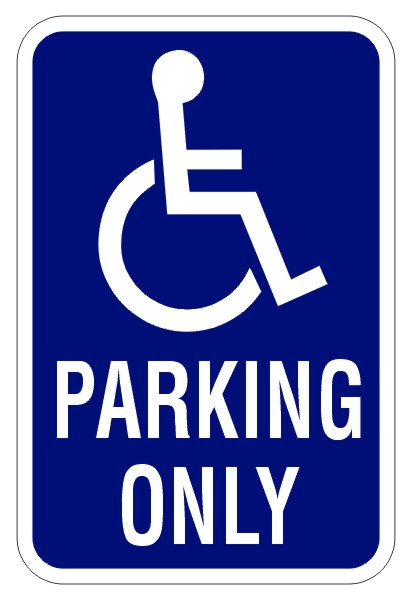
Also, I think, the symbol causes problems. We have formed a link in our minds between the
wheelchair and the
parking spot. Even Kanye West said, in his definition of disability, "Unless you got a handicap pass and you get special parking and s**t." The wheelchair, the parking pass with the wheelchair on it, these are the symbols of disability in our minds. That's a problem of representation too.