Showing posts with label transphobia. Show all posts

Thursday, May 19, 2016

Transphobia and the Middle Ages

Every year, Western Michigan University, in Kalamazoo, hosts about 3000 medievalists for a giant, sprawling, conference that I call MedievalCon. It has its significant academic context, but it's also embraced seriously fannish elements (or had them thrust upon it).

On Saturday nights, there's a panel hosted by the "Pseudosociety," in which academics deliver humorous satirical papers on invented manuscripts or whatever. Honestly, I don't know. I've been to one paper and it involved some nice elderly Irish lady making fun of "student howlers," or errors students write on their exams, and I've never really been into that kind of humor. Instead, I tend to plan a very nice dinner with friends.

This year, alas, Pseudosociety hosted two papers that were transphobic. I don't have details. I am not interested in parsing intent or whether they were really transphobic (on a listserv, a far-right-wing former prof of mine tried to make snide comments about Greek origins and changing the meaning of the word "phobia." A smart person responded, "Really, what did your Greek teacher say about xenophobia," and the far-right-wing former prof stopped talking).

What I can offer is this: An essay by MW Bychowski: "Genres of Embodiment: A Theory of Medieval Transgender Literature."

The Intro:
I am speechless. I have lost my power to speak. Last night not one but two papers were given with hate speech, transgender slurs, that use transgender to belittle medieval castrates and medieval castrates to belittle transgender. Already the next morning, the debates begin: hate speech v. free speech, ignorance v. consequence, a sense of justice v. a sense of humor. The effect of making us funny is that we are not taken seriously, we are not listened to when we speak, and we can't tell our stories. These attacks have power because they do not occur in a vacuum. Their words take force and meaning because of medievalists who believe that gender variant people don’t belong in medieval studies. Their words take on the force and meaning of laws barring trans persons from public bathrooms; a necessity to learn, teach or attend conferences. Their words take on the force and meaning of those giving women pepper-spray to use against trans people, threatening to beat us, and planting ideas in the head of a 16 year old who recently shot a local trans woman. People have asked me to say something about this. I know they want me to make sense of this; to find some way to make things better.

Now, I am speechless and I have no pardons to give; yet I come to this congress on medieval studies because my conscience leaves me no other choice. I come here because 48% of transgender women attempt suicide, because last year doubled the average number of transgender homicides, because parents bury them in clothes and names that contradict their gender identity, erasing all trace of their transgender lives. I sit with my countless dead trans friends and family looking for something to say but I have no words. So I listen. I listen to graves, the ruins of past trans lives, as they whisper to each other. They speak in many tongues from many places and many times. I hope if I learn to understand the dead and discarded trans lives that they might teach me words to say and stories to tell. I come to medieval studies because it is here that we learn to speak the language of the dead from the dead themselves. I come to medieval literature and history because we need their trans stories to make meaning out of our deaths and silences.
From there, MW dives into medieval literature, focusing on the Pardoner, first, then expanding to more general theories of medieval transgender literature and why it matters. She concludes:
Conflict is intrinsic to narrative and embodiment. It is not an over-reaction for a transgender medievalist to see the larger war and dangerous threats implicit in what may be pardoned as playful jabs. Yet the power of our oppressors can be used against them and our vulnerability can work for us. By silencing us so publicly, you are drawing others to hear our stories. By sending more of us to our early graves, you are adding to the cacophony of ghosts whispering in the machines of our destruction. By deconstructing our bodies, you reveal the maps for reconstruction written in our scars and sinews. Conflict comes with cost and we are paying it in the lives and stories of our transgender family. But one day that bill will have to be paid. For once we learn to listen to the transgender stories of the dead, each seemingly silent gravestone and medieval text will come alive with the call for justice.

Thursday, April 21, 2016

The Revictimization of a Transgender, Disabled, Immigrant: Oppressions Intersect

Content Note: Rape, Abuse, Violence

Intersectionality is often used in very positive ways - to affirm multiple identities, to demand voice for the multiply marginalized, and so forth. This is valid and vital, but I read the source material (Crenshaw's work) as saying something less pleasant. To me, the core message of intersectionality is that oppressive forces intersect, endangering people whose identity incorporates multiply marginalized categories.

Today, Tina Vasquez (writing for Rewire) has a piece on a disabled, trans, immigrant and the many ways her rights have been disregarded. As always, please read the whole piece.

The story discusses M, who has mental health issues, cognitive disabilities, and a seizure disorder. She is the survivor of trauma. She is transgender. She is, of course, an immigrant. She is (I assume) not white.

She's done everything right, but the system has failed her. Some quotes:
While there, Ramos said M was subjected to verbal abuse from officers who mocked her transgender identity, with one officer passing her cell and saying, “What’s the story with this one,” according to M’s attorney. Eventually, M was transferred to Immigration and Customs Enforcement (ICE) custody at San Diego’s Otay Mesa Detention Center, where M says the trauma continued, explained Ramos.
M was held in a cell with men for 12 hours as she was processed into Otay Mesa, with one detainee staring at her aggressively for the entire 12 hours, according to her attorney. After processing, M was placed in medical isolation for reasons Ramos said she could not share out of respect for M’s privacy. Later, M was brought into the shower area with men. Though she was given her own private stall, male detainees showered nearby, Ramos said.
“She began experiencing flashbacks and felt like she was going to be raped again,” Ramos said. “She felt helpless because the officers were not taking her concerns seriously. It was incredibly traumatizing.”
And:
Ebadolahi told Rewire current U.S. immigration policies only subject traumatized, vulnerable asylum seekers to more trauma—and M is one of the more “fortunate” ones. After successfully passing her credible fear interview, M was released from detention on April 11.
“We’re talking about a transgender woman who is a survivor of multiple rapes, who has post-traumatic stress disorder, who has disabilities, including a seizure disorder, who has gone through a lifetime of hurt, and for who the simple act of appearing at the port of entry and applying for asylum took an enormous effort—and despite all of these things, she is considered one of the fortunate ones because she has a pro-bono lawyer working on her behalf,” Ebadolahi said.
“How M and her attorney were treated at the port of entry and … in detention, is unconstitutional, unethical, and outrageous. We shouldn’t tolerate it. This treatment serves absolutely no legitimate, government purpose and only serves to further traumatize and marginalize very vulnerable people. No one should be subject to this kind of abuse. This has to stop.”
Our system to protect asylum seekers only magnifies trauma. We need to do better.


Monday, September 29, 2014

Transphobia and Miscegenation - Won't Somebody Think of the (Cis-gendered) Children

My first ever op-ed was published in the Minneapolis/ St. Paul Star Tribune. It was in 2006 and on the use of medieval rhetoric to talk about modern problems in the Middle East, a situation that continues today.

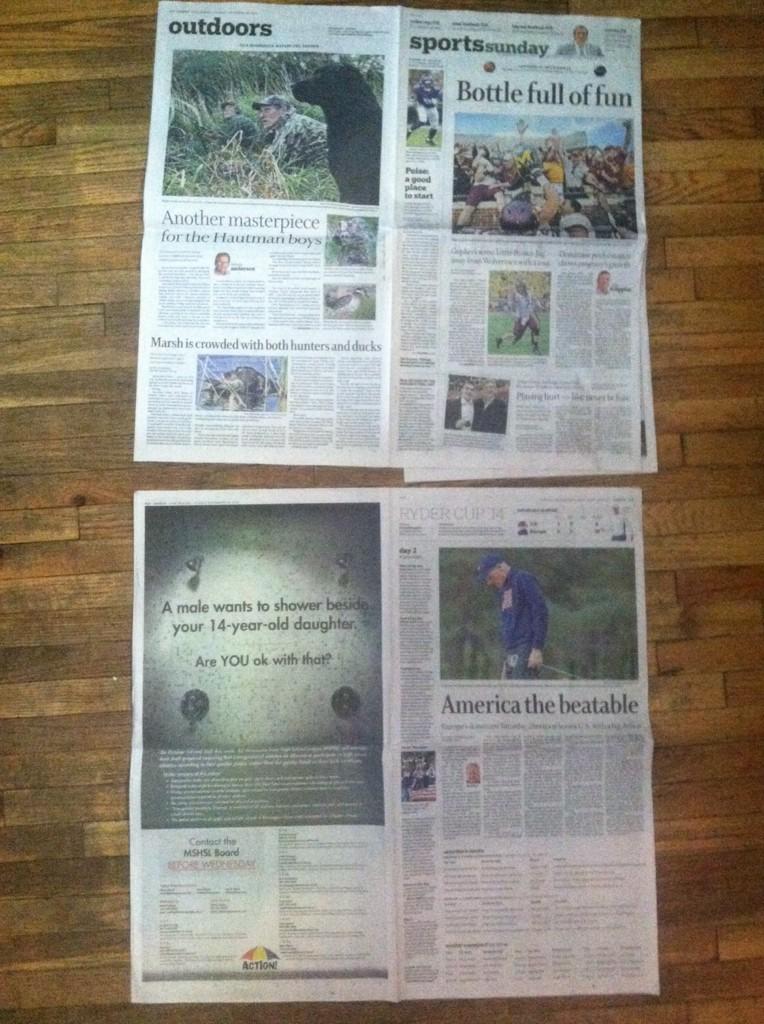
Over the weekend, the Star Tribune published this full-page ad raising the worst kind of fear-mongering about transgendered children. It says:

"A male wants to shower beside your 14-year-old daughter.
Are YOU ok with that?

So, that's pretty hateful. The context is that the MN high-school sports league is considering passing a transgender inclusion policy, and good for them for doing so. Of course, any attempt to take a step forward like this is immediately met with bigotry.

Here's a few points. 

1) Nowhere does the full-page say "paid advertisement." That seems unethical. In fact, it seems like they went out of their way to re-format the sports page to fit the ad, as shown here.


2) More importantly, while I understand that newspapers are broke, the decision to run this kind of bigotry - patriarchal (protect the daughter!) as well as transphobic - speaks poorly of the newspaper. The ad reminds me of this:


Or perhaps this


Or any number of other anti-miscegenation propaganda, as stored here on this excellent archive.

It's long been observed that the anti-gay-marriage arguments mirror the anti-interracial arguments almost exactly (fun site: Can you tell whether these quotes are anti-gay or anti-interracial marriage?). 

So congrats, Star Tribune, someday you too may be featured in an archive of bigotry so that we can look back and shake our heads and feel vaguely smugly superior to our ancestors. 

Or, perhaps you could decide not to publish transphobic, patriarchal, fear-mongering, hate speech.