Showing posts with label medieval. Show all posts

Thursday, October 26, 2017

"Medieval" Madagascar

"Medieval" Madagascar: Plague and Inequality 

The Current Outbreak of Plague isn't a Throwback, But a Sign of Modern World 

A guest post by Monica H. Green. 
Dr. Green is Professor of History at Arizona State University. 
Follow her on Twitter @monicaMedHist 

I see dead people. That’s my job. I’m a historian.

But in the past five years, I have seen many millions more dead people than I ever thought I would as a historian of medicine. In the past five years, I have had the experience of slowly realizing that the Black Death—the massive outbreak of plague that struck in the middle of the 14th century—likely affected many millions more people than we ever imagined in our wildest nightmares.

In most of the maps we see when we study this period of history, in most of the texts we read, we are usually taught to think of the Black Death as a pandemic that struck only the Mediterranean and Europe. We teach the Black Death through the stories of Boccaccio, telling us of social breakdown from the perspective of elite Florentines who could afford to escape the city, leaving others to their fate. We learn of the Black Death from manorial records in England, which show tenant after tenant having to pay the heriot, a kind of death tax, in order to inherit land from their deceased relatives. We cringe with horror listening to Ibn al-Wardi, writing from Aleppo, recount the terrifying progression of the plague across the Middle East and into North Africa.

But what we haven’t seen or heard, what we haven’t previously perceived, are the many millions of people beyond the Mediterranean who may have also been struck by the disease. Geneticists now talk of a “Big Bang” in plague’s history, a sudden branching out, an explosive expansion of the causative organism of plague, Yersinia pestis, sometime in the late 13th or early 14th century. This expansion of plague created four new branches in plague’s evolutionary tree. One “branch” went westward, reaching the Black Sea and then the Mediterranean. Two branches likely stayed fairly local in central Eurasia, and may have affected wild animal populations more than humans.

Minimum spanning phylogenetic tree of 133 Y. pestis genomes, with major historical events marked. From Y. Cui et al. 2013, fig. 1A, with additions by M. H. Green. Reproduced with permission.
But the fourth branch spread out just as widely as the first. Strains called by scientists 2.MED and 2.ANT can now be found across almost all of Eurasia, from Jilin Province in northeast China to Turkey and even Algeria, from Russia and Mongolia to Tibet and India. Perhaps as much as two-thirds of Eurasia, and maybe even major parts of Africa, were affected by this pandemic, which spawned continuing outbreaks for centuries.

How do we know this? Because strains of plague initially created in the 14th century still exist in the world today. The evolutionary history that I have just given has been made possible by the fact that this organism still persists on four of the five inhabited continents of the world. Plague outbreaks are not a routine experience for most of us today, but that is not because we ever “conquered” the disease. Plague has never been eradicated, and it won’t be. Rather, we have established an uneasy détente with the organism. We know where it lives, we know how it behaves. And we watch it. Closely.

And that’s why those of us who know plague are watching the situation currently unfolding in Madagascar with increasing alarm. The current toll of 1192 cases and 124 deaths already makes this one of the largest outbreaks in years. Equally alarming is the fact that, of the 22 administrative districts in Madagascar, 14—two-thirds—are reporting cases. This is a plague outbreak out of control.

Why is Madagascar suffering from this “medieval” disease? Because it’s part of the modern world. I live in “medieval” Arizona, a state—like most of the American West—where plague has also insinuated its way into the wild rodent population. Plague arrived in Madagascar and the American Pacific coast about the same time, around 1900, and for the same reason: it was being transported all over the world in the holds of steamships coming out of Hong Kong’s harbor. In both Madagascar and America, it spread inland, finding new hosts and taking up permanent residence.

Plague has changed very little in the past 700 years. It hasn’t had to. We control plague nowadays by using insecticides to get rid of the fleas that transmit the disease from host to host and by controlling rodent infestations. But plague never went away. Only our daily awareness of it did.

What is happening in Madagascar shouldn’t be happening. We know how to monitor this terrifying disease and we know how to control it. We know that a standard arsenal of antibiotics can halt an infection, if it is given very quickly after exposure. We also know that, if not controlled, plague has one of the highest mortality rates of any disease in history.

What we have not yet learned is a lesson the microbial world has been trying to teach us since the 14th century: we’re all connected. Madagascar is suffering now not because it is trapped in its medieval past. Madagascar was indeed connected to a larger world in the Middle Ages, but we have no evidence that plague reached it then. Rather, Madagascar is suffering from plague now because of its connections to the modern global economy. The mining, the textile production, even the very vanilla we use everyday has made Madagascar part of this global economy.

I see dead people in the past. And I cannot save them except by recovering their stories. The people of present-day Madagascar, however, are not beyond our reach. Or beyond our responsibility. We are all connected.

Thursday, February 23, 2017

There's Nothing Medieval about Trump

Columnists keep wanting to distance us moderns from Trump, but he's as modern as it gets. 

GUEST POST by Eric Weiskott

In an interview for The Guardian last week, philosopher Daniel Dennett was asked whether “deep thinking” is what’s needed in the current political climate. He responded:

Yes. From everybody. The real danger that’s facing us is we’ve lost respect for truth and facts. People have discovered that it’s much easier to destroy reputations for credibility than it is to maintain them. It doesn’t matter how good your facts are, somebody else can spread the rumour that you’re fake news. We’re entering a period of epistemological murk and uncertainty that we’ve not experienced since the middle ages.

These are the words of someone totally unacquainted with the Middle Ages. It’s not just that the picture of the medieval period as an endless cycle of ignorance and repression is wrong (it is), but the picture itself is a modern one. It’s an effect of the Enlightenment and secularization, which retrospectively created premodernity. Ironically, by describing American politics as a regression to a medieval past, Dennett is reifying the very ideology that created ‘the Middle Ages’ in the first place. There’s no there there—no real confrontation with the past and no meaningful comparison.

Dennett isn’t alone. Lou Mastriani writes for NorthJersey.com that “Donald Trump has taken us back to medieval times.” David Brooks thinks the Trump administration “is more like a medieval monarchy than a modern nation-state. It’s more ‘The Madness of King George’ than ‘The Missiles of October.’” (Note: George III reigned in the nineteenth century!) Katty Kay opines for the BBC that Trump’s White House “acts like some medieval court.” Louis René Beres at Arutz Sheva, describing Trump’s presidency as “forged in an atmosphere of determined unreason and anti-thought,” identifies it with the prediction of what he terms “resurrected medieval darkness” in W. B. Yeats’s poem “The Second Coming.” And this is just from the past week.

These statements are historically ignorant. They’re also a window onto modern liberal subjects’ sense of the world. 

The real payoff of assigning current politics to the distant past is to protect the notion of a just society, ruled by reason. The notion of a society ruled by reason stands in need of protecting because, well, it keeps bumping up against reality. Indeed, this notion has always been a fantasy, a way of papering over the violence and imperialism of modernity.

You don’t get Hume without the transatlantic slave trade. You don’t get Kant without the Holocaust. The just and rational world projected by Enlightenment philosophers turned out to be a space of whiteness called “Europe,” cloaked in universalism. Enlightenment has winners and losers across the world in 2017.

None of this is to say that the various ideas and practices we now call the Enlightenment were a bad thing. Historicism teaches us that transhistorical judgments are problematic, in any case, since there exists no position outside history from which to judge. The crucial point is that the Enlightenment inculcated new forms of hegemony even as it promised new forms of liberation. If you are sure enlightenment has been good to you, that is because you live in the historical alleyways opened up by enlightenment. You are the product of enlightenment and its beneficiary. One of the minor exports of Enlightenment thought was the idea of the Middle Ages, the negative mirror image of secularist modernity.
A quote in black and white: If you are sure enlightenment has been good to you, that is because you live in the historical alleyways opened up by enlightenment

So when Dennett makes an offhand reference to “the middle ages,” all that historical baggage is packed in yet goes unacknowledged. He means, approximately, ‘a period of epistemological murk and uncertainty that we’ve not experienced since what I imagine my rationalist, secularist self would feel in the Middle Ages.’ So stated, the sentiment is obviously devoid of historical content. Ultimately, Dennett’s appeal is an appeal to whiteness, scientism, secularism, and related ideological formations. Any of my colleagues in medieval studies will recognize this rhetorical move. It’s the same move that made Anglo-Saxons and West Africans appear primitive to nineteenth-century white Europeans. (Notice how modernity transects both space and time.) Medievalists have learned to disarm this line of reasoning by asking, “‘Primitive’ to whom? On what grounds? For whose benefit? At whose expense?” The idea that Trump is making America medieval again deserves to be greeted with the same skepticism, and for the same reason.

Dennett’s historical attitude is bound up with his own reflexive disdain for religious belief and religious institutions, a habit of thought characteristic of secularist modernity. (Every medievalist has been asked by a friend or family member, “How can you study such a religious period?”) Tellingly, Dennett remarks that “the rise of theocracy in America” is one of the few threats that can spur him to political activism. He admits to resenting politics in general, because “I simply must take time out from what I’d really like to be doing to think about the political near future.” Needless to say, the luxury of escaping politics is only afforded to those with substantial privilege and security. Dennett’s comments on organized religion suggest what’s at stake for him when he does choose to drop the pretense that his work is apolitical. Like Stephen Greenblatt, Dennett is invested in anti-religious polemic, in vindicating secularization as absolute social progress.

Like racial slavery, the scientific method, ISIS, the automobile, and phenomenology, Trumpism is an irreducibly modern response to modern conditions. Trump isn’t taking us back to the Middle Ages because history only points in one direction. We can learn much from the violence of the past, but not by wishing away the violence of the present.

Eric Weiskott teaches medieval English poetry at Boston College; he's working on a book about the division of the past into medieval and modern periods.

Monday, November 28, 2016

Who Knows Anything? - Journalism, Caesarean Section, and the Production of Knowledge

The New York Times ran a story about an amazing c-section survival in 1337. But historians of medieval medicine don't think it happened. 

By Monica H. Green

On Wednesday, 23 November 2016—the day before the Thanksgiving holiday in the U.S.—the New York Times ran what it likely assumed to be a “fun fact” story, a minor historical discovery on a slow news day. Under the category, “What in the World” and headlined “A Breakthrough in C-Section History: Beatrice of Bourbon’s Survival in 1337,” the Times piece recounted how Czech researchers had found “an apparent case” of a Caesarean section performed on the recently married, 19-year-old medieval queen of Bohemia.
Pullquote:  In our heightened debates about “Fake News,” we should give more thought to how “knowledge” (“unfake news”) is produced and disseminated.

The piece would likely have quickly become ephemera had it not been picked up by Twitter. There, the case of Beatrice reached the attention of historians specializing in medieval women’s history and medieval medical history. It immediately provoked skepticism.

In our heightened debates about “Fake News,” we should give more thought to how “knowledge” (“unfake news”) is produced and disseminated. In this case, the curtain that needs to be pulled back is the process of peer review.

To the historian of medicine, the study bears all the pitfalls of amateurish oversight. It takes no account of the past thirty years of scholarly literature in either the history of medieval obstetrics (or women’s history more broadly), nor the history of medieval surgery or anesthesia. Peer review by historians of medieval medicine would have quickly identified these problems. It seems, however, that the piece was only refereed by physicians.

What is peer review?


Peer review involves works being sent out, before publication, to other scholars who work on similar questions to the item under review. They assess the piece in terms of its coverage of the existing literature in a field, the originality of its question, and the rigor of its methods. Based on those criteria, publication (or not) is recommended.

But who are “peers”? In the case of medical history, that is a major issue. Are peers physicians who have been trained in modern medicine, who have treated living patients, excised real tumors, autopsied fresh cadavers? Or are they historians who have been trained in the languages, cultures, archives, and traditions of the past? Researchers who have both MDs and PhDs exist, but are rare. The authors of the Czech C-section study self-identify as a physician, a member of the philosophy faculty, and a historian, all at the Charles University in Prague: an impressive interdisciplinary team. The reviewing process should have involved scholars with a similar range of competence.

Pullquote: just as “local knowledge” is needed to interpret the nuances of language and culturally coded behaviors, so local academic knowledge is needed to explain how published work is generated in different professional fields.
The argument of the study hangs on the slimmest thread of evidence, the meaning of the Latin word incolumitate in two versions of a letter sent out under the queen’s name after the birth. Incolumis, according to the Latin dictionary commonly known by its authors’ names, Lewis and Short, means simply “unimpaired, uninjured, in good condition, still alive, safe, sound, entire, whole.” Its medieval usage is comparable. Yet from that single word, and from other accounts written a century or more after the said birth (leaving plenty of time for a private event to have mushroomed into legend), the authors deduce that the queen must have undergone a C-section. Since she clearly survived, the “operation” must have been successful.

There are legitimate grounds to debate the linguistic weight of the word incolumitate, and legitimate grounds to debate the political context in which this still uncrowned queen had to assert her right to the consort’s throne. There are also medical grounds to question the interpretation. Could not incolumitas here mean, for example, that Beatrice, still a teenager, had survived the birth without the crippling damage that obstetric fistula is known to visit upon girls being forced to bear children too young? Unfortunately, neither this scenario, nor many other possible obstetrical outcomes, all of which are well-known from medieval records, are assessed here.

National pride and international spin

The study appeared earlier this year in the national Czech journal of gynecology, meant, apparently, to provide an interesting reflection on national history to the country’s obstetrical specialists.[1] For its original audience, its speculations about the nation’s medieval history were no doubt fascinating. Once its message was amplified internationally by the New York Times, however, it suddenly became “a breakthrough,” a major scientific discovery. Antonin Parizek (“a noted obstetrician and expert on medical history,” according to the Times, and the study’s lead author), seems to be the only person interviewed for the news story. The unsubstantiated interpretation of incolumitate now becomes a fact of history: “Beatrice most likely passed out during delivery,” Parizek is quoted as saying, “and was believed dead … The surgeons opened her only to save and baptize the child. The pain from the operation then likely led to her awakening.”

In short, this is fiction. But, presented as “fact” by the New York Times, it becomes accepted as truth by a world-wide audience. The word “apparent” is the only qualifier given, and other statements—such as the reference to “other archival sources” without clarification that they postdate the birth by anywhere from one to five centuries—mislead the reader.

As noted above, the New York Times piece appears in a section of the newspaper called “What in the World.” This section is meant to circulate news stories coming from other national news outlets, and this one may have been picked up from Czech media. That is certainly a worthy, and indeed, necessary goal in our globalized world. But just as “local knowledge” is needed to interpret the nuances of language and culturally coded behaviors, so local academic knowledge is needed to explain how published work is generated in different professional fields.

The New York Times has given us a prime example of how fake news is generated. In this case, the news is not “fake.” The Czech study really was published. But the implication that it reflected any kind of consensus on what historians believe about women’s medical history was absolutely false.

“What in the world,” indeed.

---
Monica H. Green is a historian of medicine and global health. A professor of History at Arizona State University, she has published extensively on the history of medieval women’s healthcare, including her award-winning book, Making Women’s Medicine Masculine: The Rise of Male Authority in Pre-Modern Gynaecology (Oxford University Press, 2008). Many of her works, including her comprehensive bibliography on women and medicine in the Middle Ages, can be found on her Academia.edu page.

[1] Thanks to Roberto Labanti for this reference. Thanks as well to Maaike van der Lugt, Katharine Park, and Fernando Dias de Avila Pires for helpful comments.

Monday, November 21, 2016

Stop Saying Crusade (Psst: He's talking to us medievalists too)

Medieval history professor Matthew Gabriele, of Virginia Tech, has published a powerful new article about the word "crusade" in both its modern and medieval contexts. He's arguing not just that modern people mis-use Crusade, which they do (he digs into the famous W. Bush quote about a 'Crusade against Evil'), but that medievalists need to stop doing it as well. Gabriele is an expert on nostalgia, in particular, in medieval historical and apocalyptic writing (and of course apocalypse is just history that hasn't happened yet) and has often written about the ways in which nostalgia for an imagined past inform contemporary political discourse. Here, though, he breaks new ground (to me) by looking at the religious discourse surrounding the Virginia Tech killer's writing.

What's interesting about Gabriele's argument here is the way he focuses on the uselessness of "Crusade" in describing any actual medieval phenomenon, not just the more usual critique (which I've often made) about moderns appropriating the word in all kinds of ways. At the end, he concludes:
Is ‘crusade’ useful to us, the namers? I’m beginning to think that it isn’t. It has become a word that carries its baggage invisibly, a multivalent symbol that obscures rather than clarifies, that stands as a cipher for (almost) everything except an actual medieval phenomenon. Perhaps it is time to stop using ‘crusade' altogether — or, better, ‘archive’ the word. Remember its origins, what it has come to mean, and only deploy it sparingly. Scholars can then focus on the complex, changing relationship between religion and violence across the centuries, free from the baggage the word carries with it, free from the circular logic of arguing the ‘real’ meaning of a symbol.
You can read the whole article here. I'm ready for him to blow up Crusade Studies, much the way as there is no society for Feudalism studies. Instead, medievalists talk about Lordship, or rule, or power, or any number of other things that don't presume a coherent construct where there was none. Is it time to just talk about sanctified warfare and let the Crusades go?

I doubt that's going to happen, but appreciate Gabriele's inquiry.

Wednesday, October 12, 2016

Medievalism Watch - Trump and ISIS

Trump likes to compare ISIS to medieval times. Here's a transcript of the latest debate, and some video.
COOPER: You bragged that you have sexually assaulted women. Do you understand that?
TRUMP: No, I didn’t say that at all. I don’t think you understood what was — this was locker room talk. I’m not proud of it. I apologize to my family. I apologize to the American people. Certainly I’m not proud of it. But this is locker room talk.
You know, when we have a world where you have ISIS chopping off heads, where you have — and, frankly, drowning people in steel cages, where you have wars and horrible, horrible sights all over, where you have so many bad things happening, this is like medieval times. We haven’t seen anything like this, the carnage all over the world.
And they look and they see. Can you imagine the people that are, frankly, doing so well against us with ISIS? And they look at our country and they see what’s going on.
Yes, I’m very embarrassed by it. I hate it. But it’s locker room talk, and it’s one of those things. I will knock the hell out of ISIS. We’re going to defeat ISIS. ISIS happened a number of years ago in a vacuum that was left because of bad judgment. And I will tell you, I will take care of ISIS."
So beyond Trump avoiding responsibility for his pro-sexual-assault comment by talking ISIS, his "this is like medieval times" comment is a pretty frequent remark for him. Here's another set of video.


Trump isn't alone. Obama has talked about ISIS as medieval, as has Fiorina. So have many journalists. Read John Terry on the ISIS issues.

But there's a broader pattern. As I've said many times, the use of "medieval" to impose chronological alterity between us and something we don't like, is a move intended to deny responsibility for that thing, to deny how neatly it fits in modernity.

And it always fits in modernity very neatly.

Tuesday, May 31, 2016

Early Science Fiction (A Medievalist on the Chemical Wedding)

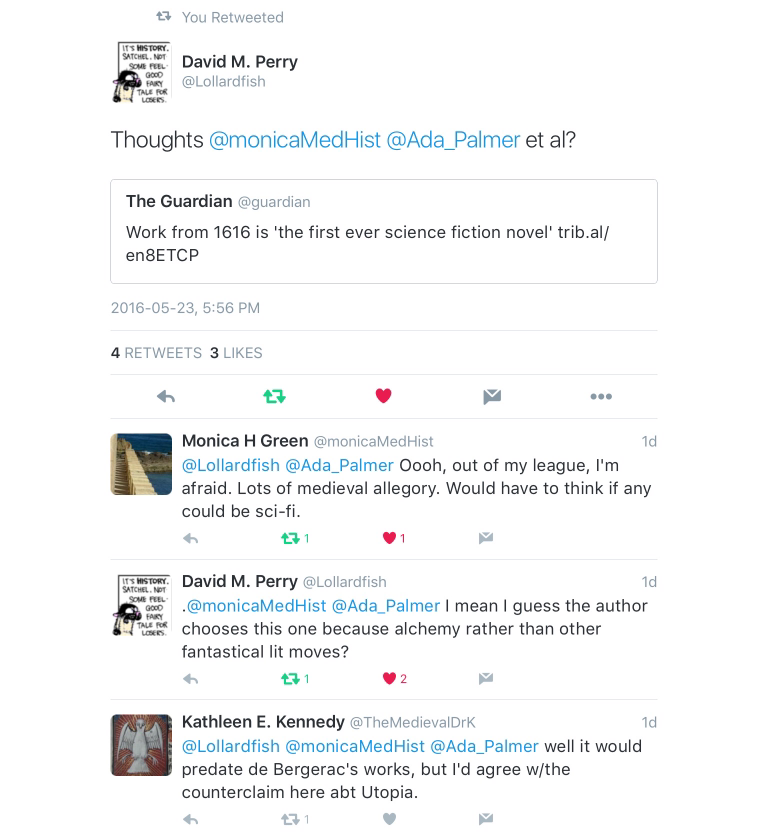
Last week The Guardian had a piece on the "first science fiction book," an alchemy fantasy from 1617. I haven't read The Chemical Wedding (though there's a Kickstarter, now funded with 60k, that's producing a new edition), but I was instantly skeptical of the "first" claim, so took to Twitter to ask for ideas of precursors.

Juliet O'Brien, at Meta Medieval, has written a long response, complete with the original article, many of the relevant tweets (here as a .png and here with a link to my starting tweet), a link to the forthcoming Medieval Science Fiction, and then her own reactions, starting here:
My own stirrings are not as an expert on medieval science fiction.
They are in part the reaction of a medievalist: exposed like all medievalists to daily ignorance and ignominy, to the horrors of our field’s abuse through the perversion of “neomedievalism,” through which “medieval” has become a pejorative in so much common usage. We’re sensitive to that sort of thing. It hurts. And we feel responsible towards the medieval, protective, with a duty of care towards that which we care about and that cannot protect itself. As people who work with and in history, we’re hypersensitive to the dark side of modernity and the blind worship of modernity for modernity’s sake: a vapid vigorous cult of speed, fashion, and shiny newness that’s been seen before, most memorably in the rise of Fascist movements a mere century ago.
This is very much where I stand as a medievalist. When someone claims  a"first" status just after the Middle Ages, I am immediately suspect and defensive, because as a historian I pursue continuities over radical over-determined periodized change (I'm a lumper, not a splitter).

It may be possible to come up with a definition of "science fiction novel" that only The Chemical Wedding and subsequent books fits, but it doesn't involve "science" or "fiction" or "novel" putting the three together. O'Brien looks at the medieval meanings of all three words, and as always, go read the whole post!
So for any given time, place, and culture: “science fiction” would be made-up stories, dependent on imagination, built on and out of contemporary cutting-edge knowledge, and building an alternative world in which that knowledge has been pushed hypothetically, futuristically, beyond its contemporary bounds. This definition avoids limitations of exclusive cultural normativity, to open up an idea inclusively. It shouldn’t detract from what makes European and North American science fiction of the modern era; just as it doesn’t currently exclude later 20th- and 21st-century writers and writings from elsewhere: Russia, China, Indonesia, Nigeria, Mexico, First Nations here in North America, Australia, Japan, … In all cases, we’re looking at longer stories that work around technologies that are a step ahead, a day away in the future (ex. Roman de la Rose); and travel to other worlds (ex. the Alexander romances), where wonders beyond our understanding may be observed, from more technologically-advanced cultures: automata and AIs in Floire et Blanchefleur—a popular pan-European hit—and in exotic Eastern scenes in the earliest Western European medieval vernacular romances, the Romans de Troie, Thèbes, & Enéas (in a piquant premodern-postmodern take on Orientalism).
The latter are already sources of wonder—sometimes downright made-up and stretching the bounds of imagination into the comedy of credulity—and may be wonders of alien cultures, such as in The Travels of Sir John Mandeville and other travel literature, and in another form of SF imaginative writing: maps. Meanwhile, the more obviously “other” medieval aliens of faery, and other places or worlds, populate Chrétien de Troyes’s romances and their kin in the Arthurian corpus; their very name related to fiction, their glamour and magics in the borderlands between advanced natural sciences and the unnatural. The distinction between alchemy and chemistry will remain to some extent unstable well into modernity, with magic as the border, through to the time of that other Crowley… And what should we do with travel to other other worlds like the world of the dead? As toyed with so subtly in the location and dislocation of Gorre in Chrétien’s Lancelot?
A final other-worldliness and “science”: dream visions, and the supernatural paranormal otherworldly othertimely knowledge beyond of religious and spiritual writing, from saints’ miracles to ecstatic transports. Allegory as a form of knowledge that works through imagination, hypothesis, thinking forward and outside and beyond. Exemplary cases: the Roman de la Rose again; the writings of Machaut and Froissart; and at the other end of the medieval, some 5th century allegorical works: the Comentarii in Somnium Scipionis of Macrobius, and Martianus Capella’s De nuptiis Philologiae et Mercurii. The latter, much read over the next thousand years, might perhaps have some influence on Johann Valentin Andraea’s Chemical Wedding.
Consider what we think of most naturally as the “science” in “science fiction” from an outsider’s point of view. As a system of knowledge, “science” in the 19th, 20th, and 21st centuries would seem as lofty, venerated, and mostly unknown to most of the population as Christianity and Church doctrine were to our parallels in 12th- to 14th-century Western Europe. A cult that’s central to a culture and to what defines it; mediated by a priesthood; but with populist and popular other expressions; and as a source for creative “… and what happened next?”
Finally: I agree with O'Brien that the need to be first, the need to define YOUR FIELD, YOUR PERIOD, YOUR BOOK as first, as devoid of contact with that which came before, is an epistemological problem. Some of this stems from academia itself - we reward "firsts" and smile politely at "continuity," "incremental change," or same-as-it-ever-was.

You don't win big prizes for locating a lack of change.


Thursday, May 19, 2016

Transphobia and the Middle Ages

Every year, Western Michigan University, in Kalamazoo, hosts about 3000 medievalists for a giant, sprawling, conference that I call MedievalCon. It has its significant academic context, but it's also embraced seriously fannish elements (or had them thrust upon it).

On Saturday nights, there's a panel hosted by the "Pseudosociety," in which academics deliver humorous satirical papers on invented manuscripts or whatever. Honestly, I don't know. I've been to one paper and it involved some nice elderly Irish lady making fun of "student howlers," or errors students write on their exams, and I've never really been into that kind of humor. Instead, I tend to plan a very nice dinner with friends.

This year, alas, Pseudosociety hosted two papers that were transphobic. I don't have details. I am not interested in parsing intent or whether they were really transphobic (on a listserv, a far-right-wing former prof of mine tried to make snide comments about Greek origins and changing the meaning of the word "phobia." A smart person responded, "Really, what did your Greek teacher say about xenophobia," and the far-right-wing former prof stopped talking).

What I can offer is this: An essay by MW Bychowski: "Genres of Embodiment: A Theory of Medieval Transgender Literature."

The Intro:
I am speechless. I have lost my power to speak. Last night not one but two papers were given with hate speech, transgender slurs, that use transgender to belittle medieval castrates and medieval castrates to belittle transgender. Already the next morning, the debates begin: hate speech v. free speech, ignorance v. consequence, a sense of justice v. a sense of humor. The effect of making us funny is that we are not taken seriously, we are not listened to when we speak, and we can't tell our stories. These attacks have power because they do not occur in a vacuum. Their words take force and meaning because of medievalists who believe that gender variant people don’t belong in medieval studies. Their words take on the force and meaning of laws barring trans persons from public bathrooms; a necessity to learn, teach or attend conferences. Their words take on the force and meaning of those giving women pepper-spray to use against trans people, threatening to beat us, and planting ideas in the head of a 16 year old who recently shot a local trans woman. People have asked me to say something about this. I know they want me to make sense of this; to find some way to make things better.

Now, I am speechless and I have no pardons to give; yet I come to this congress on medieval studies because my conscience leaves me no other choice. I come here because 48% of transgender women attempt suicide, because last year doubled the average number of transgender homicides, because parents bury them in clothes and names that contradict their gender identity, erasing all trace of their transgender lives. I sit with my countless dead trans friends and family looking for something to say but I have no words. So I listen. I listen to graves, the ruins of past trans lives, as they whisper to each other. They speak in many tongues from many places and many times. I hope if I learn to understand the dead and discarded trans lives that they might teach me words to say and stories to tell. I come to medieval studies because it is here that we learn to speak the language of the dead from the dead themselves. I come to medieval literature and history because we need their trans stories to make meaning out of our deaths and silences.
From there, MW dives into medieval literature, focusing on the Pardoner, first, then expanding to more general theories of medieval transgender literature and why it matters. She concludes:
Conflict is intrinsic to narrative and embodiment. It is not an over-reaction for a transgender medievalist to see the larger war and dangerous threats implicit in what may be pardoned as playful jabs. Yet the power of our oppressors can be used against them and our vulnerability can work for us. By silencing us so publicly, you are drawing others to hear our stories. By sending more of us to our early graves, you are adding to the cacophony of ghosts whispering in the machines of our destruction. By deconstructing our bodies, you reveal the maps for reconstruction written in our scars and sinews. Conflict comes with cost and we are paying it in the lives and stories of our transgender family. But one day that bill will have to be paid. For once we learn to listen to the transgender stories of the dead, each seemingly silent gravestone and medieval text will come alive with the call for justice.

Wednesday, May 18, 2016

Adventures in #MedievalTwitter - Racists and Swans

I was going to post this yesterday, but was too sick. Below is a tweet from former graduate student in medieval literature, responding to a petulant tweet by a racist UKIP (right-wing English political party) about an actress of color playing Queen Margaret of Anjou.
Here's good coverage of the whole affair by The Independent, including an interview with Le Chevalier (with whom I have also corresponded), saying:
Chevalier au Canard' wrote afterwards about how in the 21st century it's representation rather than medieval misappropriation that matters:

If I'd been able to complete my PhD, it would have been about exactly this - myth solidifying into history, then liquefying into myth again. Everywhere you think there is solid 'history' to lean on, it falls out from under you.

It's wrong to try and dictate what roles black actresses can play, whatever the context - but this guy decided to do it using an image from a manuscript I've written half a PhD on, unluckily for him. I thought it was a great opportunity to show that the sources we rely on to imagine a golden age of pure "historical accuracy" are often anything but.
As ever, the important thing is purpose - it's not misuse of medieval stuff that matters, it's attempting to deny work to a black actress.
Le Chevalier is handling her sudden twitter fame with good grace and a continued fine sense of wit. It's been a pleasure to watch.

There were, of course, some similar backlashes surrounding Hamilton, in which the founding fathers of American history were re-imagined as people of color. Not to mention Black Hermione.

There is, of course, a long history of experimenting with race and, for that matter, gender, in casting of Shakespeare (from which this Margaret of Anjou is drawn, more or less). As many tweeters pointed out, the earliest actors playing Margaret, for that matter, would have been male. I find the idea of Queen Margaret - a French queen tasked with defending the House of Lancaster, as her husband flounders (perhaps due to mental disability) - being cast as a Jewish/Nigerian actress, to be an interesting move for many reasons. Her identity in the plays (I haven't seen this BBC show) is very much structured around her foreignness to England, as I recall them, and so marking that in ways other than a fake French accent seems like a sharp approach.

ICYMI, here's an interview I did around race and representation in medieval fiction.

What's going on here, of course, is yet another proof that representation really matters. The UKIPper knows it, which is why he wants to keep the memory of medieval Europe lily white. As experts, we don't have to let him get away with it.


Wednesday, May 4, 2016

History and Memory: Richard III and Leicester City (and British Football)

So Leicester City won the British Premier League title, which is very exciting for people it excites! I noted in the preview last weekend in the New York Times that there's an interesting touch of history and nostalgia in their narrative:
April 4, 2015 Sitting in last place with nine games to go, it seems certain that the Foxes will be relegated to the second-tier Championship. Yet a week after King Richard III’s remains are reinterred in Leicester, the team beats West Ham United on a goal by a player named King (Andy, in this case). It is a harbinger, fans now say, as Leicester goes on to win seven of its final nine games and ensure its return to the Premier League.
This year's title is probably the greatest victory for Richard III in history.

Saturday, March 19, 2016

Annals of Patriarchal Equilibrium: The Alewife and the Park Director

In the book History Matters, as well as the focused studies on which the book is based, Judith Bennett discusses the curious history of the medieval village alewife. She tracked the way that the internal ale-based economy worked, then, as ale shifted to beer, suddenly men took over the field. It turns out that beer, which kept better, could be made as a high value commercial product. With more money and status involved, women were gradually squeezed out. They lacked the capital to parlay their expertise in ale into commercial beer production. Moreover, the arrival of beer closed off some of the benefits of the less formal ale-economy that local women enjoyed.

Bennett used this case study as one of her examples of what she defined as the patriarchal equilibrium. Her argument is that sure, women's experiences of work and wages have changes over time, but that the relative status of their work has remained flat. The great work transformations - women heading into the factories in the early industrial period - may look different in kind, but in status, nothing has really changed. When a field's status rises, men take it over. When women enter a field, the status/remuneration drops. That's the patriarchal equilibrium.

Yesterday, New York Times reporter Claire Cain Miller wrote a piece on the same phenomenon:
Once women start doing a job, “It just doesn’t look like it’s as important to the bottom line or requires as much skill,” said Paula England, a sociology professor at New York University. “Gender bias sneaks into those decisions.”
She is a co-author of one of the most comprehensive studies of the phenomenon, using United States census data from 1950 to 2000, when the share of women increased in many jobs. The study, which she conducted with Asaf Levanon, of the University of Haifa in Israel, and Paul Allison of the University of Pennsylvania, found that when women moved into occupations in large numbers, those jobs began paying less even after controlling for education, work experience, skills, race and geography...
A striking example is to be found in the field of recreation — working in parks or leading camps — which went from predominantly male to female from 1950 to 2000. Median hourly wages in this field declined 57 percentage points, accounting for the change in the value of the dollar, according to a complex formula used by Professor Levanon. The job of ticket agent also went from mainly male to female during this period, and wages dropped 43 percentage points.
England seems more sure this is about intentional gender bias, whereas Bennett, working in a remote period, argues a little more abstractly about broader patriarchal forces. Still, the phenomenon tracks across time.

Thursday, February 11, 2016

Women and War (and Public Scholarship) - Medieval Style

I've been caught up in my disability journalism lately, but don't want to neglect some of my other passions  - medieval history and helping academics share their expertise with wider audiences.

Over the past few weeks, a number of outlets have passed around research - just a working paper really - that argues women rulers are more violent than male. It's a classic case of correlation without context. On the Society for Medieval Feminist Scholarship mailing list, a long thread emerged pointing out all the ways this research was either wrong or misguided in its findings. I offered only this - anyone on that list who wanted to publish an oped could contact me within 24 hours and I'd help them craft a pitch, critique their essay, and try to help them find the right editor.

I mention this only because I extend my offer to you, dear reader. If there's a timely story and you are willing to hustle (and willing to be rejected), contact me and I'll see what I could do.

Here's Katrin E. Sjursen's first piece for The Atlantic on what medieval history really shows about female rulers. It's an outstanding piece of public scholarship, detailed and interesting, teaching me things I didn't know, hopefully shaping our national discourse around women, history, and power.
Hillary Clinton’s victory in Iowa marks the first time a woman has won the presidential caucuses there. Enter the latest round of gender-based speculationsabout female candidates’ inherent pacifism versus their over-compensating hawkishness. With Clinton in the presidential race for the long haul, now is definitely—finally—a good time to throw out the binary competition between passivity and warmongering that always seems to be ascribed to female leaders. There’s no need to cram women—including Clinton—into one-dimensional categories: History demonstrates that women employ multiple and complicated approaches to leadership.
Politically active women thrived in the Middle Ages—as queens, duchesses, countesses, and so on—because the medieval period seated political power within noble families, and women were members of those families. Medieval history may not be the obvious source for an examination of active women rulers—after all, books on the Middle Ages often center on the infighting between kings and their knights, while increasingly misogynistic monks produced diatribes against the wiles of women. Nevertheless, noble wives in the Middle Ages were regarded as co-rulers of territory, alongside their husbands, and were expected to participate in both political and military affairs even when their husbands were present and available. This expectation meant that medieval noblewomen had the opportunity to develop a personal ruling style.
Sjursen  wants us to discard the false binaries of women as hawk/dove, and instead embrace the complexity of gender and rule in both past and present. I look forward to her next piece!

Friday, November 6, 2015

Medievalists in Public! (Writing about the Humanities)

Yesterday at The Conversation, Cecilia Gaposhkin, a medieval historian at Dartmouth, wrote a piece arguing that STEM are not distinct or in competition with the liberal arts. They are the same thing.
The idea that STEM is something separate and different than the liberal arts is damaging to both the sciences and their sister disciplines in the humanities and social sciences.
Pro-STEM attitudes assume that the liberal arts are quaint, impractical, often elitist, and always self-indulgent, while STEM fields are practical, technical, and represent at once “the future” and “proper earning potential.”
First, let’s be clear: This is a false and misleading dichotomy. STEM disciplines are a part of the liberal arts. Math and science are liberal arts...
Advocates of STEM are missing the point. The value of a liberal arts education is not in the content that is taught, but rather in the mode of teaching and in the intellectual skills that are gained by learning how to think systematically and rigorously.
Gaposhkin concludes with a discussion of the specific ways in which a liberal arts education is necessary for an engineer or doctor to truly thrive.

Today, at Inside Higher Education, Paul Sturtevant, who works for the Smithsonian and runs The Public Medievalist, makes a similar argument about how to promote our worth in the public square:
There is a different unifying principle for most non-STEM disciplines -- among them English, history, politics and civics, languages and literatures, education, the arts, philosophy, psychology and sociology -- which I call the human disciplines. All of the subjects within human disciplines are fundamentally interested in people and with subjectivity. Our disciplines not only illustrate esoteric questions of the meaning and purpose of life but are also uniquely well suited to explore questions of how to live and work with other people. In practical terms, if the job requires being able to work with and understand people -- particularly those different from yourself -- these degrees can, and should, make you better suited for it. They promote empathy, and require students to regard problems, and people, with complexity and the understanding that no single answer is right.
These kinds of jobs exist in all walks of life and include CEOs, kindergarten teachers, judges, advertisers, curators, coaches, social workers and many others. They form the linchpin of our society. They not only drive our economy but also make our country a better place to live by having good, well-trained people doing these jobs.
In my heart, I fear that making instrumental arguments about the humanities is a losing game. If we try to play the "gets you a better job" - even if it's true, which it is! - we're going to lose the rhetorical fight to defend the humanities. People - from Barack Obama to the random parent who comes looking at my college - just don't believe it. 

But it is true. People who learn a set of technical skills without the critical thinking, intellectual curiosity, and systematic analysis to expand those skills as circumstances change, are merely being trained for yesterday's job. I'm so pleased to see two colleagues making that case in public.

Friday, August 7, 2015

postmedieval Reactions: Brantley Bryant's Seven Theses

As promised, I'm working through the fascinating postmedieval forum about the public Middle Ages, starting with Brantley Bryant's Seven Theses for "A Social Media Strategy."

Bryant is a successful user of social media through, as he puts it, "playful experimentation with medieval personae on social media." In this piece, he offers seven different strategies or principles related to medieval use of social media. It's a warm, geeky, funny, smart piece of writing, and I can't comment on everything. Instead, I'll focus on two points: [My emphasis]
IV. SOCIAL MEDIEVALISTS DWELL AT THE SLINGSHOT POINT: Sci-fi ships gain speed by shooting themselves along the curve of a big planet’s gravity. Social medievalists too can slingshot off news events and pop-cultural planets to enhance their visibility and reach. There are obvious slingshot events (Richard III, carpark), as well as not-so-obvious ones. To take best advantage, social medievalists will need to move at the rapid pace of the news cycle, and scholarly organizations will need to plan for this kind of speed alongside the slower timeline of journals and conferences. Importantly, this point applies only to news items that have relatively neutral political valence. The issue of the ethics, methods, and time scale of providing a medievalist perspective on tragedies and conflicts is a much more complicated one. As an academic enterprise, social medievalist outreach must always keep ethical concerns central as we strive for visibility and reach.7
On the morning that Pope Benedict retired, I started a Facebook thread griping about all the things people were getting wrong about the papacy and its history of retiring popes. Urged by my friends, I sent a pitch - before breakfast was over - to a CNN editor for whom I had written once before (I had published a grand total of 3 pieces on 7 years at that point), and had a piece to her by about 2:00 in the afternoon, which now seems painfully slow. The next day, my CNN piece ran, an Atlantic editor emailed me asking questions about the papacy and race (early North African popes), and I responded with an answer and a new pitch. When Francis was announced, I had filed a new piece on "the importance of being Francis" within two hours of hearing his name selection.

Speed matters, and that can be the hardest thing for academics to learn. Speed leads to mistakes (some of which can be corrected). Speed-writing is not something we are trained to cherish.

But in graduate school, my experience was PACKED with speed writing, trying to meet the demands of my professors. We learn how to do it, and many of us continue to apply those skills to conference papers, classroom lectures, blogs, and other kinds of writing.

That said, not all takes have to be instant-hot-takes. When a news event happens, there's a window in which every editor is looking for experts right away, and a first cycle of news will emerge from that. I almost never catch that cycle, unless it's to give a comment, unless it's a predictable event (papal election, anniversary or holiday, etc.). But there's a second cycle, in which editors want essays that add to or (better yet) disagree with the common approach in the first cycle. Academics, with their expertise, can do very well by working in this second cycle of newsworthiness. And if it's a big enough event, there could be third or even fourth cycles of takes, each one valuing a new thought, an expert addendum, a connection between the event and other things, etc.

So don't feel you have to get your essay written within a few hours of the slingshot event. You have a day. Or two. Or maybe even four. That's probably it, though.

Here's the good/bad news: Things repeat. While we might not find another Richard III in a carpark to write about, if you're more interested in trends like the mis-application of medieval to terrorist groups, or bad history being used by politicians, or medieval ideas on public safety laws, or something slightly more abstract - don't stress missing your media hook. There will be another hook.
I. THE SOCIAL MEDIEVAL IS A CLASSROOM: When it comes to public social media, a pedagogical impulse is the best guiding principle for our choices about method and message. Social medievalists can apply Paulo Freire’s “problem posing” education on the widest level possible.5 Think about our readers as an audience of potential learners. Marketing language serves us poorly if unadapted to our goals. “Promotion” (of self, institution, or product) goes with the grain of social media, but “pedagogy” serves us best.
This is true, social media can be a wonderful educative space, but don't overdo it. When a person on the internet starts demanding hours of lecture, of answering spurious accusations, or starts trolling you, hit mute. I've noticed that academics, trained as we are to engage our students and our peers, feel like they have failed when they just turn off annoying/abusive people on line.

Block/mute. Do it early. Do it often. These people are not your students and you owe them nothing.

Thursday, April 23, 2015

Medieval (Dan) Savage

Dan Savage, famous sex columnist, featured a letter from a medievalist that echoed many of my complaints about lax medieval discourse. The letter is in response to Savage calling a conservative religion "medieval." This anonymous medievalist explains why it's wrong, then writes:
The reason why this matters (beyond medievalists just being like OMG no one gets us) is that the common response in the West to religious radicalism is to urge enlightenment, and to believe that enlightenment is a progressive narrative that is ever more inclusive. But these religions are responses to enlightenment, in fact often to The Enlightenment. As such, they become more comprehensible. The Enlightenment narrative comes with a bunch of other stuff, including concepts of mass culture and population. (Michel Foucault does a great job of talking about these developments, and modern sexuality, including homosexual and heterosexual identity, as well—and I'm stealing and watering down his thought here.) Its narrative depends upon centralized control: it gave us the modern army, the modern prison, the mental asylum, genocide, and totalitarianism as well as modern science and democracy. Again, I'm not saying that I'd prefer to live in the 12th century (I wouldn't), but that's because I can imagine myself as part of that center. Educated, well-off Westerners generally assume that they are part of the center, that they can affect the government and contribute to the progress of enlightenment. This means that their identity is invested in the social form of modernity.
So that's all pretty great, especially as the anonymous medievalist signs off, "And sorry for such a long letter, but it allowed me to put off my grading for a while."

Yesterday I also read a long essay from John Gray in The Guardian about the problems with Steven Pinker's "the world is getting more peaceful" rhetoric. It's a wide-ranging piece with lots of arguments, but one is again about the Enlightenment and the way we construct it as a sole source of positive results. Here are two key paragraphs.
Among the causes of the outbreak of altruism, Pinker and Singer attach particular importance to the ascendancy of Enlightenment thinking. Reviewing Pinker, Singer writes: “During the Enlightenment, in 17th- and 18th-century Europe and countries under European influence, an important change occurred. People began to look askance at forms of violence that had previously been taken for granted: slavery, torture, despotism, duelling and extreme forms of punishment … Pinker refers to this as ‘the humanitarian revolution’.” Here too Pinker and Singer belong in a contemporary orthodoxy. With other beliefs crumbling, many seek to return to what they piously describe as “Enlightenment values”. But these values were not as unambiguously benign as is nowadays commonly supposed. John Lockedenied America’s indigenous peoples any legal claim to the country’s “wild woods and uncultivated wastes”; Voltaire promoted the “pre-Adamite” theory of human development according to which Jews were remnants of an earlier and inferior humanoid species; Kant maintained that Africans were innately inclined to the practice of slavery; the utilitarian Jeremy Bentham developed the project of an ideal penitentiary, the Panopticon, where inmates would be kept in solitary confinement under constant surveillance. None of these views is discussed by Singer or Pinker. More generally, there is no mention of the powerful illiberal current in Enlightenment thinking, expressed in the Jacobins and the Bolsheviks, which advocated and practised methodical violence as a means of improving society.
***
Like many others today, Pinker’s response when confronted with such evidence is to define the dark side of the Enlightenment out of existence. How could a philosophy of reason and toleration be implicated in mass murder? The cause can only be the sinister influence of counter-Enlightenment ideas. Discussing the “Hemoclysm” – the tide of 20th-century mass murder in which he includes the Holocaust – Pinker writes: “There was a common denominator of counter-Enlightenment utopianism behind the ideologies of nazism and communism.” You would never know, from reading Pinker, that Nazi “scientific racism” was based in theories whose intellectual pedigree goes back to Enlightenment thinkers such as the prominent Victorian psychologist and eugenicist Francis Galton. Such links between Enlightenment thinking and 20th-century barbarism are, for Pinker, merely aberrations, distortions of a pristine teaching that is innocent of any crime: the atrocities that have been carried out in its name come from misinterpreting the true gospel, or its corruption by alien influences. The childish simplicity of this way of thinking is reminiscent of Christians who ask how a religion of love could possibly be involved in the Inquisition. In each case it is pointless to argue the point, since what is at stake is an article of faith.
These arguments matter to me. I've frequently written about the way that loose appellations of "medieval" impose a chronological alterity between the thing we dislike and ourselves (most recently here, in a review of Bruce Holsinger's latest historical novel).

I am similarly frustrated with loose praise for modernity, given that the genocides of the 20th century are at least as much a factor of the modern age as are the advances. I wrote, in response to a piece on the Jewish victims of the First Crusade:
And so this is the problem with Jacoby's closer. She says that ISIS shows us what the world might look like had there never been the great leaps forward by white folks in the West, ignorant of the catastrophic violence those leaps brought to the west itself, the world, and indeed the very Jews she mourns in her essay.
The 21st century is a different world. A more connected world. A world with weapons and technologies unfathomable to our ancestors. But the belief that we are more advanced, and thus relegate people who are nasty to other eras, is something we say only to comfort ourselves. It's a lie.
Anyway, kudos to the anonymous Savage Medievalist for making the argument.

Friday, March 6, 2015

The Ferguson PD is NOT medieval. It's modern white supremacy.

Terrence McCoy of the Washington Post has published the latest mis-use of the word medieval, not as a casual pejorative, but as a specific pejorative. He writes:
“The new Department of Justice report depicts a system in Ferguson that is much closer to a racket aimed at squeezing revenue out of its population than a properly working democracy,” wrote George Washington University political scientist Henry Farrell in the Monkey Cage blog, which runs in The Washington Post. Ferguson city employees, from the police chief to the finance director, collaborated to generate revenue through tickets and fees, according to the Justice Department. As described in the report, Farrell and others pointed out, Ferguson is reminiscent of medieval Europe, when gangster governments collected “tribute” and bamboozled the subject population at every turn.
No. There was plenty of internal and external plundering of subject populations in the Middle Ages, but to make this comparison is not only to be confused about medieval community norms, but also - and far more importantly - to mistake what's happening in Ferguson.

The Ferguson PD plundered a specific racially-defined subset of the population through the use of citation/fine systems, a lack of due process, all supported by white supremacy embodied in the local legal enforcement system. While governments did frequently use fines as regular fund-raising methods in later medieval cities, there the comparison ends.

- The racial issue is wholly modern.
- The "ticket" system to plunder a population is wholly modern.
- Medieval societies were frequently oppressed, but not "bamboozled ... at every turn." Rather, they participated in complex, hierarchical modes of organizing society.

When you share the post, you get this picture and caption.


Notice that "It isn't just racist, scholars say. It's medieval." Now McCoy doesn't write his captions, but it shows how fast these things can move. Now the "medieval" appellation is being provided by scholars, not the journalist. It's not what the scholars quoted in the piece say though, although one does use a historical example from early modern Venice:
“Consider the definition of a racketeer as someone who creates a threat and then charges for its reduction,” Tilly wrote, citing how European states first formed during the early 1600s. Venice, for example, was inhabited by both merchants working the ports and a government with questionable motives. “Governments’ provision of protection, by this standard, often qualifies as racketeering,” he wrote.
Venice in 1600 isn't medieval, for starters.  Certainly urban governments often do what they can to extract wealth from their citizens and from outsiders, as possible, often in predatory ways. This happened in early modern Venice and plenty of other cities in other eras.

But to focus on racketeering and protection is, again, to exclude the specific white supremacy aspects of the department and the system. This is how white supremacy replicates itself in a post-slavery, post-Jim Crow, society.

And while the Middle Ages are filled with things both terrible and glorious, white supremacy is not one of them.

I've said this before about the use of "medieval" for ISIS. The appellation of "medieval" to modern things that we don't like imposes distance between us (good people living now) and them (bad people living now / bad people living in the past). It excuses and excludes us from culpability for our present.

The Ferguson PD is modern. It takes modern policing, modern racism, modern judicial systems, modern urban environments, decades of predatory housing policies, white flight, and so much more to make the Ferguson PD. History can help us understand what's going on here. But the solutions, and the blame, need to focus explicitly on this moment.


Sunday, July 13, 2014

Sunday Roundup - Eden Foods,

Unexpectedly, Eden Foods became my big story of the last few weeks. It introduced my writing to thousands of new readers, for which I am grateful. 

I came to this topic because it's about language and power. 

Like any consumer, I wrote Eden to complain, got their response, and thought, "grotesque," now there's an interesting word. A week later, ten thousand views, three pieces on my blog,  a radio interview, a new CNN piece, and I'm now deeply invested in the topic.

I'll have one more blog tomorrow on Eden, so check back in the morning.

I wrote two pieces on medieval metaphors, and why it's vital that we understand both the ways that history does and does not inform our current situation. The first was a quick hit on Karl Steel's blog and his critique of using "feudal economy" to describe our current situation. Our current situation is vastly more unequal. 

The second worked from Stephanie Miller, a liberal radio host that I like, criticizing the "war on women" as medieval. It's the modern elements that concern me.

I also wrote one more essay on Down syndrome diagnosis. It's much more likely that you will be called on to support someone who has had a diagnosis than to receive one yourself. Be ready. My friends got themselves ready and helped us immensely as we struggled in those first hours.

I'm buried in copyedits on a 90,000-word book. Blogging may be limited. 

Thursday, July 10, 2014

Something Old, Something New - The Medieval and Modern War on Women


“I respect you very much as a woman for your accomplishments. I even read that you studied medieval history, which I think will come in handy with trying to defend the Republican war on women.”
Liberal Radio Host Stephanie Miller to Carly Fiorina, failed Republican Senate Candiate, on CNN State of the Union, 7/6/2014.

On CNN last Sunday, Stephanie Miller used Fiorina’s degree in medieval history and philosophy from Stanford as an easy way to score a rhetorical point. Miller argued that the Republicans, especially in their views on women, are medieval, and medieval things, as everyone knows, are bad.

This idea that the Middle Ages were especially backwards doesn’t really hold up to close analysis, but it’s a pretty pervasive myth and I’m not surprised to see Miller use it. In fact, Fiorina has used that kind of language as well. In a keynote address in 2000, she labeled ignorant government regulators as medieval and celebrated cutting-edge tech companies as the heroes of the Renaissance.  

This is, of course, nonsense. 

The kinds of regulations to which Fiorina objects are a product of the development the modern state and economy. The heroes of the Renaissance frequently served tyrants in an era of terrible war and strife, though they produce beautiful art in a time of chaos, disease, and religious strife.

Despite this, if we take Miller seriously and think about what the study of the Middle Ages might tell us about gender discrimination, patriarchy, and health care in the wake of the Hobby Lobby decision, we might make two arguments. First, knowing about the past in fact does come in handy when trying to understand the present. Second, one of the things the past reveals is that dangerous parts of the war on women are very modern.

Let’s start with a medieval story about women and healthcare.

14th-c drawing meant to depict "Trotula,"
a female doctor. Miscellanea medica XVIII
Wellcome Library, London. CC-zero
In 1322, the all-male medical faculty of the University of Paris took Jacoba Felice to court for practicing medicine without a license. At trial, witness after witness attested to her skill and denied that she had ever asked for payment. The court nevertheless found her guilty and ordered her to refrain from practicing medicine on pain of fine and excommunication.

On the surface, this looks like a classic example of medieval patriarchy at work.  But if the Middle Ages last from 500 to 1500 or so (and some scholars would end the medieval much earlier), 1322 is actually pretty late in the period. This is important because it shows that the specific issues in 14th-century Paris are new. 

Before that point, the men and women of the city had trusted Felice, investing her with social capital, although that didn’t help her in the face of the law. After this, male doctors increasingly worked to ban women from practicing medicine solely on the basis of their gender. In fact, according to Monica Green,   Professor of History at Arizona State University, Felice’s case may have sparked the physicians’ practice of applying gender-based barriers to the profession, since competency was harder to argue (Felice being supremely competent).

A modern analyst could use the case to inform either right-wing or left-wing arguments. On the one hand, it’s a kind of overreach of regulation that served the vested interests of male physicians who felt threatened by Felice’s competition. On the other, the case features a corporate body (the medical faculty) that used the courts and the church to enforce gender norms and restrict women’s access to quality healthcare. In the wake of the Hobby Lobby decision, that latter analysis does seem especially relevant, even if it’s not one Fiorina would make. 

Beyond the relatively narrow confines of medicine, the story of Felice also says a lot about the power of the state and what happens when that power is leveraged to reinforce gender or religious norms. The “state,” as we know the term, really begins to take shape in what we call the “early modern” period (starting around 1500, more or less), but we can see the roots in moments like the trial of Felice.

On the other hand, at its height, the pre-modern state had nothing like the kind of power that the weakest government can exercise today. The richest men or groups had nothing like the kind of wealth that corporations and plutocrats hold. The medical profession may have achieved power over credentials, but the knowledge and invasive possibilities of medicine today would have seemed largely inconceivable to the pre-modern physician.

At the core, Hobby Lobby’s arguments against providing contraceptive care do reflect older Christian ideas about gender, religion, and power. They are dangerous not because they are old, however, but because of the intrusive power of modern technology to peer into our most intimate lives. They are dangerous because of the control that corporations have over their worker’s health, a truly bizarre accident of 20th-century American labor history. They are especially dangerous because of the vast wealth leveraged by powerful conservative men who want to enshrine their religious views into law.

This is a modern battle as we decide what kind of country we want this to be. We resist the forces behind the Hobby Lobby decision not by mocking them for being antiquated, but through the ballot box, the courts, public opinion, and even the ultra-modern tool of internet-organized consumer boycotts.

On CNN, Miller’s quip suggested that patriarchy, gender repression, and even would-be theocracy are problems of the past, that the “war-on-women” is some kind of throwback to a barbaric and long-past age.

If only that were true.


Wednesday, July 9, 2014

Loose Medieval Metaphors

Copyedits for my academic book arrived in my email yesterday. My blogging will likely be a little sparser for the next three weeks. Or I'll write twice as much. There is no middle ground! Today is quick.

Medieval metaphors are flying around these days, as medieval is a shorthand in our national discourse for "bad," "backwards," or "unequal." We have descended into an age of acute inequality, so people turn back to "medieval" as a way of describing it.

That's nonsense. It's not like the Middle Ages were happy times one-person one-vote liberal democracy or anything, but the really important elements that shape modern inequality - technology, globalism (also a force for equality, in some ways), Wall Street, and so much else - are the very definition of modern. It's true in terms of state power, too. Sure, medieval rulers would have liked to be able to track you like the NSA does, but they couldn't. It's only once our entire lives enter a searchable digitial sphere that suddenly a body like the NSA can exist and imperil us.

Over on medievalkarl.com, Karl Steel takes on the notion of the feudal wealth gap. He writes:
We’re living in an era of unprecedented wealth, although perhaps not an unprecedented era of wealth concentration. What distinguishes 2014 from, say, 1014, is that the plutocrats couldn’t have fed everyone well even if they chose to try; lord knows they couldn’t have provided quality medical care and top-notch education to all of the poor, because they couldn’t even provide it to themselves; they couldn’t have extended the life of all the poor by decades, because even the rich back then, whenever that was, tended to top out at 40 years.
Also read his piece on religious warfare as an Enlightenment problem.

The possible now is very different from the possible then, for good and for ill.

And now, back to copyedits.

Sunday, May 11, 2014

Going Public - A Medievalist on CNN.com

I've been at the 49th International Congress on Medieval Studies, held annually at Western Michigan University in Kalamazoo, MI. It's an extraordinary event - over 3000 medievalists come to this small town and lovely campus and, over four days, work on everything from the most micro-specialized topic to giant sweeping questions about the academy and the nature of knowledge. Often followed by merriment and music.

I spoke at a session on writing about the Middle Ages for multiple audiences. Ellen Arnold, Ohio Wesleyan,  spoke about the extraordinarily creative assignments she's given to her students (creating pop-up physical and virtual museums, for example). Matthew Gabriele, Virginia Tech, revealed to us the mysteries of the sub-reddit "Ask Historians." Laura Saetveit Miles, Univ. Bergen, talked about being a feminist and medievalist in future public writing.

I talked about being a medievalist on CNN.com - how it happened and why it mattered. Below is a version of my remarks with some supporting links and some of the images.

-------------------------------------------

GOING PUBLIC

I’m here to talk about my experience writing about the Middle Ages for mass media. I’m not a popular historian – in the sense of writing about my subject field for a general audience. Instead, I write popular essays for places like CNN, the Chronicle and the Atlantic some of which are about the intersections between the Middle Ages and now. I see these intersections everywhere.

I began by writing about the medieval echoes at play in Benedict’s surprise resignation and the intentional medievalism of Pope Francis – I often say to my students that the church is firmly in a 13th-century moment. I’m going to tell you a little bit about how that happened, what I wrote and why, and then shift to current events. But first what I really want to say is this:

As medievalists, as intellectuals, you have authority to weigh into public conversations. To the extent possible, to the extent that you can find a platform, to the extent that you feel safe – I think you should do it.

*

In February of 2013 Pope Benedict retired abruptly. He announced it in Latin, and an Italian Vatican reporter who happened to know Latin broke the news to the world. Go Latin! In general, it caught the media off-guard, media platforms were looking for content, and the content quickly turned to the medieval. Reporters were asking questions about whether Popes had ever retired before, how does papal retirement work, what comes next, what’s the canon law on the subject, and so forth. For a few weeks, medieval history was hot.

A lot of the commentary focused on Pope Gregory XII, who was indeed the last to retire, but who did so in the context of the fifteenth-century Council of Constance as part of a deal to get two anti-popes deposed, Gregory to retire, and a new legitimate Pope elected to unify the church. Hardly analogous to Benedict. I started looking at the late 13th-century canon law on the subject [all before breakfast], much of which was organized by the man who became Boniface VIII. Boniface became pope after his predecessor, Pope Celestine V retired in order to return to a life of contemplation.

Why does this medieval history matter today? Well, Benedict’s statement announcing his retirement echoed Celestine’s own bull of retirement. Benedict visited Celestine’s shrine twice as Pope. Benedict and Celestine are even featured on the wall of the church in L’Aquila.


Given the clear impact that Celestine’s example had provided for Benedict, I had an easy medieval story to write, and I wrote it for CNN.

Over the next few weeks, I kept writing in the run-up to the conclave, after Francis was elected, and even throughout the first few months of his papacy. I felt that a lot of reporters were mis-reading Francis’ early statements. It turns out that my PhD in medieval history makes me a good interpreter of papal texts; go figure.

I used these writing opportunities, as much as possible, to educate readers about the Middle Ages.

Here’s my favorite example – an essay in which I suggested ways to think about the upcoming papal election, but in which I really wanted to say that voting is medieval. Medieval people, as you all know, loved making groups, writing bylaws, and voting for stuff. They did it all the time. The College of Cardinals, no less than a faculty senate, offers a direct continuation of that tradition of medieval voting.

These are the kinds of stories that I think we can, and again as possible, should all write. We all have these moments that we observe a relationship between our scholarly subjects and modern conversations, whether about politics, religion, the environment, or culture. I’ve become an evangelist for writing local op-eds, national pieces, blogging, talking to school groups, participating in library reading groups, anything that might combat myths about the Middle Ages, get our perspective out of academia and into broader discourse.

Here is where current events take over my talk. I had planned to speak about the institutional challenges facing academics who want to do public engagement – namely; that our professions don’t see it as something that counts.

But then something happened that drove me to write a very different kind of piece about the Middle Ages.


There’s Sarah Palin at the 2014 NRA convention. She made an incredible speech. I’ve watched it many many times in whole and in part, and few demagogues in history could do much better. She knows her audience. She owns them.

The minute I heard these words – waterboarding is how we baptize terrorists – I started thinking about forced baptisms in both Visigothic and late medieval Spain, Saxony under Charlemagne, and in the context of massacres after the First Crusade and during the Black Death. I remembered Palin’s invocation of “Blood libel” after Representative Giffords was shot. So here was an extraordinary thing – a modern demagogue claiming the traditions of both Christian persecutor and victim.

I decided that this situation really did call for a medievalist.

This piece was published last Thursday, on May 1. I want to point out a few features of how I wrote about the Middle Ages.

First, I explicitly claimed my authority as an historian.

I quoted an episode on forced baptism from the Chronicle of Mathias of Neuenberg – a reference I actually chose from a Facebook thread I started on forced baptisms in medieval history. And hey, whatever you think of Sarah Palin, getting 14th century German chronicles time on CNN.com is pretty cool, right?

I described the ways she evoked both fear and dominance in her audience, making them afraid on the one hand, claiming absolute moral authority on the other, and assuring them that with the proper weapons, they could safe. In followup blog posts, I would describe her language as a form of militant Christianity.

I then looked back on her use of “blood libel,” which I defined as a medieval myth, as evidence of her consistent pattern of wanting to be both the unjustly victimized Chosen people and the Christian triumphalist. That rhetorical move is very familiar to medievalists who study the Crusades, for example.

I ended with a nod to apocalyptic thought, a subtext I see running throughout her work.

In my reading, Sarah Palin’s medievalism is evident throughout this speech and her speeches and writing over the years. Throughout, she echoes some of the worst moments in medieval history.

*

I’m a little nervous about showing you this, here, at Kalamazoo. More nervous than I was about writing it in some ways, because you are my peers. This is not a political conference and I know many of you won’t agree with my take. Moreover, I’m not just being an educator in this piece. I’m not just revealing the ways in which medieval history informs modern events. I’m not acting as a professor in public. I've left the safe spaces behind.

No, in this piece for CNN I am using my status and knowledge as a medieval historian to make an explicitly political argument that a modern politician is dangerous.

Here’s the thing.

I think she’s dangerous.

Moreover, it is my knowledge of the medieval past that has led me to that conclusion. What is our obligation to society as scholars when we draw such conclusions? What is one to do with such a thought other than to share it?

I’m not here to try to persuade you to adopt my politics, but I am here to say that our historical knowledge gives us a perspective that is valuable and usually missing in public discourse. Our status as academics, for all intellectualism can be derided, gives us entry into local and national conversations.

You have the authority to weigh in.

Please use it responsibly.

Thank you.