Showing posts with label discourse. Show all posts

Monday, September 29, 2014

Transphobia and Miscegenation - Won't Somebody Think of the (Cis-gendered) Children

My first ever op-ed was published in the Minneapolis/ St. Paul Star Tribune. It was in 2006 and on the use of medieval rhetoric to talk about modern problems in the Middle East, a situation that continues today.

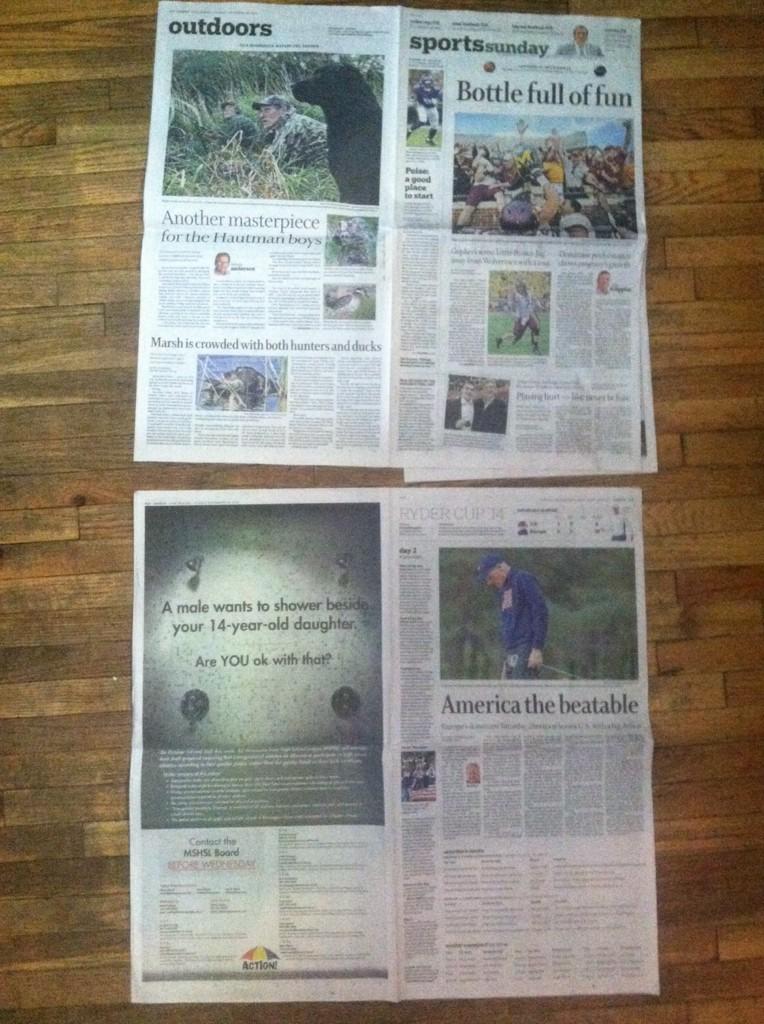
Over the weekend, the Star Tribune published this full-page ad raising the worst kind of fear-mongering about transgendered children. It says:

"A male wants to shower beside your 14-year-old daughter.
Are YOU ok with that?

So, that's pretty hateful. The context is that the MN high-school sports league is considering passing a transgender inclusion policy, and good for them for doing so. Of course, any attempt to take a step forward like this is immediately met with bigotry.

Here's a few points. 

1) Nowhere does the full-page say "paid advertisement." That seems unethical. In fact, it seems like they went out of their way to re-format the sports page to fit the ad, as shown here.


2) More importantly, while I understand that newspapers are broke, the decision to run this kind of bigotry - patriarchal (protect the daughter!) as well as transphobic - speaks poorly of the newspaper. The ad reminds me of this:


Or perhaps this


Or any number of other anti-miscegenation propaganda, as stored here on this excellent archive.

It's long been observed that the anti-gay-marriage arguments mirror the anti-interracial arguments almost exactly (fun site: Can you tell whether these quotes are anti-gay or anti-interracial marriage?). 

So congrats, Star Tribune, someday you too may be featured in an archive of bigotry so that we can look back and shake our heads and feel vaguely smugly superior to our ancestors. 

Or, perhaps you could decide not to publish transphobic, patriarchal, fear-mongering, hate speech.

Monday, August 18, 2014

Rethinking Trigger Warnings - David Sedaris and This American Life

[Content Note: Ableist Speech including use of the "r-word." Later, I quote a passage from Huckleberry Finn that contains the n-word.]

This post works with a 1996 piece from David Sedaris and This American Life that contains terrible depictions of the intellectually disabled. It was re-broadcast in 2013. I'd like to see content notes on this episode. Here are my questions.

Can the trigger warning open up conversation, preserve texts that contain prejudicial language, and be a pathway to communication? When something from the past contains speech that now is widely deemed offensive, what do we do? I argue that the content note or trigger warning is a pathway towards preserving dialogue, preserving material, as it offers a middle ground between banning and shrugging.

The post is long, but you can just go read the storify of about 12 tweets that summarized the whole thing, with my conversation partner David quoted with permission.

For those just joining me ...

A few weeks ago I wrote a piece for CNN about an episode of This American Life featuring Wyatt Cenac. He compared a drug episode to having adult-onset Down syndrome, which I didn't like for reasons I explain. To my surprise, we connected over Twitter, then talked for a long time on the phone (summarized at link). I came away thinking that he's an enormously thoughtful person about comedy, discourse, prejudice, and representation. He's now, actually, a guy I hope I could go to first to ask for smart thoughts about the complexities of humor. I hope he still takes my emails when this kind of thing comes up again (as it will).

One of the things I argued in the piece is that perhaps we, in the disability community, focus too much on the r-word over the issues of representation that such language reflects. I'm calling for a broader engagement on such questions beyond the single word. So, naturally, here's a piece about the r-word.

The next day, another father wrote me about his experience in 2013 hearing a re-broadcast of the 1996 "The Santaland Diaries," the enormously successful radio adaption of David Sedaris' tale of being an elf at Santa-land. It's a story of loathing for others and self, and includes this section:
At noon, a large group of retarded people came to visit Santa and passed me on my little island. These people were profoundly retarded. They were rolling their eyes and wagging their tongues and staggering towards Santa. It was a large group of retarded people and, after seeing them for 15 minutes, I could not begin to guess where the retarded people ended and the regular New Yorkers began. Everyone looks retarded once you've set your mind to it.
Here are a few opening points.

First: this is MUCH WORSE than Cenac's joke. Cenac knew his story required explanation, tried to provide it in a way that explained he knew there was no such thing as adult-onset Down syndrome. He wanted to be true to his experience with pot, the actual words he thought at the time, without offending ... well ... me and those like me. What was interesting to me was that, as a listener and parent of a child with Down syndrome, the explanation failed to change the meaning of the bit. I wrote about it because I think these gray areas, these complexities, are exactly where we need to explore. If he had just made a lot of r-word jokes, there would have been no story there other than: Comedian offends to try and get a laugh. And that's not a story.

My question for the CNN piece was how Gervais' "it's not about disability" or Cenac's "I know this is not how Down syndrome works" play into the world of disability and representation. Although I regret that Cenac got a lot of grief on twitter over it (and called for it to stop), and I wish we had been able to speak before hand, I stand by my experience as a listener to the bit. I also accept Cenac's articulation of his intentions and find them reasonable. I think just a shade more context, a few more minutes of time, something, might have really changed the nature of that story.

But in Santaland, Sedaris is deliberately using this kind of language in order to say, ultimately, that New Yorkers at Santaland all seem retarded to him. He is using the most stereotypical descriptions possible in order to get that laugh. Rolling eyes. Wagging tongues.

Second: This was recorded in 1996 and written some time before. The word "retard" was already objectionable then, but had not achieved the kind of wide-spread cultural rejection as it had by 2013. We have made progress. In 1996, it was not reasonable for a parent to expect to avoid the r-word altogether. Here, though, I don't expect to hear someone saying it directly at my son, but rather as the casual self-or-other insult that teens use. And even that is fading generationally. So far, I have only heard it used to describe people with intellectual disabilities directly when voiced by an older person who learned to say "mentally retarded" as the correct, polite, non-insulting language. I rarely correct such cases.

So Sedaris was, to my reading, deliberately mocking the disabled in order to mock New Yorkers. He used a term that had not become a universal pejorative at the time, but I think he recognized the cruelty of the humor because his comedy depends on loathing. Principally, he claims the rhetoric of self-loathing; given that, he can loathe all others with impunity. It's obviously worked very well for him as a writing strategy.

But let's give him and Ira Glass the full benefit of the doubt and say that in 1996, no reasonable media personality would have thought this was objectionable. Maybe a little mean, but totally fair game. I hope everyone will agree that in 2013 (or now), no reasonable person would NOT think this is objectionable and offensive. The offense is now evident.

Third: As I recounted in my blog, here's what the father who heard the re-broadcast in 2013 wrote:
I cannot explain my reaction to hearing this in any other way than to say that I felt like I was punched in the gut. I suddenly could not breathe, I had to pull over the side of the road, I turned off the radio, and then I cried. I cried so hard because I have been waiting for this moment for 6 years. I have been waiting for someone to overtly make a discriminatory comment that shook me to my core.
THIS IS WHAT BEING TRIGGERED LOOKS LIKE.

Moreover, that someone would be triggered like this was predictable. I'm glad I didn't hear it without warning.

What I asked Ira Glass, in an email that was not answered (I'm a nobody; and since he wouldn't comment for the CNN piece, he's certainly not going to spend any time on me for my blog. Busy man, I know), was what obligations the radio host had when presenting material from the past. I wanted to know what kinds of conversations and decisions they made. Whether they would just broadcast a show like this forever, or would it expire someday? How do they make those decisions?

I went back and looked at other issues in the This American Life catalog, which is of course both vast and available online. I just did a search for the word "warning." I do not claim this is

Here are some interesting sentences:
  • Episode 458 - "Play the Part" - "A warning to listeners that this is a story that's partly about race, and a racial slur gets used."
  • Episode 341 - "How to Talk to Kids" - "A warning to listeners, we don't get very explicit in this discussion, but we do acknowledge that people, and teenagers, have sex."
  • Episode 404 - "Enemy Camp 2010" - "A quick warning for listeners before we begin. This story acknowledges the existence of sex."
  • Episode 457 - "What I did for Love" - "A warning, I should say, before we go any further in this story. We're going to acknowledge the existence of sex between adults. Nothing explicit."
  • From a Facebook post of theirs last August 11, on pedophilia: "Warning: the article includes some graphic descriptions of abuse."
  • Episode 119 - "Lockup" -  "A warning before we start. This reading contains material that may not be appropriate for some younger listeners. There is no explicit language or graphic depictions of anything, but it does acknowledge the existence of certain sex acts."
  • And most interestingly, Episode 531, from just last July (a few weeks ago). First, this intro from Glass on the website:
Hey there, podcast listeners, Ira here. So there's some cursing in this week's show, and we're not going to beep it here on the podcast and internet version of the show. If you prefer a beeped version of our program, like we do on the radio, that's great. Go to our website, thisamericanlife.org, and you can download it from there.
This thing about not beeping the words is something we've tried a few times here on the internet. And we're not sure how often we should do it, or if we should keep doing it. We would love to hear what you think. If you have an opinion about this, email us at web@thislife.org, and it would help us a lot to sort these emails out if you put in the subject header, Beep Yes, or Beep No, in the subject line. OK, Beep Yes or Beep No. I think that's pretty simple. I think you understand which one goes with which one you feel. I'm not going to say anything more about that. OK. Here is today's show.
Then Glass says [my emphasis]:
A quick trigger warning, for anybody who needs a trigger warning, that this story does include descriptions of incidents of violence against women. 
That's a fascinating aside, right? At least if you've been apart of the whole trigger warning debate (too many links to even start. Just go google it. Here's something I wrote in which I am opposed to TW policies but say that good teaching requires informing students about content.), this kind of aside shows that the folks at This American Life are, right now, trying to figure out what to do about the triggering material of their show.

Let me go on record again to say, basically, that I am a fan of the show. I don't listen to all of every episode. But when they get a great story, they do it right - funny, sad, thoughtful, etc. They can be great.

There is no trigger warning on The Santaland Diaries. I'd like to hear from Ira Glass and the other producers whether that might change. What is the process for deciding these things?

One argument against trigger warnings, one I've in fact made, is that trauma is so specific that you never can tell what might trigger one person or another. Content notes, therefore, are a better model. You say - here is the content, as best you can, and let people decide as they might. I think, though, that in 2013 it is impossible to listen to that David Sedaris passage and not think - whoa, something is wrong here, maybe we need to warn people.

This is not a new problem. Here's Huckleberry Finn, chapter 6, the voice of "Pap."
Here was a free nigger there from Ohio—a mulatter, most as white as a white man. He had the whitest shirt on you ever see, too, and the shiniest hat; and there ain't a man in that town that's got as fine clothes as what he had; and he had a gold watch and chain, and a silver-headed cane—the awful- est old gray-headed nabob in the State. And what do you think? They said he was a p'fessor in a college, and could talk all kinds of languages, and knowed everything. And that ain't the wust. They said he could VOTE when he was at home. Well, that let me out. Thinks I, what is the country a-coming to? It was 'lection day, and I was just about to go and vote myself if I warn't too drunk to get there; but when they told me there was a State in this country where they'd let that nigger vote, I drawed out. I says I'll never vote agin. (6.11)
So that's pretty complicated to read. But it's in a great work of literature, it reflects a voice of the time, and anyone who argues that Huck Finn should be banned is, well, wrong. But no one should just have it handed to them without some contextualization, right?

The Santaland Diaries is not Huck Finn. It's also not a minstrel show, though, in which the premise of the material relies on racism. We don't broadcast "Little Black Sambo." We don't show Disney's "Song of the South." We don't show overtly racist material - material that is about projecting racism - without very good reason in highly specific contexts. We do read Mark Twain.

So where does this leave us?

I do not believe that in 2013 you can broadcast a show with Sedaris' brand of speech there without a content warning. The trigger was predictable. The problem with such speech is widely known across American culture (and of course beyond). I don't think you have to cut it - though I would, as the joke is fundamentally, rather than incidentally, demeaning to the disabled.

The trigger warning, therefore, emerges as a pathway towards preserving content, preserving material as its language ages our of the mainstream into the widely and wildly offensive. Because without the trigger warning, well, then I have to advocate that this never be aired again.

Surely more on this to come.

Wednesday, July 23, 2014

Resource Post: This American Life and Down Syndrome

Resource Posts on "How Did We Get Into This Mess?" provide full or partial transcripts of relevant documents, organized links, and minimal commentary on issues. 

A fellow parent and internet friend alerted me to a show on This American Life in which Wyatt Cenac, former Daily Show correspondent and comedian, made some jokes about Down syndrome. With the permission of my friend, I am posting excerpts of her email, the response from Ira Glass (producer and host of the show), and the transcript of the relevant piece.

Here's the transcript of show 524: I was so High. You can also listen to it on their site.
And my phone rang. I answered the phone. But no words would come out. I couldn't say anything. And I could hear my friend Laura on the other end. And she's saying hello.
Then, I'm trying so hard. I'm just like, say something. Just talk. Talk damn it! And finally, I am like, (UNUSUAL ACCENT) I am so [BLEEP] high. This is terrible.
[LAUGHTER]
And I did it in that voice. And I have never done that voice before in my life. I don't know where that voice came from. But I heard myself use that voice. And in my mind, I went, oh [BLEEP]. I just gave myself Down Syndrome.
[LAUGHTER]
(NORMAL VOICE) Now let me just say, I know what Down Syndrome is. I know that Down Syndrome is something that you're born with when you are born with an extra chromosome. I know all that information. I knew that information then. But something about eating this brownie made me think that somehow I had grown an extra chromosome and I now had adult-onset Down Syndrome.
[LAUGHTER]
And for people who have Down Syndrome, it's something they grow up with. And they grow up and they have healthy and happy lives. I just got it.
[LAUGHTER]
And I start freaking out. I'm just like, I'm going to have to explain this to people. And I start panicking. And I just start freaking out, freaking out to the point where I start weeping in the middle of Dodger Stadium.
And then, I start laughing. And then, I start weeping again. And then, a bunch of cops start walking towards me. And something in my brain just clicks on. It's like, Wyatt, you have to keep it together right now. I was like, (UNUSUAL ACCENT) yes. Keep it together.
(NORMAL VOICE) Yeah, Wyatt, there are cops right there. They cannot know you are high. (UNUSUAL ACCENT) No, they cannot know I am high. (NORMAL VOICE) And now, my internal monologue has become my external monologue. And I start pointing at the cops.
[LAUGHTER]
And I'm like, (UNUSUAL ACCENT) you cannot know I am high. I have to fool you. I am fooling you.
[LAUGHTER]
(NORMAL VOICE) We thought maybe it's time we should leave Dodger Stadium. I'm not sure exactly how far into the game we were. I know it was past the first inning. We might not have made it to the third inning.
My friend, J., wrote to complain and to ask that the segment was removed. That obviously hasn't happened. She wrote:
I am writing you in reference to the “I Was So High” episode broadcast a few weeks ago. We are members of our local NPR station KERA and we enjoy listening to This American Life. On this particular Sunday, my husband & I were listening to the radio on our front porch while our children were playing nearby. We tuned in about ten minutes into the episode before Cenac’s piece aired. This episode was like most: entertaining, thought provoking, and amusing. We were laughing up until the moment we heard Cenac say the words “Down syndrome” – at that moment we feared what might come next. Both of my daughters, including my younger daughter, who happens to have Down syndrome, were watching us and listening to the story, which now had our complete attention.
 When Wyatt Cenac said “Down syndrome” we feared how it would be discussed in the context of a comic’s routine about drug abuse. We anticipated hearing the R-word, Retard (a term of derision). But Cenac was choosing his words carefully and he stopped short of using the R-word in his monologue. Yet his implicit denigration for those with Down syndrome was impossible to overlook. In essence, Cenac describes an incident of abusing marijuana: he is unable to speak coherently, compulsively uses the bathroom and his thinking becomes disorganized and paranoid. He describes being so inebriated that he fears he has “grown an extra chromosome” and is convinced he has acquired “adult-onset Down syndrome”. The punch line of his monologue is having a cognitive disability: “Oh Shit!” Cenac says, “I just gave myself Down syndrome” and the crowd erupts in laughter. “This is terrible!” he repeatedly states. 
The letter, which is excellent, continues to analyze Cenac's reaction and says:
Even though Cenac avoids using the R-word, he tries to hide behind the medical term – believing it’s a safe, politically correct way to deliver an insult. As historian and author James W. Trent, Jr. writes (from Inventing the Feeble Mind: A History of Mental Retardation in the U.S.):
These words – idiot and imbecilefeeblemindedmorondefective and the like – are today offensive to us, and yet they reveal in their honesty the sensibilities of the people who used them and the meanings they attached to mental retardation…More recently, the mentally retarded have become mentally retarded persons and…persons with developmental disabilities or personas specially challenged…Behind these awkward new phrases, however, the gaze we turn on those we label mentally retarded continues to be informed by the long history of condescension, suspicion, and exclusion. While our contemporary phrases appear more benign, too often we use them to hide from the offense in ways that the old terms did not permit [emphasis mine]. 
To air a program that equates cognitive disability with the effects of drug abuse is far from humorous and entertaining – it’s reprehensible. I would no more laugh at this story than I would a racist joke. Try replacing the words “Down syndrome” for “Cripple” or “Transsexual”: disability-rights and LGBT activists would be alarmed and outraged! Hate speech against persons with cognitive disabilities is no less deplorable. 
In response to complains, Ira Glass wrote:
Hi J. -
Apologies for taking so long to get back to you.  Thanks for your thoughtful emails.  Sorry you've had to be so persistent in reaching out to get a response.
We've done many stories about people with various disabilities, including two about kids and parents of kids with Down Syndrome (Episode #311 <http://www.thisamericanlife.org/radio-archives/episode/311/a-better-mousetrap?act=1#play>  and Episode #358<http://www.thisamericanlife.org/radio-archives/episode/358/social-engineering?act=3#play> ).  I agree with you completely that nobody should have to listen to stories that mock and denigrate them.  This was a concern for me and my producers when we were working with Wyatt Cenac on his story for episode #524.  We talked about it as we shaped the story.  
But I don't agree with you that his story mocks and denigrates people with Down Syndrome.  Perhaps we will never agree on this point, but just to share my side of it: In my view, the only people being made fun of in his story are people who get high.  Wyatt goes out of his way to point out that Down Syndrome means that you have an extra chromosome (not offensive).  He points out that people with Down Syndrome grow up with it and have healthy and happy lives (also not offensive).  And he talks about his own freakout.  The only thing that possibly could be offensive is his imitation of what a person with Down Syndrome sounds like, and again - we may disagree about that - I think that's fair game for a comedian.  Black comedians imitate white people.  White comedians imitate black people.  Male comedians imitate females and females imitate men.  Wyatt isn't doing a disability version of some racist comic making fun of Mexicans or something.  In my view, it's clear he's the butt of the joke.  
If I felt differently, I wouldn't have put this on the air.  
If there's something you think I'm missing here, I welcome your thoughts.  Let's discuss it here in email.  Again, I say respectfully that it's possible we are not going to agree on this one, but if it's possible to come to some understanding with each other, I'd like that.
I've pasted below the transcript from our website, of this part of Wyatt's story.
Best regards,

Ira Glass
There we have it. I think J's letter makes the argument every strongly, but Glass wasn't persuaded. Expect to see more on this in the near future.

Thursday, June 26, 2014

Girls and Science - Makers vs a Scientific American Blogger

So Verizon and Makers teamed up to make a great new video about the insidious ways that we push girls away from science.


I am always suspicious of corporations getting involved in social causes, as they tend to be followers rather than leaders. Still, Makers is pretty great and I think the video highlights some typical ways that we push girls away from science, math, and so forth.

The takeaway is that starting very early, mostly without meaning to, our society (and especially parents, but surely friends and school and media and commerce and so forth) lets girls know that their place is NOT in the lab or the workshop or the field. It's socially constructed, it may well not be intentional, but it works.

This conversation matters because, much to my surprise, the fundamental premises are still subject to debate. This morning I was alerted to a post on Scientific American blogs, in which a psychology doctoral student named Chris Martin wants you to know that women are just naturally not so scientific, at least not when we're talking about the super-duper-smart people. He invests in the Larry Summers argument because he wants to debunk Neil DeGrasse Tyson, who when asked about women in science, gave a smart answer about race and science by way of analogy.

Martin writes, with intense disciplinary snobbery to my reading:
Neil deGrasse Tyson responded to the question quite well, but since he’s not a social scientist, he wasn’t able to draw on psychological research on gender differences. His answer focused on stereotyping and self-fulfilling prophecy effect. I don’t blame him the slightest for lacking expertise in an area outside his specialty, but I do think people who only watch that video could come away with a misconception about the impact of stereotyping. I’m not going to discuss self-fulfilling prophecies here—they have a weak effect—but I will talk about how recent research has addressed this question.
Yes, Martin argues, there might be a weak effect of stereotyping, but really it's not such a big deal. The key, he argues, is that there are plenty of women in science, but they tend to be in biology and psych, and most of them do not "choose" to go into academic careers. Martin wonders why.

I am not going to quote more fully. At the end, he nods to the notion that stereotyping might have a tiny bit to do with why women don't become scientists, but mostly he makes claims that in the context of the Larry Summers debate have been well discredited. Yes, it's not impossible that there are evolutionary factors that have a tiny effect on career choice. It's not impossible. But as said on twitter (quoted with permission):
We've been through this before.

There's a place for a smartly argued thoughtfully nuanced piece on the ways that evolution may in fact shape certain kinds of gender difference. This is not that piece. This makes these bold confident truthy statements claiming that the matter is resolved, and this man will tell how it really is.

It wouldn't matter. Except that it is on Scientific American's blogs, a major forum, and I suspect it reflects the beliefs of countless people in positions of authority, people who hire, people who train, people who run labs.

Here's the deal I'll make.

Let's get rid of all the stereotyping, all the micro-aggressions that drive girls and women out of science, the social messaging that women who nurture are the only real women, that pretty matters more than smart. The phrases in the video are real, I hear them, I see them in our media. Let's beat those back, and then we can see where the evolutionary gender differences really take us.

Because these stereotypes run deep. Sometimes, I feel them coming out of my own mouth, directed at my daughter. She'll be wearing a pretty dress, she'll be heading for the mud, she'll be doing something that might be a bit dangerous, and I'll find my words telling her to stop. And I'll be appalled at myself.

Then, even if my daughter's wearing a pretty dress, I hand her a shovel and we go out and dig for worms. I would dig out the science kit and do an experiment with her, but it turns out ... her mother is a scientist.

I leave the hard science to mom. 

Wednesday, May 28, 2014

Talking While Privileged - A continuing series

I write a lot about privilege and I have a lot of privilege. I've long argued that it's important to be very thoughtful when writing about academic labor while tenured, gender while male, race while white, disability while able-bodied, and so forth.

When writing about a given power dynamic, I often have the power by virtue of my race, class, gender, sexuality, ability, etc. And yet, I really do want to engage on these important issues. What to do?

My response was to come up with some guidelines, writing first about gender (my rules for male feminist discourse) then academic privilege. In the wake of #UCSB, I've been watching men talk, even men who take the label of feminist, perhaps especially men who call themselves feminists, who could really use these rules.

For example, here are two posts on Charles Clymer, who has said some amazingly offensive things in pursuit of his perfect male feminism. Some of the issues here aren't new, but they have re-emerged in recent days. Here's one particularly telling quote:
"Stephanie, I'm going to let you in on a little secret that, apparently, no one has had the guts to tell you up to this point in your life: having a vagina does not grant you magical powers of perception and nuance anymore than my penis magically blinds me from the horrors of the world.
This may, I guess, have some truth in it. Our genitalia does not necessarily determine our degree of knowledge. And yet, our gender identity does position us on various power spectra that come into play here.

So for Mr. Clymer and anyone else who need it, it feels like it might be a good time to revisit my rules, with a few revisions.
  1. Don't talk at all. Listen for awhile. 
  2. It's not about you (it's about the people with less privilege)
  3. It's sometimes about you (i.e. it's very important that men talk to men about rape)
  4. It's always about them, so amplify their voices.
  5. When you speak, don't expect gratitude and take criticism graciously.
Make sure, throughout the process, that the people with less privilege, with less power, have their voices at the center of the discussion. For example, I never publish about feminism or gender, or really just about anything, without linking to articles written by women, usually women of color, and preferably naming them and their expertise in public. 

I do this for two reasons: One, rule #4. 

Two, these people are brilliant. And while folks such as Amanda Marcotte, Brittany Cooper, Jessica Valenti, Soraya Chemaly, Melissa McEwan, Tressie McMillan Cottom, just to name a few who I read and from whom I learn, don't especially need me to amplify their voices, they lead me to lesser known feminist writers who do.
Men have a crucial place in this conversation. But instead of asserting it, I try to ask those who are disadvantaged by the power dynamics what would they like from me? Sometimes, I get told to listen. Sometimes, I get told to call out sexism when I see it. Sometimes, I get told there is in fact no place for me in this conversation. I think that's wrong, but by understanding the privilege at play, thinking about my rules, I let such things go.

My advice for Mr. Clymer, which is clearly too late, is this - When you have privilege, sometimes people will get angry at you, be rude to you. It will feel unfair. It may be unfair. Be gracious. If you are a male feminist, there will be women who are deeply angry at men, who just want men to shut up, or more reasonably want men to allow women to have their own conversation without you. And you will REALLY REALLY want to insert yourself into the conversation, to show that you are a great ally, that you really get it, that not all men are bad, and that maybe you even understand feminism better than lots of other women!

Instead, please revisit rule #1.

Friday, May 2, 2014

Major Fruit-Alert: Conservative Reaction to my Writing

Today is my last day of grading for the year, so here's a very quick post on reactions to my Sarah Palin essay.

I'm continuously fascinated by the way that conservative reaction - mostly male reaction I think, but on the internet who knows - to my essays fixates on my sexuality, often by talking about my earring. One deleted comment began, for example, "Get off of your pompous high horse (and please, remove the earring, really)."

Over on Free Republic, there's a thread about my essay. Here are some comments there:
  • Hmm...looks very smug and rather "dainty" to me, if you get my drift.
  • Yup. Major Fruit-Alert. 
  • He looks gay.
  • I believe the guy is a homo...but he’s not “man enough” to come out of the closet completely.
  • Someone showed a picture of a Maypole dance - I think to say that I was a fairy?
  • There's feminizing too, or a suggestion that I wear women's underwear: "Poor little Marxist got his panties bunched," "Another hand wringing bed wetter got his panties in a wad over Sarah," and "Needs a “wet panties” alert."
I get this a lot when I write about gender, too, the conservative male response that if I am a feminist, if I think it's important that we don't essentialize gender, then I have to be gay. The comments here have lots to say about my earring, in particular, which baffled me the first time. I mean, I'm 40, I have an earring in my left ear. This is normal.

What's interesting for me here, but not surprising, is the necessity to de-masculine me (emasculate?) in order to argue. No "real man" could see the world differently than them. Is it threatening? Or is calling someone a fruit simply the worst thing they could think of, that thanks to their homophobia they would never want leveled at them, so they throw it at me.

I also keep thinking about the way these people would respond to me if I were female. They'd have much worse things to say then.

At any rate, grading awaits. Thanks to everyone who read and shared the piece yesterday.

Thursday, April 24, 2014

Adjuncts are Labor. Professors are Labor. Graduate Students are Labor.

Adjuncts are Labor. Professors are Labor. Graduate Students are Labor.  Staff are Labor. Administrators, well, that's more complicated. What's a "Chair" anyway? More on that later (and in the meantime follow that link for a good piece on definitions).

I am going to be writing regular columns for the Chronicle and Chronicle Vitae over the next few months (and hopefully indefinitely, but I've got about 15 columns planned at this point on various topics, though organized around language and how it shapes the decisions we make).

I wanted to start with a few pieces nominally about adjuncts, but in many ways really about the rest of us and our response to adjuncts. Here's the first column - Sharecroppers. Migrant Workers. Adjuncts? - and some thoughts on it.

Resources: Adjuncts as slaves. Contingency in the modern workforce.

My opening anecdote is true. A friend, just about to finish his PhD and finishing a great 1-year, offered me a lift to JFK from Fordham's Lincoln-Center campus. I paid for parking and tolls, glad to skip the taxi or the train. In the car, he asked me what I thought about adjunct rights as civil rights. I gave him a response then and this essay is the longer form version once I actually read the work to which he was alluding.
Over the past few years, an increasing number of voices have argued that adjunctification is best understood as something especially terrible rather than an all-too-typical example of the rise of contingency across the North American workforce. Why do advocates need to go to such rhetorical lengths to gain our sympathy? 
In the piece, which I hope you will read and share (thus increasing my chances of having more columns published there),  I do two things. One, I argue that adjuncts are not slaves, migrant workers, or sharecroppers. Two, I argue that people use this language because we're not listening, or if we are listening, we don't act.
The issue here is not that writers are loosely deploying hyperbolic metaphors. The real problem is that adjuncts and their advocates believe the rest of us aren’t on their side.\
We tut-tut and say it’s too bad, but then throw up our hands, blame the budgets, and let the system continue. Civil rights, slavery, sharecropping, migrant laborers—these are terms that evoke sympathy and demand action within the neoliberal world of higher education in ways that just calling adjuncts “temps” does not.
The solution is not to see adjuncts as labor - the solution is to see yourself as labor.

 More to come.

Thursday, April 17, 2014

Resource: American Universities and Undocumented Students

I'm writing a piece on the ways that Catholic Colleges and Universities, especially my own, are helping undocumented students. The help comes in three ways: Money for tuition/expenses, changing discourse, and political action. What I'm really interested in for this piece is the link between mission and policy changes.

One piece that has emerged is terminology
  • Some universities use the term "Dreamers," referring to students who are advocating for the DREAM act. A typical dreamer came to this country as a child, often as a very young child.
  • More universities use the term "undocumented," and the students to whom I have spoken use that language to describe themselves most commonly. 
  • There are still places that endorse "illegal." In fact, yesterday the USA - Undocumented Students and Allies met at Illinois Institute of Technology to demand an end to such terminology and to publicly ask for a meeting with the higher administration to talk about undocumented students at IIT. That said, I also know there are people at IIT who have been working on this topic for a long time. I'd need to do more reporting to figure out what's going on there (and it's not the focus of this piece).
Related to terminology, I have found both in interviews and in reading/listening to undocumented students the adoption of the language of "coming out" about their status. It's an interesting turn of phrase because, of course, sexuality is a very different kind of identity statement. People who are undocumented would like to change their status, but I think coming out is appropriate - it's about being open about with one's identity and fighting stigma and exploitation. It also enables the language of allies, offering a clear role to people who are documented but who want to fight for equality here. Perhaps most importantly, it places undocumented students into the category of diversity

Diversity is something that universities try very hard to improve. Diversity has an office. Sometimes a Chief Diversity Officer, too! It has committees. It has budgets. Maybe not big budgets, but budgets none the less. So making undocumented about diversity and status has, I think, helped the issue find traction in academic institutions.

Here are some resources:
I haven't verified most of these statements here, and the formatting is weird, but what I find interesting is the schools that use "international" student as the way to accept undocumented students. 
Dominican Resources

For students at Dominican, the word is out. "When undocumented students apply to a school it's because they've already heard that it's welcoming," says freshman Arianna Salgado, 19, an undocumented student who was born in Mexico and has lived in the USA since age 6. "It makes you really comfortable with the whole application process."
I also interviewed Salgado for my piece.
  • CNN Interview with Donna Carroll - 2/1/12 - Video, Transcript of followup discussion.
There's more, but this is a good start. And no, no one is trying to sue us about it.

More to come on this. Do you know your university's position? Let me know.


Thursday, April 10, 2014

I can’t do your show tonight, I’m taking care of my kids

The day Pope Francis was elected, I got an email from local news asking me to be on a panel to discuss the new papacy. I demurred. First, I'm not really an expert on twenty-first century Catholicism. Oh, I know the macro just fine, but I don't have the whole cast of characters memorized. On live TV, I don't have time to pause, check, and think, before I'm called upon. Second, my wife was working late that night and I had to pick up the kids and make dinner.

In a recent blog-post, Melonie Fullick, one of my favorite writers on language and higher ed, took apart a Canadian conversation about the lack of women on an important television show. The author, Steve Paikin of The Agenda, had written a piece acknowledging the problem and basically blaming women for their own absence. I find it ironic that I missed my one chance so far to appear on TV as a talking head (I've done radio; I like radio; I might not even be wearing trousers)  for two of the reasons that Paikin cites as gendered.

Here's Fullick's key commentary.
First, Paikin argues that “no man will ever say, “Sorry, can’t do your show tonight, I’m taking care of my kids.” The man will find someone to take care of his kids so he can appear on a TV show. Women use that excuse on us all the time” (emphasis added). So apparently, we can comfortably ignore the entrenched, gendered inequalities in domestic work and especially in child care. While it’s true that men have been taking on more parenting responsibilities over time, the ongoing, underlying assumption – a systemic one, as described in this excellent post by Sarah Mann – is that women are responsible for child care. So given the logistics involved, as well as cultural and relational pressures and expectations, how can this be described as an “excuse”?
 The post continues: “No man will say, “Sorry, can’t do your show tonight, my roots are showing.” I’m serious. We get that as an excuse […] But only from women.” The glaring omission here? There’s no mention of the way that women politicians, journalists, activists, professors, and other public figures are subjected to public judgement based on their looks (and sexuality), as opposed to the work they do....
Paikin also states: “No man will say, “Sorry can’t do your show tonight, I’m not an expert in that particular aspect of the story.” They’ll get up to speed on the issue and come on. Women beg off.” Research has indeed indicated that women are less keen to speak to an area beyond their immediate expertise, but that might have something to do with the way women’s expertise is constantly questioned and challenged in overt and irrelevant ways (for example…by criticizing their looks). 
Two things are going on here, I think.

First, Fullick is acknowledging that Paikin may be in fact honestly recounting his experiences trying to book women on the air, but failing to acknowledge the patriarchal structures that lead to these experiences. Instead, Paikin just blames the women. This is true so much more broadly than TV bookings, as Fullick indicates. Men (and some women) who mean well, or at least think they mean well, shrug and say that the women just don't want to be here! Or that women need to be more confident and fake it like men do (faking it is NOT a virtue, being a generalist is not necessarily good). Or that women need to be less vain about their hair. Fullick, I think, takes those "excuses" apart very nicely.

Second, I wonder how many men have said no because they needed to take care of the kids, but just didn't bother saying it, feeling comfortable in their male privilege that they don't need an excuse. Or who didn't have expertise in a topic, and just begged off. I can't be the only man who thinks - not my topic & gotta make dinner - when invited onto television. I also wonder whether Paikin even thought to ask.

Fullick concludes:
It’s not that Paikin is wrong to point out a gender gap – of course not. This isn’t about whether he and his colleagues are “trying hard enough” or not; and I’ve tried to explain here, it’s about the way the problem’s being framed. Paikin’s arguments just can’t get past the descriptive notion of “choices” to the point of addressing the structural and cultural issues that inform them. 
Framing is everything here. I'd have more to say, but I have to go make breakfast for the kids. I won't tell Paikin that if he calls to ask though.

Wednesday, April 2, 2014

Autism Speaks, But Not For Everyone. Say No to Blue-Washing.

Here is a tl;dr - Support ASAN over Autism Speaks, Ok? If you want to know why, read on.


April is Autism Awareness Month. It's also Sexual Assault Awareness Month, a fact for which I was not aware until after I wrote yesterday's topical post. I wasn't really aware of AAM either until yesterday's tweets about it. I have issues with "Awareness" (that post is long brewing and I'll get to it one of these days) as a concept and think that we suffer from awareness-fatigue. Still, it is Autism Awareness Month. So here is a story that people not in the disability community might have missed (and people inside the Autism community, in particular, know pretty well).

Autism Speaks is the giant charity at the heart of the Autism non-profit world. They are the Susan G. Komen-sized 800 lb Gorilla in the community and one of the more successful disability non-profits out there. When a celebrity brings up an Autism charity, it's almost certainly going to be Autism Speaks. Here's a partial list, and I recently saw one of my favorite TV Chefs, Michael Symon, and a baseball announcer, Ken Rosenthal, name AS as one of their charities to support.

It's deeply controversial. It's controversial because it uses "eliminationist" rhetoric in calling for a cure. It's controversial because it doesn't actually empower people with autism to speak, but it speaks for them. It's controversial because of how it spends its money.

I focus on this blog on language and I've written about the problems with Autism Speaks before. Yes, they "light April blue" and get a lot of money as a result (blue-washing instead of pink-washing), but let's look at their language. Here's the infamous "Call to Action."
This week is the week America will fully wake up to the autism crisis.
If three million children in America one day went missing – what would we as a country do?
If three million children in America one morning fell gravely ill – what would we as a country do?
We would call out the Army, Navy, Air Force and Marines. We’d call up every member of the National Guard. We’d use every piece of equipment ever made.
We’d leave no stone unturned.
Yet we’ve for the most part lost touch with three million American children, and as a nation we’ve done nothing.
We’ve let families split up, go broke and struggle through their days and years.
No more.  Tomorrow in Washington, D.C. we will gather an unprecedented number of bipartisan officials, congressional leaders and experts in every area of autism for a three-day summit.  We will demand a national response.
Don’t our families deserve it? America has always been about its great people.
Yet, we seem to have forgotten our children - and our children are our future.
Each day across this country, those three million moms, dads and other care-takers I mentioned wake to the sounds of their son or daughter bounding through the house.  That is - if they aren’t already awake. Truth be told, many of them barely sleep—or when they do – they somehow sleep with one ear towards their child’s room—always waiting. Wondering what they will get into next. Will they try to escape? Hurt themselves? Strip off their clothes?  Climb the furniture? Raid the refrigerator?  Sometimes – the silence is worse.
These families are not living.
My response is this. Disability is not war. Autism is not an enemy to bomb. The CEO of the ARC wrote a fantastic critique, which you should read.

But reading more deeply into AS material, beyond just this release: the focus is on pity. Pity the poor families. See their struggles. Give your money. Find a cure. Eliminate Autism. As the founder of Autism Parenting Magazine writes, "The bottom line is this – I and therefore Autism Parenting Magazine as a whole will not support an organization that uses their press releases to create pity for autism families instead of knowledge of ASD."

Because families with disabilities are often struggling, but they don't pity or military metaphors. They need support, often tax-payer funded (respite care for example is always under pressure), they need reasonable accommodations, and they need inclusion based on understanding (which is where awareness might be helpful). But as Michael Berube says:

The reason all the T-shirts say ‘RACE FOR THE CURE’ is that ‘RACE FOR THE REASONABLE ACCOMMODATION’ doesn’t fit neatly on one side of the shirt.”  By which I mean, of course, that the discourse of the cure is everywhere, and the discourse of reasonable accommodation, so far as I can see, is understood only by those people who already know something about disability, US disability law, ramps, kneeling buses, in-class paraprofessionals, and job coaches.  It’s almost like a kind of sign language, spoken only by those who are already disability-literate.
Autism Speaks isn't the worst organization out there in terms of rhetoric. That privilege belongs to Operation Rescue/Autism One, the group associated with Jenny McCarthy and her ilk. I'm not linking to them and their brand of dangerous quack medicine (here's my piece on it, but science-blogger Orac is better). But the parents who feed their kids bleach to cure autism (no, really) are the extreme cases who feed off the eliminationist rhetoric of Autism Speaks. The big gorilla blue-washes the discourse, sets the pattern, and the quacks who feed off fear profit. 

And speaking of profit, where does the money go? Not to help families. 3% of their take goes to families. 25% to research. So if families are "not living," as the call to action attests, maybe they could use some help from this organization? People donate because they want to help families, but they aren't.

Finally. People with autism can speak. Some of them can speaks more articulately than I can. Why are there no people with autism on the board? I've never found a good answer to this question.

To sum up - eliminationist/alarmist/military rhetoric. Money doesn't go to families. AS speaks FOR people with autism but doesn't create room for people with autism to speak for themselves.

I see them as a fundamentally anti-inclusion charitable organization.

ASAN, on the other hand, has the great slogan - "Nothing about us without us." Go support them if you can.


Thursday, March 6, 2014

Jonathan Ross and the 2014 Hugos

I decided to weigh in on the Jonathan Ross/Hugos story because of what I saw as gendered discourse in the backlash to the backlash, and because Seanan McGuire is someone I know (and I make music with her girlfriend) and deeply respect for her non-fiction writing on feminism, sexual orientation, and representation in fandom and fiction. Her fiction is great too, but that's not why I'm here.


Angry Mob Playset. OMG I want one. http://www.neatoshop.com/product/angry-mob-playset

I think angry women get dismissed as hysterical or irrational as a way of rendering their anger illegitimate and something that can be ignored. I also know that when you say something offensive, and someone gets offended, one way to take the high ground back is to accuse them of "not wanting dialogue." Both of these elements are at play in the  Ross-Hugos controversy, particularly the post-facto focus on Seanan. 

In this post I'm going to offer some examples of the accusations and vitriol leveled at Seanan, then rely on the good works of others to show why they are at best cherry-picked, and finish with a few thoughts about how to read this aspect of the whole event. But as you read please remember: at best cherry-picked. So why does she become the poster-child for "bullying" Jonathan Ross?

Here are some examples.

From the Telegraph - "It really is time people stopped hating Jonathan Ross."
The angry mob was led by Hugo-winning Californian author Seanan McGuire, who tweeted: “I’ve really enjoyed knowing that, were I to be nominated for a Hugo, the host wouldn’t see me and make fat jokes. Like, that thought has actually crossed my mind, when shopping for Hugo dresses, ‘The host won’t mock me’."
... Several things struck me about all this. First, how sad it was that McGuire inadvertently fat-shamed herself. She clearly felt so bad about wearing a posh frock that she started imagining insults being hurled at her by a generic ghastly man. That’s hurty as hell but it says more about her self-esteem than it does about Wossy.
The New Statesman wrote: "Seanan McGuire, the most vocal of the Twitter pitchfork mob."

Jane Goldman, Ross's wife and a Hugo winner for her screenwriting, took to Twitter to single Seanan out
“Reading all your yay! women! tweets this morning, while you rudely ignore a real, live 17 yr old girl ... whom you hurt deeply with your words, is jaw-dropping[sic].
“You falsely accuse her father of sizeism, she gathers the courage to speak to a bullying adult with 12.5k followers ... and you ignored her and casually blathered on about the Oscars. Don’t worry about the three real women whose weekend you ruined (me and my daughters).
Goldman then deleted her twitter account. The Independent called the piece in which they quoted Goldman as "family bombarded with abuse."

Throughout the pro-Ross camp, the goal has been to make him the victim of feminazi aggression, led by McGuire, when after-all Ross hasn't really been that offensive since 2008, and those quotes were mostly taken out of context (I linked to some in my previous post). Seanan and Goldman's daughter have since exchanged twitter pleasantries.

But there are some basic factual problems with these accusations, beyond the bigger context of the delegitimzation of female speech that interests me. As writer K. Tempest Bradford points out:
Why did Jane say all this to Seanan? Because one of her daughters tweeted at Seanan earlier and Seanan didn’t respond. And Jane decided that this is because Seanan is a bully and a weekend ruiner and a tear bringer.
Now, I can understand Jane being upset that Seanan did not answer her daughter’s tweets. But what’s fucked up here is that she assumed Seanan ignored them on purpose. While knowing that Seanan has 12.5 thousand followers. Perhaps Jane doesn’t understand that when you’re popular enough to have 12.5K followers, the @ mentions feed can get very full and you might miss some things. Except maybe she could have asked her husband about that since he has 3.65 million followers and must go through he same thing.
"I tweeted at him/her and they didn't respond," is, I think, the weakest accusation of bullying I've read in quite awhile. 

But there's an even bigger issue with the accusations against Seanan, encapsulated in the following image provided by brilliant reader Claire, who pointed this out to me first:


The important thing is this: Ross' announcement, the initial backlash from well-connected men and women in the SF world, and his first offer to withdraw, all happened during the day ON U.K. TIME. Seanan McGuire, wise woman that she is, was asleep for much of it. 

Here's a much more detailed Storify of the unfolding of events on twitter, where most of this "happened." Using the time stamps on the tweets, which are not necessarily reflective of local time for anyone. 


  • 4:15 AM - Farah Mendlesohn, member of the concom, resigns over Ross before the online announcement goes out but after news was released to staff. She writes a livejournal post (since gone private)about her concerns. So the concom should have known the storm was coming. 
  • 4:16 AM - Loncon announces.
  • 4:21 AM - Charlie Stross, author, relays his response to his 20,000+ followers. "Fuck." No one calls him hysterical or accuses him of leading a mob.
  • 5:07 AM - Patrick Nielsen Hayden, "master of Tor," asks Loncon, "Are you out of your mind?"
  • 5:41 AM - Ross (3+ million followers) responds to a fan expressing dismay (with 95 followers) by calling her stupid.
  • The conversation continues, lots of people weigh in, lots of dissent and dismay, some reasonable responses by defenders, Ross himself is pissy at detractors (celebrities doing things for free expect to be thanked, not castigated).
  • 9:37 AM  - Ross reveals he has already offered to withdraw.
  • 10:32 AM- Six hours later, Seanan wakes up, hears about Ross, and begins tweeting to her 12,000+ followers. Like Charlie, her first post says, "Fuck." Like Charlie, later posts are articulate about her dissent.
  • 11:31 AM - Ross resigns.
The only time Seanan actually tweeted @Wossy was to acknowledge that Ross' onstage persona was likely more caustic than his off-stage one, that he was probably a nice person, but has a history of making fun of people. Like me, I'm sure Seanan knows that this is endemic to British chat-show laddish culture. Like me, I'm sure Seanan knows that it's a culture that pushes women off the air, restricting their public voices (obligatory link to the amazing Mary Beard essay, again, just in case). No one (well, not these famous people) is saying that Ross is, deep down inside, a bad person. 

But they are saying that as part of his job as a host he has relied on sexist commentary to get a laugh. He could have gone on twitter saying, "I'm excited about the Hugos, I know sometimes I get a bit mean on the telly, but I just can't wait to be part of your community at Loncon" or something similar (no doubt more witty than I can construct). Instead, he called a fan "stupid" for questioning him. 

Charlie Stross and Patrick Nielsen Hayden are pretty high profile members of the community. Other artists and authors weighed in. The voices of the fans were many. But somehow Seanan has become the focal point even though Ross had offered to resign before she was even out of bed that morning. 

Hence my continued reading this through the lens of gender. Seanan is a queer, articulate, outspoken, feminist. She is the kind of woman who doesn't accept "I was only joking" as an excuse for sexist discourse. She's a woman who wants the SFF community to be a safe space. I'm standing with her on this.

Here's one more tweet from Seanan (and the storify) to finish:
So to sum up:
1) The fixation on Seanan doesn't meet the facts or the timeline.
2) Jane Goldman's accusations of Seanan shaming her daughter don't stand up.
3) Given the role of powerful  men in the SFF community in this, the media and fannish fixation on Seanan reflects the continued power of patriarchal norms in shaping our response to events - consciously or unconsciously.

So knock it off.

Sunday, March 2, 2014

Sexism in fandom and Bullying (in which Jonathan Ross calls me a [poor] journalist)