Wednesday, September 10, 2014

Boycott GoFundMe - Silencing pro-choice voices; Enabling anti-choice voices.

I have a pledge. I hope you'll join me and take it too.

I will not contribute to any GoFundMe campaigns started after 9/9/14 until they treat abortion the same way they treat all other personal medical procedures. 

I have contributed to many campaigns in the past, including just last week (funeral expenses for an unexpected death). I watched as the Darren Wilson GoFundMe campaigns soared into the hundreds of thousands of dollars, as the campaign profited off of racists (based on the many comments on the pages before they were deleted).

Now, another story breaks. GoFundMe refuses to let any abortion-related campaigns start - not to fund abortion, not to fund pro-choice messaging. Pro-life groups though; they're fine.

Salon has the story.
Last week, crowdfunding platform GoFundMe pulled a campaign to raise money for an Illinois woman’s abortion. In a message to the woman, identified only as Bailey, GoFundMe said that the fundraiser was not “appropriate” for the site because it contained “subject matter that GoFundMe would rather not be associated with.” In an earlier comment to Salon on its decision to shutdown the campaign, a “customer happiness” representative said that each review is handled on a “case-by-case basis” and, “In this particular case, GoFundMe determined that the fundraising campaign titled ‘Bailey’s Abortion Fund’ would be removed from the site.”
But as of this week, the site will no longer handle campaigns to fund abortion on a case-by-case basis. According to GoFundMe’s updated guidelines (“What’s Not Allowed on GoFundMe“), abortion fundraisers are banned without exception. In addition to prohibiting crowdfunded abortion campaigns, “content associated with or relating to” abortion is also banned.
Clear enough. No abortion. Unless you're pro-life. The article details numerous groups fighting against choice who are fine with GoFundMe. And then there's this one intended to "help" "Bailey" with her pregnancy if she doesn't have an abortion. 

I could have accepted, grudgingly and barely, a decision to stay out of the abortion issue altogether. Now that they have taken sides, I have offered my pledge.

Abortion is a personal medical decision. 

GoFundMe must treat it that way or it deserves to be boycotted, to lose revenue, and to fade into internet oblivion. Or maybe it can reinvent itself as "crowdfunding-for-bigots." I'm sure that's a fine business model, but count me out.


Tuesday, September 9, 2014

Steven Salaita's Press Conference - My reactions.

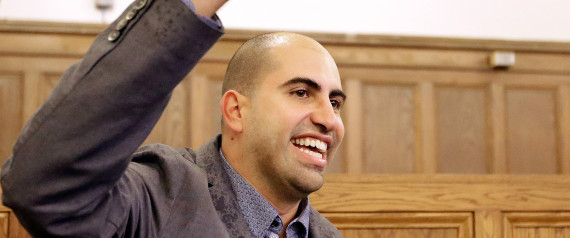
Today Steven Salaita gave a press conference. I was there. Full video here.

Salaita spoke, along with with his constitutional lawyer Maria LaHood, one of his employment lawyers, Robert Warrior (chair of American Indian Studies), and Michael Rothberg from English (who read a statement from the MLA).

You can read Salaita's statement here.

I'd like to offer a few key thoughts as an initial summary, in chronological order.

LaHood
  1. LaHood said that in just the last few years, there were over 200 cases of people at universities being reprimanded, fired, or even litigated against for making anti-Israel statements. She argued that this is sign of a persistent attempt to silence critics of Israel in American higher education. Palestine Solidarity Legal Support will be publishing a study on this in the next month. 
  2. Salaita's lawyers also call this a termination. Their legal strategy is that Salaita was, in fact, already hired, so this is unjust firing.
Salaita
  1. Salaita himself said many things in his statement worth noting, but you can just read it. His comments on twitter, the real-time nature of it, his teaching record, his concern about academic freedom as a principle, and more. Seriously, it's not long, go read it.
  2. I am struck by how committed he remains to UIUC and his lifetime of scholarship spent challenging orthodoxies. So, here he is now, challenging orthodoxies.
  3. He also revealed that his offer letter specifically references UofI adherence to the 1940 AAUP principles of academic freedom. I've confirmed this is standard. Everyone associated with the AAUP today agrees the UofI violated those principles. Are they going to keep sending that out in the offer letters when they are under AAUP censure (if it comes to that)?
Robert Warrior

In a few ways, his comments were more informative about the process than Salaita's statement
  1. Chancellor Wise didn't engage with Salaita's whole twitter stream, but accepted the cherrypicked inflammatory statements as proof positive that Salaita was not acceptable for UIUC.
  2. Wise initially said that Salaita's social media use "would be monitored" so as to make sure he wasn't using university property to tweet about Israel. Chilling.
  3. Most disturbing, Wise said that Warrior needed to tell Salaita (video here), "We live in a town, we have to shop together, at Target, at Sam's Club, we have to follow a different set of rules." Collegiality is, I think, barely an acceptable norm on which to judge colleagues - i.e. can we function together as a body. Whether we're nice at Target is no way to run a major university hiring decision. In fact, it's not an acceptable way to decide about who to include in anything, not even your country club (though in fact it's just how such things work and perpetuate bias).  
Question and Answer Time
  1. Salaita and his lawyers are not considering any option other than reinstatement, including the possibility of a court injunction mandating reinstatement. He absolutely wants to work at Illinois, even after all this.
  2. His employment lawyer looked eager to do some document discovery and deposing of people. Given the lack of care with some of the statements already made public, I'd be worried if I were in the Chancellor's office. After all (this is me, not the lawyer), they can just settle and avoid discovery, but it takes two to settle. Salaita might choose not to do so anytime soon.
  3. "Do you support the boycott?" - A long long pause, followed by the answer, "I do." After, Salaita explained that he just didn't want to say anything that made it sound like it was his action. He supports all free speech, the freedom to dissent in any number of cases, not just his.
  4. If this case is really not about the donors, but about civility, then the chancellor and trustees should sit down with Salaita and have a dialogue, rather than reading angry tweets and angry letters from donors and letting them decide the situation.
Let me add a few thoughts. As of August 1, I hadn't really heard of Steven Salaita, although I knew something vaguely was going on at Urbana-Champaign.  Like many others, I read his tweets and thought they were harsh, but defended his hiring on the grounds of academic freedom and public engagement. I still believe in those grounds.

But it is increasingly clear that Salaita is an open and engaging teacher who welcomes all evidence-based arguments regardless of viewpoint. UIUC would be lucky to have him in the classroom. As a taxpayer of Illinois, I certainly don't want the state paying hundreds of thousands (or whatever number emerges) in order to have him NOT teach.

More on this to come. 

Monday, September 8, 2014

Brief Q&A with John Scalzi - Disability, Lock In, and #WeNeedDiverseBooks

Lock In is the newest book by the well-known sci-fi author John Scalzi. In my review at Huffington Post, I wrote:
On a certain level, this is a story about "wheelchairs," or rather assistive mobility devices. That's unusual. While many science fiction stories depict advanced technological responses to plagues or injuries, such stories usually involve seemingly miraculous cures. To my knowledge, this is the first science fiction novel based largely around the complexities of providing reasonable accommodations for disability.
The essay I wrote had to cover a lot of ground. It had to feel like a review and it had to engage the complex issues that are invoked by the book. It's a place to start with the conversation, not at all a place to finish. Still, I am encouraged.

Over the last many months, the hashtag #WeNeedDiverseBooks has been floating around twitter. And we do - our books tend to be so western, so white, so hetero, so reinforcing of perceived normative values. My particular focus, of course, is disability as diversity, but to write about that is not to ignore the pressing needs of race, class, gender, sexuality, religion, and more. 

I am, however, pleased with Scalzi's new book. I felt he wrote right up to the limits of his knowledge of disability issues and nicely wove that material into the book. 

I asked him two questions which he kindly answered.

1. You raise lots of issues about disability in Lock In. What research into these issues as you wrote? Are they issues which you were interested in before trying to flesh out the politics of your premise?
​Some of it I knew, in a very basic sense, from having friends engaged in various communities, in particular the deaf community. This gave me a lay of the land that I could then backstop with additional research. I was casually aware but not deeply engaged in disability issures prior to the book, but once I developed the idea for the novel it was important for me not to just blunder through imagining the development of the Haden culture -- I wanted it to have some resonance with disability cultures that exist today. As I've noted elsewhere, I still run the risk of missing things, but if so it's not for lack of effort. ​ 
2. In Old Man's War, you deal with age (which can be seen as a form of disability) and a new body. In Lock In, it's disability and a new body. Is this a Scalzi theme? Technological responses to the body as it doesn't work as expected? Is that an intentional theme, or more something that I, as a disability writer, detect?
​I think it's true that I am interested in how the body can be extended and as a result what that means for the identity of the person who is "extended" in that fashion -- and obviously as a science fiction writer, the path of that extension will be through technology (rather than through magic, as it might be for fantasy). I don't intentionally work the theme you identifiy -- but that doesn't mean it's not there. Writers often miss themes in their work that others detect.
The main theme in Scalzi's work is his engagement with re-purposing classic genres, this time murder mystery. It's also, in a way that appeals to me, an anti-zombie premise. Zombies are stripped of their mind, their identity, and their bodies just churn forward, based on a simple need to feed. Hadens, on the other hand, retain their identities and minds even as their bodies cease to respond.

Finally - I totally blew it in my review in two instances. The minor one was that I revised the review just before publishing, and I forgot there's a hilarious appearance of a wheelchair in the book. Just one. Originally, though, I wrote, "Technically, no wheelchairs appear ..." Oops.

More interestingly, I entirely missed that the main character, Chris Shane, is intentionally gender neutral. Scalzi uses no pronouns. There's no description of a human body. But I, a man, reading a book written by a man, with the surname Chris, assumed male. That was my mistake.


Sunday, September 7, 2014

Sunday Roundup - Vikings and Security Guards


My semester has begun and I'm working on a book proposal. I'll tell you all about it if it goes anywhere. These things are eating up some of my writing time.

Still, it was a pretty lively week on the blog.

The story I didn't tell yet is on Medicare rules for speech devices. The story here is that tablets with good apps and add-ons are much, to my mind, better than dedicated medical speech devices. But the latter, thousands of dollars more expensive, are the things that are covered. I'm going to try to figure out a way to tell this story this Fall.

I wrote two blogs on the incident of the mock-frisking of a boy with Down syndrome in Syracuse. It's bullying, the guard was fired, but I still want us to do some thinking about the culture that enables such behavior.

The most fun piece to write was on Viking Women Warriors - History is not a straitjacket for fantasy. But we do need more diverse books.

I'm deeply concerned about academic freedom and I wish more scientists would get involved in this case in Illinois. I offered some opening thoughts on how to persuade our scientist friends who think it's just not their concern.

Finally - two stories of involuntary commitment. The details of both remain unclear to me, but I'm watching them and the broader argument that says the solution to police killing folks with disabilities is to lock up the folks with disabilities for their own safety.

And that's the week on the blog! See you tomorrow and happy Sunday.

Friday, September 5, 2014

#CultOfCompliance - How a White Guard Decides It's Funny to Fake-Frisk Black Boy with Down Syndrome

Yesterday, in something of a rage, I wrote the story of an African-American boy with Down syndrome who was heading to his first day of school in Syracuse. His parents were with him and, as they entered the school, they paused to take a picture.

A white security guard intervened and pushed the boy against the wall to 'assume the position' as if he were being frisked.
"Wait, wait, wait, hold on,'' Brandiss Pearson [the boy's mother] recalls the sentry saying. Then the sentry turned Brandon to face the wall and lifted Brandon's hands above his head on the wall, as if to be frisked, she said.
"And he starts laughing and says, 'Now take the picture, he's in the right position,' '' Pearson recalled.
This is racism, ableism, and authoritarianism. Racism because the "right position" for a black boy in this guard's eyes is against the wall. Ableism because he's relying on the fact that Brandon has Down syndrome to make it funny - indeed, Brandon thought it was all a game. To me, that intensifies the awfulness of it.

Authoritarianism because this is one way that the cult of compliance has entered our schools.

I don't want to overlook this last point as I wallow in the anger at the racism and ableism. Schools are not militarized yet, not in the ways our police forces are, but they are increasingly a part of our compliance-driven state.

Within the school, the guard has intensifying power to control the space and control the bodies - especially the bodies belonging to people of color - all in the name of safety. And sure, safety is important, but as Bruce Schneier says, 1) We're bad at assessing risks and 2) all security comes with trade-offs.

There are consequences when we fill our schools with guards, with metal detectors, with draconian dress codes, with zero tolerance policies, with the constant drumbeat of fear that your school or your kids' schools or your neighborhood school is beset by armed gangs ready to do battle or psychopaths ready to commit a massacre! There are consequences and we have not properly assessed the trade-offs here between security and not just loss of freedom, but loss of sense of self-worth and the price of empowering men like this security guard.

Our schools do need security, sadly. What they don't need is a demand for total compliance. They need guards who understand their job is to protect and empower the students as they chase their future, not control, not dominate, not bully.

This guard is a bully. He's the same as the kids who dumped feces and urine over an autistic boy who thought he was doing the ice bucket challenge. He's the same as the people who sent mean texts to a girl with seizures. He's the same as the "teachers" who use electrical shocks to "control" people with autism. He's the same.

But he has a kind of power in the school that he's used to exercising, and it seemed like it would be funny to him, and if it's funny to him, surely it's funny to the parents and boy too.

The incident is disgusting. The guard will likely be fired (he's been suspended). If he talks to the press, he'll express regret, he'll say that he was just trying to make a joke and didn't think about it. I believe him that he didn't think. Such acts of petty control have become normal, and if Brandon didn't have Down syndrome, if the guard just pushed another black boy up to assume the position, we probably wouldn't hear about it.

I'm going to end with a quote from Alice Goffman's controversial book On the Run. One thing that even her critics agree is that she did a good job showing the consequences of police abuse, not just on the people arrested, but on the whole community. She writes:
I saw children give up running and simply stick their hands behind their back, as if in handcuffs; push their body up against a car without being asked; or lie flat on the ground and put their hands over their head. The children yelled, “I’m going to lock you up! I’m going to lock you up, and you ain’t never coming home!” I once saw a six-year-old pull another child’s pants down to do a “cavity search.”
These are the trade-offs of our pursuit of perfect safety and total compliance - Brandon against the wall, the six-year-old pretending to do a cavity search.

UPDATE: The guard was fired. That's good. The question is whether the school admin will also think about the culture that enables such a guard to exist in the first place.

Thursday, September 4, 2014

White Guard to Black Student with Down Syndrome: Assume the Position (as a joke)

Sometimes I write about Down syndrome and comedy and why I think it's so important. I get the pushback - lighten up, it was only a joke, don't take things so seriously, and so forth.

So here's this story from Syracuse.com (via the Daily Mail, which loves "outrage" reporting on authoritarians in the U.S.). A 12-year-old boy with Down syndrome was heading to school for his first day:
Brandon was accompanied on his first day at Huntington K-8 School in Eastwood by his mother, Brandiss Pearson, her husband and her father.

When they stopped in front of a hallway mural to snap pictures, a school sentry, or security guard, who is white, inserted himself. Brandon and his family are black.

"Wait, wait, wait, hold on,'' Brandiss Pearson recalls the sentry saying. Then the sentry turned Brandon to face the wall and lifted Brandon's hands above his head on the wall, as if to be frisked, she said.

"And he starts laughing and says, 'Now take the picture, he's in the right position,' '' Pearson recalled.
As always, I suggest an intersectional reading of the event. Racism takes the center, but disability enables the racism to play out, to make the argument that this is only a joke.
Pearson reported the incident to Huntington's principal Tuesday afternoon. She tearfully confronted the security guard, or school sentry, Wednesday when she saw him in the hallway. He responded that he thought it was "a funny joke,'' she said.

School administrators put the sentry on leave Wednesday while they look into the incident, said Michael Henesey, coordinator of communications for the school district. Henesey declined to identify the sentry. Pearson said she did not know the sentry's full name.
This is a prime example of why I am so concerned about how we represent disability, how we make sure we tread people with disabilities as full people, not as objects. Because I don't care if Brandon didn't understand what was happening on some level, if he was laughing. This is objectifying and humiliation. It's akin to the constant bullying that plays about an eagerness to please and a confusion about social norms for people with developmental disabilities.

I write this little post as I ponder what happened in North Carolina thirty years ago. Two black men with intellectual disabilities were harassed and bullied by police into signing confessions, they were placed on death row, they lost thirty years of their lives, they were innocent. The cops at the time knew that they were innocent, or at least had the evidence of the true criminal at their fingertips, and yet decided to go ahead and throw these two in jail.

Yes, racism. Yes, ableism. Yes, authoritarianism. 


Viking Women Warriors and Diversity in Literature

And that no one may wonder that this sex laboured at warfare, I will make a brief digression, in order to give a short account of the estate and character of such women. There were once women among the Danes who dressed themselves to look like men, and devoted almost every instant of their lives to the pursuit of war, that they might not suffer their valour to be unstrung or dulled by the infection of luxury. For they abhorred all dainty living, and used to harden their minds and bodies with toil and endurance. They put away all the softness and lightmindedness of women, and inured their womanish spirit to masculine ruthlessness. They sought, moreover, so zealously to be skilled in warfare, that they might have been thought to have unsexed themselves. Those especially, who had either force of character or tall and comely persons, used to enter on this kind of life. These women, therefore (just as if they had forgotten their natural estate, and preferred sternness to soft words), offered war rather than kisses, and would rather taste blood than busses, and went about the business of arms more than that of amours. They devoted those hands to the lance which they should rather have applied to the loom. They assailed men with their spears whom they could have melted with their looks, they thought of death and not of dalliance. Now I will cease to wander, and will go back to my theme.

- Saxo Grammaticus, The History of the Danes, Book 7.

Over the last few days, many people shared a cool link about Viking women warriors that has been circulating lately. It came from Tor.com, the sci-fi/fantasy publisher that has recently launched an excellent online publication. The piece declares, "Half of the Warriors Were Female," based on new archaeological evidence. That title does not actually hold up to a closer reading of the evidence, but the evidence is still really interesting. More below.

Part of why I'm interested is the backlash to the new female Thor, who looks like this.

THOR! (This is my daughter)

Oh wait, actually more like this.


The article then provided fodder for people wanting to argue not just that female warriors were artistically permissible (because everything is artistically permissible), but supported by historical evidence. It's part of the much bigger conversation about diversity in speculative fiction. 

Unfortunately, the evidence, which comes from this study (you will need a good library to access it), doesn't support the headline. The blog "Missed in History Class," provides an excellent summary of the actual findings, as does this comment to the original post, and this by Kate Wiles.

Here are the takeaway points, as far as I am concerned.

1. I was skeptical of the Tor article, and thought - I suspect that if I dug into the original evidence, I'd find that we have a better idea of biological sex balance of the overall early Viking population in England, but that the "warrior" claim is not especially supported by available evidence - because that evidence is going to be fragmentary and limited in what it reveals (as is the nature of such archaeological work, as vital as it is).

2. I didn't want to be the grumpy historian mansplaining away Viking women warriors, so I let it go. More importantly ...

3. The actual evidence is REALLY COOL and here are things worth knowing. Common wisdom suggests that the initial wave of Viking invaders of Britain were almost all men. Analysis of the bones (osteoarchaeology) of 13 first-wave Vikings shows 7 men and 6 women. That common wisdom must be questioned, as then must the narrative that the first-wave was a bunch of raiders, rather than colonizers. This is good stuff, well worth thinking about. 

Also, we learn that using grave goods to determine biological sex is bad methodology (archaeologists already knew this, by the way). Bodies with jewelry are not necessarily female. Bodies with weapons are not necessarily male. But in the 19th and early 20th centuries, such assumptions were routinely made. Bones are a much better way of determining biological sex, and there have been women found with weapons. Being buried with a weapon doesn't mean that the woman fought with the weapon, but at least it shows its culturally a possibility.

4. Given the quote with which I opened above, we actually already knew that. There is lots and lots of textual evidence for a tradition of women warriors in pre-Christian Scandinavian culture. Notice that Grammaticus (who lived in the 12th century), who we believe worked for an Archbishop of Denmark, is writing about this as a distant past tradition. 

5. If you have time, you could go read Book 7 and skip down find the word "Alfhild." It's a great story, suitable for Disney, in that we've got a beautiful princess whose parents are so screwed up that her dad locks her in a room with snakes, and when Alf the suitor defeats the snakes, her mom convinced her not to trust Alf. Alfhild runs away and becomes an awesome pirate. Later, Alf's ship and Alfhild's ship encounter each other in battle. Alf is winning, but then Alfhild's helmet gets struck off and so he either - sweeps her into his arms and kisses her and they all live happily ever after; or, he rapes her then marries her and they all live ever after. 

This is not atypical of medieval women-warrior narratives. One of my favorites is the Romance of Silence. Silence is a woman who puts on armor, goes to court, the queen falls in love with the beautiful young warrior, Silence demures, the queen gets mad and talks to the king, and Silence is sent off on a hopeless quest to capture Merlin. Merlin, it is said, "can be defeated by no man" (yes, echoes of Tolkein. He was a medievalist). When Silence meets Merlin, Merlin laughs and laughs and they all head back to court, tell the king about his treacherous wife, and so the king marries Silence instead. Silence ends the story, like Alfhild, in a dress. Gender norms are restored. 

6. I understand the current debates among fiction writers focused on whether the Middle Ages were mostly homogenous or quite diverse. My attitude is that it depends where you look, and that they were both homogenous and diverse. The stakes, though, are whether authors who do not write with characters diverse in race, gender, religion, etc. can say, "I'm just being accurate!" The stakes are whether people who introduce diversity into medieval western settings, which thanks to Tolkein (and now GRRM) is really common, can be criticized for being inaccurate. My attitude is generally this - write whatever story you want, understand that the choices you make about diversity have consequences, and that they are choices. History is not a straitjacket for fantasy.

We can have a conversation about historical fiction another day. 

Wednesday, September 3, 2014

ALS and Medicare rules for Speech Devices

There's a story happening with medicare and "speech generating devices," especially those involving eye tracking (of the sort frequently used by people with ALS). I'm trying to figure out where we stand now.

Last Feb,the folks who admin Medicare changed the rules for speech devices (devices in which you push buttons to make words/phrase).

1) One issue involves renting for 13 months (and then owning) rather than owning outright. This is an issue because coverage stops if there's a hospitalization or nursing home stay.
2) They said they wouldn't cover devices that allowed users, with their own money, to add functionality (eye tracking, email, internet, etc).
3) Questions about supporting eye tracking at all.

Some went into effect April 1. Others were to go on 9/1, but now it's been delayed to 12/1.

Here's what I know. There's a congressional "Dear Colleague" letter that can be signed by Friday. Write your congressperson.

Here's some coverage.

Washpo - Medicare spokesperson says nothing is changing.

Plain Dealer - Everything is changing.

I think the real issue can be found here:
People with Medicare will no longer have the option of buying the basic devices outright. Before, insurance would pick up the majority of that cost if it accepted a report prepared by a licensed speech pathologist and signed off by a physician.
No longer will families be able to pay for upgrades (Internet access, newer software and eye-tracking technologies that let people without speech or hand capabilities "type").
There - it's the ability to add technologies that seems to be the problem.

CMS has said:
The new rules are being reviewed, and a final decision is slated for Dec. 1. CMS said in a statement that the agency will “ensure that we are able to review and address issues that stakeholders have raised, including the ALS community’s desire for beneficiaries to have access to devices with expanded functionality.”
ALS groups say:
Medicare had long allowed families to use their own money to upgrade the basic speech-generating devices covered through the program, the Center for Medicare Advocacy said. The policy review, however, seems to make clear that any device capable of being adapted for nonspeech uses such as email and Internet access — as most are nowadays — won’t be covered in the first place.
“We’re very concerned,” said Marlin Seymour, executive director of the ALS Association Central & Southern Ohio Chapter. “If you happen to be an ALS patient, then you want your device to include the ability not just to speak through it, but to do email, use the Internet, turn the TV on, those kinds of things.”
Call your congressperson by Friday.

Other reporting on the issue (prior to the delay to 12/1 for implementation).


Scientists and #SupportSalaita

I asked a faculty member at the University of Illinois Urbana-Champaign  whether they thought there was any chance that the chancellor and board might reverse their decision on Steven Salaita (you can read here for my take on the case). Their answer - If the scientists  (i.e. the people with the money) get involved.

So far, to my knowledge, the scientists haven't really gotten involved.

There's one petition/boycott-letter for scientists and engineers hosted here. It has about 18 names on it, compared to 500 for philosophy. I am sure there are scientists among the 1766 signatories to this general boycott. I'm sure there are some scientists among the 17,000+ signatories to this petition. It has not, however, caught on with scientists in general, to my knowledge.

I maintain that this is an issue of academic freedom and that Salaita is being punished for criticizing Israel, and not for being rude. Academics are rude all the time. They don't generate well-designed letter-writing campaigns unless they hit a triggering issue. I am taking no position on Salaita's tweets and their content. I am, instead, saying these things:

Either Salaita's public speech reflects his identity as a scholar, so must be protected, or it's the uttering of a private citizen, so then it cannot be considered relevant. 

Academics can, of course, cross lines in their personal and professional conduct that would make it impossible or unethical to continue to employ them. When such lines are crossed (and it's a very high bar), they still merit due process and a chance to respond to accusations made against them.

Steven Salaita was given no such chance. Instead, on a Saturday morning in August, he got a half-page pdf letter emailed to him telling him the job was off (this letter has been made public via FOIA).

If you believe in the principle of academic freedom, then you must extend that principle to those with whom you disagree, or you have no principles.

So how might we motivate scientists?

Here's my first stab. Scientists, as they know better than anyone, are extremely susceptible to public and political pressure. They may not be writing about Israel (except for archaeologists, who are, and who get plenty of pressure too), but they are writing about climate change, about energy policy, about subjects involving billions and billions of dollars. Have they forgotten the words of VP-Candidate Palin?
"Where does a lot of that earmark money end up anyway? […] You’ve heard about some of these pet projects they really don’t make a whole lot of sense and sometimes these dollars go to projects that have little or nothing to do with the public good. Things like fruit fly research in Paris, France. I kid you not." - Sarah Palin, 2008.
The same forces that are capable of generating outrage at a Palestinian-American professor are also coming for your science. Palin in 2008 was a warning shot. In 2013, the GOP tried to pass the "High Quality Research Act," in which Congress would get to choose what kinds of  subjects got funded by the NSF. Lamar Smith and Eric Cantor took to USA Today to tout their bill, mocking, just like Palin, the crazy things that those wacky scientists study. Then in a more formal letter, Smith said he didn't like studies on the international criminal court, Chinese dairy, or conservation in South America.

Lots of science writers protested and even Obama defended the process of peer review, The bill isn't getting passed this year. But wait, it will cycle through again, it will appear in state legislatures, it will make its way to Boards of Trustees. Why, they will be asked, are your faculty studying /that/? Why are they wasting taxpayer money on /that/? I suspect it's already happening, but I lack the examples.

These kinds of political pressures - don't study gun violence, don't study conservation, don't study global warming, don't study fracking, etc. - are not exactly analogous to the Salaita situation. The tools to defeat these pressures, though, are exactly the same.

Faculty review, faculty governance, and academic freedom.

There's lots of money in R1 science. Lots of it. That brings power, but it also brings a kind of attention and oversight that we poor scions of the humanities can mostly avoid. So here's my thought:

Scientists - do you study something controversial, or just something a few politicians dislike? Do you ever hope to move to a new job? Do you hope to keep getting grant money at your current job?

Then you should #supportsalaita.


Tuesday, September 2, 2014

#CultOfCompliance - Thought Crime and Involuntary Commitment

Today's stories about compliance take a different spin. Thankfully, no one is being shot or tasered by the police in these examples. Two men have, however, been involuntarily committed for what they might do in the future.

One is an English professor. His case has not made the news but he was involuntarily committed and tweeted about it. I understand there has been some misinformation and definitely misinformed speculation (I was responsible for some of it). It's put the issues of involuntary commitment front and center, especially given the next case.

The other wrote science fiction set centuries in the future. He worked at a school. His story was set at a future school, beset by violence. And then he was taken for a mandatory emergency psych eval, his home and school were searched for weapons and drugs, and as far as I know he remains un-free. More details below.

When police justify violence, they often speak as follows: I told the person to comply, they didn't comply, so I felt there was an imminent danger to me, I felt at risk or threatened, so I had no choice but to shoot/taser/beat the individual. I'm sure I have hundreds of those justifications in my file by now.

In my work on the cult of compliance (click here for the overview), though, I am arguing that such incidents reflect a broader cultural veneration of compliance, a decreasing tolerance for risk, and the rise of authoritarian strains more generally in our society. As people with disabilities often behave in unpredictable ways, a compliance-driven society will tolerate such unpredictability less and less, which is my point of entry into the broader issue.

Involuntary commitment is predicated on incarcerating someone for actions that they have not taken yet. It's based on predicting imminent danger. As such, it's subjective (though there are medical requirements), it's been historically subject to immense abuse, and it's one of the topics on which my research is going to focus over the next few months.

Involuntary commitment is an important tool for law enforcement and mental health treatment. The problem is that it has frequently been abused as a way of enforcing social norms or even for eugenic purposes. Deviancy often gets classified as a mental illness, mental illness gets classified as a danger to society, a danger to society requires incarceration, and into institutions the deviant is forced.

Here's an excellent overview of the history of involuntary commitment. People familiar with Queer history are very much aware of the dangers here, because homosexuality was classified as a mental disorder subject to psychiatric treatment and commitment and such things as shock therapy (i.e. torture to remove homosexuality). Here's an upbeat piece on "danger" redefined, saying things are pretty good now (and they are much better). Here's a consumer factsheet on your involuntary commitment rights from HHS (that word consumer baffled me).

Alicia Curtis, the author of the overview, notes some of the complexities of the situation. She writes:
Dr. Paul Chodoff, who has written several articles on the topic, points out that the focus of the involuntary commitment law on "imminent harm" as the main criterion for commitment, leads psychiatrists to feel frustrated that their work is aimed more at serving the police state in keeping dangerous people off the streets than in carrying out the aims of psychiatry. He argues that the involuntary commitment law should be broadened to allow commitment of those with a mental illness who need hospitalization due to the severe state of their illness, whether they are dangerous or not.
Chodoff is right to some extent. For a long time, people with psychiatric disabilities (for illness vs disability, see here. When I use "illness" I am intentionally mimicking common use, not endorsing it) were routinely committed. Then we as a society moved away from that model, leading in some cases to better inclusion in communities. In too many cases, though, it's led to homelessness and the rise of prisons as the de-facto institution for the mentally ill.

Moreover, every time there is a mass shooting in which "mental illness" is involved, politicians and law enforcement call for looser involuntary commitment laws (see Sandy Hook). In fact, right after that event, a teacher was committed for buying a gun and claiming that the government was behind the massacre. Maybe he was a danger; I don't know. He denies it. And I don't agree with his conspiracy theory, of course. Still, I see involuntary commitment function, in many cases, as a tool of social control. And that worries me.

So these are the debates. What is the best way to manage situations when we perceive a risk of harm to self or other by someone who cannot, by themselves, seek help? How can we avoid the abuses of the past?

Here's the recent story.

Patrick McLaw writes science fiction. He teaches, well, taught, language arts at a school in Cambridge, MD. One book, The Insurrectionist, tells the story a huge school shooting in the 29th century (i.e. 900 years from now). McLaw is black. He is 23. He writes under an alias.

As near as I can tell, based on reports, he was suspended from his job, banned from school property, and involuntarily committed. Law enforcement swept the school and his home, finding no weapons or explosives.

And then there's this.
With school starting Tuesday, some parents tell WBOC they are concerned about safety, but both Wagner and Phillips said there is nothing to worry about.
"There will be a Cambridge Police Department presence at Mace's Lane middle school for as long as we deem it necessary," Wagner said.
"I think that the various police agencies that we have, working in conjunction with the board have a handle on the situation and I think we're going to have a safe and happy opening day of school tomorrow," Phillips said in an interview Monday with WBOC.
Reaction to the case from Reason, DailyKOS, The Atlantic. There's been lots of links made to Soviet practice of incarcerating dissident artists, but I think that's not what's going on here.

Rather, this is about a demand for thought-compliance. To think about a school massacre is to create the possibility that one might do it. Any evidence of violence must be met with overwhelming response - loss of freedom, loss of job, public exposure.

And then the kids can have a "safe and happy opening day of school" in our zero tolerance, and highly compliant, world.