"More house?" My son emphasizes the aspirated "H" as he climbs into our blue minivan. I pause and turn to look at him.READ THE WHOLE THING!
"What?"
"More ... house." This time he says it even more slowly, with a long drawn out "'hah" before getting to "ouse." He's eager to get the car moving and continue touring properties for sale in the Land of 10,000 Lakes.
"Good job saying 'house,' Nico," my daughter chimes in from the neighboring seat. I'm relieved. We're not going to buy a house today, but I'm glad to see everyone is having a good time as our realtor leads us on a tour through some of our Minneapolis options. We are moving from Chicago to the Twin Cities in just eight weeks. Moreover, we're doing it, at least in part, in hopes of ensuring a better future for our son.
When it comes to life with disabilities, state administrations matter. Sure, federal laws ensure basic civil rights, federal programs mandate (sometimes, but not always, with funds attached) all kinds of services, but states and their third-party partners (think non-profits) tend to administer everything. When a state collapses, it takes the disability services down with it. As Politico recently wrote: Illinois is a failed state.

Showing posts with label illinois. Show all posts
Showing posts with label illinois. Show all posts
Friday, July 7, 2017
Moving to Minnesota
For people with disabilities, state government matters. Illinois finally has a budget, but it's not a state on which I can gamble my son's adulthood. We're moving.

Wednesday, April 20, 2016
WBEZ: Trading parental rights for mental health care
In our system, parents have to abandon their disabled children (officially anyway) in order to make the state into a child's legal guardian, and thus the state will provide actual health care.
From WBEZ:
From WBEZ:
One of the worst moments in Eileen’s life was the day she called a local Chicago hospital to tell them she refused to pick up her 15-year-old son after he was discharged. He was in the hospital for psychiatric care, one of many visits over his young life.It makes terrible sense. I've written about the ways our system is so focused on crisis response rather than crisis prevention, so people can get into emergency rooms (maybe, sometimes, if not shot), but not long-term preventative psychiatric care. See here on Phillip Coleman and here on Paul Ryan for my work on that.
It’s hard to imagine why someone who loved being a mom would decide to refuse to pick up a child who had been discharged from a hospital. But it was a painfully logical choice.
Across the country, and especially in Illinois, it can be incredibly difficult to get psychiatric services for a child, let alone pay for them. So when a parent has a child that needs psychiatric help, that parent sometimes make an excruciating choice to give up custody.
The reason these parents abandon their children is because once the state becomes the child’s legal custodian, the state is forced to provide the mental health care the parent couldn’t access. According to the most recent data available, about every four days in Illinois, a parent gives up parental custody to get critical mental health services for their child.
Tuesday, September 9, 2014
Steven Salaita's Press Conference - My reactions.
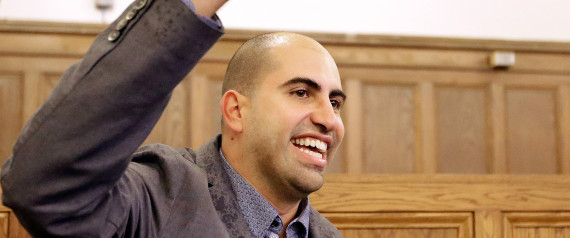
Salaita spoke, along with with his constitutional lawyer Maria LaHood, one of his employment lawyers, Robert Warrior (chair of American Indian Studies), and Michael Rothberg from English (who read a statement from the MLA).
You can read Salaita's statement here.
I'd like to offer a few key thoughts as an initial summary, in chronological order.
LaHood
- LaHood said that in just the last few years, there were over 200 cases of people at universities being reprimanded, fired, or even litigated against for making anti-Israel statements. She argued that this is sign of a persistent attempt to silence critics of Israel in American higher education. Palestine Solidarity Legal Support will be publishing a study on this in the next month.
- Salaita's lawyers also call this a termination. Their legal strategy is that Salaita was, in fact, already hired, so this is unjust firing.
Salaita
- Salaita himself said many things in his statement worth noting, but you can just read it. His comments on twitter, the real-time nature of it, his teaching record, his concern about academic freedom as a principle, and more. Seriously, it's not long, go read it.
- I am struck by how committed he remains to UIUC and his lifetime of scholarship spent challenging orthodoxies. So, here he is now, challenging orthodoxies.
- He also revealed that his offer letter specifically references UofI adherence to the 1940 AAUP principles of academic freedom. I've confirmed this is standard. Everyone associated with the AAUP today agrees the UofI violated those principles. Are they going to keep sending that out in the offer letters when they are under AAUP censure (if it comes to that)?
Robert Warrior
In a few ways, his comments were more informative about the process than Salaita's statement
- Chancellor Wise didn't engage with Salaita's whole twitter stream, but accepted the cherrypicked inflammatory statements as proof positive that Salaita was not acceptable for UIUC.
- Wise initially said that Salaita's social media use "would be monitored" so as to make sure he wasn't using university property to tweet about Israel. Chilling.
- Most disturbing, Wise said that Warrior needed to tell Salaita (video here), "We live in a town, we have to shop together, at Target, at Sam's Club, we have to follow a different set of rules." Collegiality is, I think, barely an acceptable norm on which to judge colleagues - i.e. can we function together as a body. Whether we're nice at Target is no way to run a major university hiring decision. In fact, it's not an acceptable way to decide about who to include in anything, not even your country club (though in fact it's just how such things work and perpetuate bias).
Question and Answer Time
- Salaita and his lawyers are not considering any option other than reinstatement, including the possibility of a court injunction mandating reinstatement. He absolutely wants to work at Illinois, even after all this.
- His employment lawyer looked eager to do some document discovery and deposing of people. Given the lack of care with some of the statements already made public, I'd be worried if I were in the Chancellor's office. After all (this is me, not the lawyer), they can just settle and avoid discovery, but it takes two to settle. Salaita might choose not to do so anytime soon.
- "Do you support the boycott?" - A long long pause, followed by the answer, "I do." After, Salaita explained that he just didn't want to say anything that made it sound like it was his action. He supports all free speech, the freedom to dissent in any number of cases, not just his.
- If this case is really not about the donors, but about civility, then the chancellor and trustees should sit down with Salaita and have a dialogue, rather than reading angry tweets and angry letters from donors and letting them decide the situation.
Let me add a few thoughts. As of August 1, I hadn't really heard of Steven Salaita, although I knew something vaguely was going on at Urbana-Champaign. Like many others, I read his tweets and thought they were harsh, but defended his hiring on the grounds of academic freedom and public engagement. I still believe in those grounds.
But it is increasingly clear that Salaita is an open and engaging teacher who welcomes all evidence-based arguments regardless of viewpoint. UIUC would be lucky to have him in the classroom. As a taxpayer of Illinois, I certainly don't want the state paying hundreds of thousands (or whatever number emerges) in order to have him NOT teach.
More on this to come.
Subscribe to:
Posts (Atom)