Friday, March 21, 2014

World Down Syndrome Day - The Long Game. Or why cute and happy is not enough.

Today is World Down Syndrome Day, chosen because 3/21 reflects the three 21st chromosomes that mark the genetic condition Trisomy-21, also known as Down syndrome. It's a day about awareness and you will, if you're lucky, see lots and lots of cute pictures of kids and adults with Down syndrome. Here's a cute picture of my son hugging a stuffed alligator at the zoo. I love cute pictures of kids with Down syndrome.


Cute, right? Do you feel more aware? 

You might see people wearing funny mismatched socks, not, I think, because people with DS are funny and mismatched (though I feel there's an implication here I'm not comfortable with) but as a conversation starter.

I am wearing black socks. They are not funny. They do match. Even more unlikely, they don't have any holes in them.

When it comes to the cutesy and commercialized elements of the Down syndrome internet, I am a curmudgeon.

My basic argument is this. Cute pictures are nice. You know what, my son IS cute. Most kids are cute. Cute is what kids do. But they render our children as objects to coo over, and the labels of cute and sweet persist past the delicate phases of toddlerhood and infancy, defining even the perceptions of teenagers and adults. What about the moments in which humans, real, complex, three-dimensional humans, are not so cute? What about pain? Violence? Sorrow? Poverty? Rape? Murder? My fear is that because there's so much emphasis on cute and on children, that cute makes it hard for other stories to emerge.

Cute is the low-hanging fruit. If we in the community employ it, we must do so as a tool to open the door and start the conversation, not as an end to itself. Otherwise, cute just becomes "sweetness porn." It makes you feel good, but it doesn't do anything - except perhaps shut out the non-cute. At best, it promotes a nice feeling of passive awareness, because it's easy for people to be aware of something cute.

But as I've said before, I'm playing the long game. I want inclusion (and not same-ness). I want resources. I want justice. I want to change perceptions.

Disability scholars use the phrase "inspiration porn" to describe ways in which people with disabilities are leveraged to inspire others, losing their own agency, losing their wholeness as a complex person, and often sending messages that if you aren't inspiring as a disabled person, you're letting the side down. I argue that our focus on cute, sweet, and happy in the Down syndrome community does the same thing.

And so I write about death and rape, I write about violence and enforced compliance, and I question the utility of things that make me feel good about people with Down syndrome and the world. I question the value of letting kids with DS score uncontested touchdowns, even if it makes them happy. I question the significance of voting kids with DS as homecoming kings and queens - yes, it makes everyone happy and helps the typical kids feel good about themselves, but tomorrow are they going to go out and advocate for reinstating respite care for struggling parents of kids with disabilities? Or is it just patting themselves on the back for showing how great they are. I am a cynic; a curmudgeon; a writer about difficult topics - and I grateful to CNN and others for letting me have that surly voice on a national stage.

Again, if you post lots of cute pics and blog or publish heartwarming stories, thank you. You are doing a lot for awareness.  I believe in our community and am so privileged to be a part of it. I believe we are all trying our best and trying to make a difference. And again, cute opens the door. But it just can't stop with that.

Here's one example.

Below is an amazingly heartwarming video called #DearFutureMom. It features people with DS from around the world describing life with Down syndrome, trying to ease her fears. Frankly, it makes me a little teary at the end when they talk about love and hug their parents. Over 2.6 million people have watched it at the time of this posting.


The moral at the end: "People with Down syndrome can live a Happy Life."

And they can. 

But happiness isn't enough for me. There's so much more work we have to do.

Happy World Down Syndrome Day.

Thursday, March 20, 2014

Nazis (re-enactors) in Minnesota

Updates below including a comment that the whole concentration camp thing is just "water under the bridge.

On Martin Luther King Jr. Day, in Minneapolis, a group of people held a Nazi-themed dinner at a German restaurant in Northeast Minneapolis. It turns out that they were German-themed WW2 re-enactors. 

A member of the group, Jon Boorom says:
He also maintains that members of the German WWII re-enactment groups are given extensive background checks and no neo-Nazis or "political racists" are allowed to take part in the events.
"If you wear a German uniform or a Nazi uniform, it's not like you're saying, 'I think Hitler was super cool' or 'I hate Jews' or 'I hate gays' or 'I hate democrats,'" Boorom explains. "You're not there because you believe in what Hitler stood for -- you're there to educate people about history, and a lot of that is so people don't forget. It's the same as wanting to be the bad guy when you're playing cowboys and Indians. There's an attraction to the bad side."
This claim interesting, given the Nazi tattoos on the organizer of the dinner, Scott Steben. On his right arm, he has tattoos of the Nazi SS bolts and the official SS skull on his right arm, and perhaps the eagle and swastika above that.


Steben responded to inquiries from the City Pages, which broke the story, with:
We are a historical reenactment and professional actor society dedicated to promoting understanding of World War II. In no way are we or any of our members affiliated with groups that promote the subjugation of anyone. All our members value education, equal rights and the complex relationship between good versus evil. These values shine through during our frequent public, Re-enactment Society-sanctioned reenactments of historic WWII battles and events and nationally released movie, Memorial Day. Sadly, these values were not captured in the photographs taken of us during the private dinner.
I guess once you tattoo the double bolts on your body, not drawn on for an event or something, but permanently embedded in your skin, you've kind of crossed a line. It's not to say that there aren't perfectly benign reasons for re-enacting as Nazis.

We could probably have a conversation about Nazi symbols vs the Confederate symbols in Civil War re-enacting, and I'd be interested in hearing your thoughts on that. Are they the same? I'm sure there are confederate parties and dinners all over the country, though concentrated in the South of course.

But here's my other question:

What the hell is the restaurant owner, Mario Pierzchalski, thinking (other than about money) as he bedecked his restaurant with swastikas? Did the staff have a choice about working the event or not? What did they think about going to work surrounded by those symbols of genocide and evil? I see the staff in this picture, hugging the Nazi officer, flags on the wall behind them. What's on their minds?

More photos of the dinner here, like this one:


So now what, Minneapolitans and others? Is it fair to be upset at a business that takes money for a bunch of re-enactors who want to play Nazi? Because I'm upset.

------------------------------

Updates:

UMN Faculty, including one of my professors, respond, weighing in on the meaning of historical memory in this case:
We wonder what exactly the mostly male participants in this Nazi-themed dinner party were re-enacting. A militarized, fundamentally antidemocratic and ethnically cleansed community? A supremacist fantasy of conviviality stripped of its underlying genocidal violence and passed off as nice and normal? To witness fellow Minnesotans entertaining themselves in this fashion, no less at a restaurant named “Gasthof zur Gemutlichkeit” — German conviviality inn — is nothing short of obscene.
Update on the staffers:
The Jan. 20 party drew concern from a Gasthof staff member, who was one of three working that night. The staffer shot at least five photos with his cellphone that show people milling about in German army uniforms with four Nazi banners hanging in one of the restaurant’s dining rooms. Another photo shows a black T-shirt adorned with a Swastika that the staff member was given by someone at the party.
The photos themselves were shown to a Star Tribune reporter by a friend of the staffer. Neither agreed to be identified.
The staffer was fired Friday after he admitted to Gasthof’s owner Mario Pierzchalski that he took the photos and shared them with friends.
More updates on the details of working the event:
He told us that during an event, one of the group members asked him if he was German. When he told the group member he was Polish, he was asked if he had any family in the war.
"I said, 'Yes, my grandfather was in a Nazi concentration camp.' And they said 'Oh, well, water under the bridge then,'" the source says.
The group in the photos visited Gasthof's at least once each month and was given a private room in the back of the restaurant, according to another former employee who worked at Gasthof's for eight years before being terminated in December for unrelated reasons.
The former employee chose to opt out of attending the events, but heard about them from co-workers, he says. Only longtime servers and staff members were told the details.
"They would always ask people if they were German," the source says of the guests. "One of my wife's friends who was actually a server at the time, I think she was asked because she was German, they said, 'Oh we can make the perfect babies together because you're German and I'm German.'"
There was also a T-shirt with the swaztika and eagle and "tour dates" on the back to commemorate Nazi conquests.

The most important line here is, "water under the bridge." Atrocities? Meh, just water under the bridge according to this Nazi (re-enactor).

I am having increasingly difficulty writing about this dispassionately.

Wednesday, March 19, 2014

Hate Mail and Rape Culture

Last week I published a CNN essay on rape culture. It was reasonably widely read - some tens of thousands of people at least, 1000 comments, 7400 shares, hundreds of tweets. I think I did a pretty good job. And then I braced for impact.

When I wrote about Jenny McCarthy last summer, I got some of hate mail, disagreement mail, conspiracy theory mail, and so forth. When I wrote about Pope Francis, I got some anti-Catholic mail and covering-up-pedophilia hate mail. It's never been too bad though.

But when people write or speak about rape culture, they get hate mail, death threats, rape threats, and more. So yesterday, I decided I would share all of the hate mail I got in the wake of my CNN piece.


Of course, I am a guy. A straight, white, married, man.

It's not that I want threats or hate mail, it's that I think the lack of them in my case is significant of the broader problem faced by women online or women speaking in public in western culture more generally.

Tuesday, March 18, 2014

Management vs Administration - Reactions to my latest in the Chronicle

A few weeks ago a friend alerted me to a job ad for a Renaissance/Early Modern English professor at Texas A&M - Kingsville (TAMUK). The job summary read: PROVIDE EXCELLENT CUSTOMER SERVICE. I reacted (with some hyperbole) with a blog piece about why the retail model of customer service, in particular, didn't serve the students very well.

Today the Chronicle of Higher Education published an expanded and, hopefully, refined reaction to the job advertisement. There's plenty to complain about the way such a model treats faculty (and, as I'll say below, the negative consequences for administration too!). But I focus on students and learning.

Here are a few followups:

1. Someone is going to get this job. Given how many early modern lit grad students I know, it could even be a friend of mine. It's a solid, if busy, job (4:4 is hard, especially with research requirements). I wish all my friends the best and hope whoever gets it will thrive there.

2. I have reached out to TAMUK for comment, sending to both HR and faculty (and promised the latter anonymity). I asked HR, both over the phone and email:
I am writing a piece for the Chronicle of Higher Education on the use of business or corporate language throughout higher education. I've come across your job advertisements and the inclusion of the phrase, "Provide excellent customer service" in nearly all of them, including in positions for professors, administrative assistants, coaches, etc. I was wondering if you, or someone in HR, might be willing to comment on what you mean by that phrase in the context of academic hiring? Who are the customers? What does service mean in this context? In what ways is the significance of that phrase conveyed to job candidates and new hires? Finally, to what extent is customer service used as a category for weighing tenure and promotion?
They have not responded. I'll let you know if they do. Are these the right questions?

UPDATE 3/18 6:00 PM: I received a voice mail with a comment about Customer Service from someone in Human Resources. The comment is:
"We put [the phrase about customer service] in every job because we consider outside people, our students, as customers, and if they weren’t coming here they wouldn’t be our customers, so we want to express our excellence of service to them."
I'm not quite sure what that means. I've asked for clarification. 

3. Based on the comments, I think there's room to expand with some additional thoughts about administration. I was called out for using the phrase, "administrative bloat." It's pejorative and I think I will drop it. There certainly has been a rise in the number of administrators. This has both cultural and financial costs. A recent piece from the Chronicle notes that the faculty:admin ratio declined from 2000-12 by 40%, now at 2.5:1. Thus the savings from shifting to the adjunct model have largely been spent on hiring new admin. But at least some of this has happened because of new regulatory models (assessment assessment assessment), and "bloat" suggests that the university did this on purpose, rather than having no choice. It's an issue to consider.

4. More importantly, though, is the management vs administration shift which I articulated as follows:
Faculty members respond to the student-as-consumer by teaching defensively, fearing the management that we formerly referred to as administration. But administrators administrate on behalf of the faculty. Employees delivering customer service get managed.
These lines compress a lot of issues.

First: My argument is that once you move to the student as customer model, the faculty shift into the employee role, and administration shifts to management. It's bad for everyone. It's bad for education.

Second: I am fortunate to be surrounded with administration in my job who work collaboratively with the faculty. They do administrate us (I don't think the verb works that way, but whatever) and for us. I do not feel managed. This isn't to say that I agree with every decision or that sometimes I don't feel the gap between the faculty perspective and the admin perspective. This gap is by design and wholly appropriate. Admin must look on a macro level. Faculty should concentrate on the classroom, department, advisees and scholarly-field level. A well-functioning university finds ways to empower both of these fields of vision. When we disagree, which we will, the goal is to let the different perspectives lead us towards a useful synthesis rather than hostile division.

Third: Academics don't want to think of themselves as labor. In many ways, academia embodies precisely the kind of relatively high-status occupation for which collective organization and bargaining works very well. But despite the pressure from above, academics are loath to think of themselves as employees needing to organize. I assume it's cultural, but haven't really studied this issue. As the landscape of higher-ed changes, as more and more faculty work as contract labor (adjuncts), the labor model is going to be increasingly important for us to adopt. Collective organization, however adversarial, is the only way that a managed workforce with increasingly smaller shares of the financial pie and increasingly smaller roles in governance can change the dynamic.

I've reached out to a business professor and wonderful teacher to tell me what I get wrong about customer-service in my piece. I'll be back with more later as it comes up.


Monday, March 17, 2014

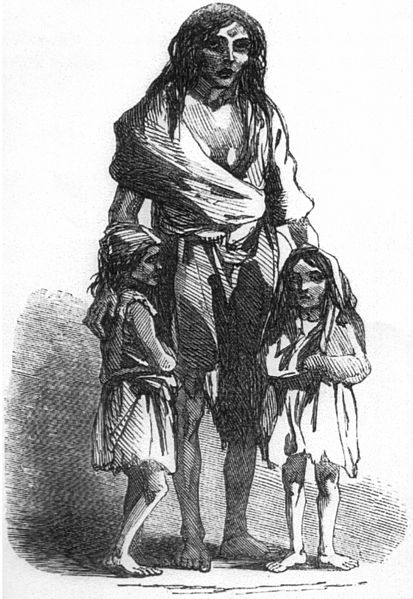
The Irish Famine and the Discourse of Poverty; or Why Paul Ryan should study history

As many of you know, I am not just a father, husband, professor, columnist, and blogger - I'm also a musician. I play in two Irish pub bands: The Tooles and Mulligan Stew. As a result, the last few days have been busy, with more shows to come.

Last summer, I played the Iowa Irish Festival in the town of Waterloo. There, I met Derek Warfield, a famous Irish musician, and a partisan for the Republican movement (about which there was some controversy, some decades ago). He and his band, the Wolfe Tones, wrote some of the great Irish rebel songs. Those that they didn't write, they certainly sang and with gusto. But in the last decades, Derek has spent as much time working as a historian. At the festival, I heard Warfield give a talk on the great famine in 19th-century Ireland, the famine that drove so many Irish to come to America. His thesis: The famine was an act of genocide by the English against the Irish.

The standard definition of genocide, a definition that emerged out of WW2, remains, "Genocide is the systematic killing of all or part of a racial, ethnic, religious or national group." While intention doesn't matter in terms of the crime, I'm also interested in why the systematic killing takes place. Does it happen because of perceived identity differences?

Warfield's basic argument is this:

1) The Irish were starving. They were starving because of a shift to monoculture (potatoes) that left them susceptible to blight. This was, at least in part, the fault of English landlords.
2) The English in power knew their Irish subjects were starving. [This is debated]
3) The English had plenty of extra food in storage, including in the major estates in Ireland. [This is debated too]
4) The English debated sending food relief to Ireland, and explicitly discussed the risk of wide-spread suffering and death due to inaction.
5) They chose not to help for both philosophical and racist reasons. [Hey, this is also debated]

Hence, the Irish who died or had to leave (ethnic cleansing) did so because of English inaction.

There does seem to me to be a categorical difference between marching groups to a field, having them dig graves, then shooting them as opposed to letting a "natural" event take its course without interceding. If this is genocide, it is a passive genocide, but that statement isn't intended to let the specific 19th-century English bastards who allowed the Irish to starve off the hook. They definitely made their choices and the repercussions of those choices have resonated across American and British history ever since.

I'm writing this up, in part, as a reaction to Timothy Egan's op-ed in yesterday's New York Times. He wrote a scathing response to Paul Ryan's exhortations about poverty by linking Ryan's speech to the speech of those very English bastards who decided to let Ryan's ancestors starve.

Paul Ryan, after relating an invented story about a poor child who didn't want a free lunch, said:
On Wednesday, he went further, using the language of racial coding. This, after he told a story of a boy who didn’t want his free school lunch because it left him with “a full stomach and an empty soul.” The story was garbage — almost completely untrue.
We have this tailspin of culture, in our inner cities in particular, of men not working and just generations of men not even thinking about working or learning the value and the culture of work.” [Egan] In other words, these people are bred poor and lazy.

“We have this tailspin of culture, in our inner cities in particular, of men not working and just generations of men not even thinking about working or learning the value and the culture of work.” In other words, these people are bred poor and lazy. 
Where have I heard that before? Ah, yes — 19th-century England. The Irish national character, Trevelyan confided to a fellow aristocrat, was “defective.” The hungry millions were “a selfish, perverse, and turbulent” people, said the man in charge of relieving their plight.
This is not the most damning quote from Trevelyan, who also said, "The judgement of God sent the calamity to teach the Irish a lesson, that calamity must not be too much mitigated. …The real evil with which we have to contend is not the physical evil of the Famine, but the moral evil of the selfish, perverse and turbulent character of the people." Trevelyan was concerned that if the government gave relief, people would be come dependent on that relief, and develop the habit of not working. 

Interestingly, and not in Egan's piece, when Ryan was confronted over the racism implicit in his comments, he responded that rural areas also have poverty because of a lack of jobs. Note: Urban - no culture of working; Rural - no jobs.

At any rate, although I think Egan's prose is a little overblown, I find the correlation between nineteenth-century right-wing attitudes about poverty and the modern right-wing movement to be fairly apt. In both cases, we have white elites looking at the poor of another race (the Irish were judged by the English to be severely "other") and thinking it a fault of character and breeding, not economics or government policy. Tough love is their solution (and tax cuts). All government aid is characterized as habit-forming handouts.

I write the historical parts of this blog to think about the way that history does and does not inform and infuse contemporary issues. That's my question - how did we get into this mess? In this case, it seems to me that in the West we remain bitterly divided about the proper response to poverty, the causes of poverty, and the duties of the government to its people.

The 20th century was the century of genocide. Whenever people say mean things about the Middle Ages, I like to note that there has NEVER been a century as brutal for human-on-human violence as the 20th. 

But as we seem to be entering this age of severe weather and environmental catastrophe - whether from cold, flood, drought, fire, storm, earthquake - we may well see more passive acts of genocide in the 21st century if those who believe that the poor need to be protected - not from poverty, not from disaster, but from habit-forming governmental assistance.

Happy St. Patrick's Day!


Sunday, March 16, 2014

Sunday Roundup

On Sundays, usually, I try to round-up my week's posts and maybe draw attention to something that people missed. I naturally spent a lot of time on my CNN piece on rape culture and Down syndrome. I have received a lot of great feedback, did a radio interview, wrote a blog post on sexual agency among people with DS, and another on how I see the facts of the case (once again, let me re-iterate, I am neither lawyer nor law enforcement professional. That said, the lawyers who talked to me have more or less agreed with my reading of the case, often with scathing commentary about the ineptitude of the judge).

I'm very proud of the CNN piece. I've written plenty of pieces about gender and male feminism before for mass media, but never about rape. I wanted to get it right and hope I did. Some of the professionals working both in law enforcement and for organizations dedicated to ending violence against women have said nice things, so I'm feeling good.

The under-read piece of the week was about "Talking to Girls about Sex." It was really a plea to help fund Scarleteen, a site that does this important job better than anyone else I know of. Please help if you can.

I also wrote a post on code-switching and white male privilege in the classroom that got a lot of readership, mostly because Inside Higher Ed tweeted it out (I was responding to two of their essays).  One interesting response: A friend suggested that he was tired of the phrase "white male privilege," not because he didn't believe in it, but because it was too soft. White male privilege, he argued, should be called racism and sexism. I'm not quite sure. I think racism and sexism are the causes of white male privilege, and maybe we could emphasize that more clearly. Another friend and colleague wrote that she wanted to erode my privilege. Me too, me too! I wrote another post in the wake of an internet hubbub about Nazareth College rescinding a job offer on "fit" as a way to conceal bias - even to oneself!

For International Women's Day, I wrote about the discovery of Trisomy-21 and the all-too-familiar tale of a man stealing a female scientist's work. Down syndrome also featured in yesterday's piece on the challenges of inclusion, in which I thought about the difference between help and friendship. Reciprocity is the key, as is my continued mantra that inclusion is not same-ness.

It's been a year of public writing for me and a busy week on the blog. Thanks for reading, commenting, and sharing.

And if you are looking for something new to read - try this on the origins of college rankings. It's Galton's fault, of course!

Saturday, March 15, 2014

The Challenges of Inclusion (not same-ness): Friendship vs Help

My son rides the regular school bus, a step that we decided on this year. The system has been supportive. Nico's aide meets us at the bus stop and facilitates the ride. On the rare days when he takes the bus home, she's there (she has to take the bus anyway to get back to her car).

But there's also a girl named G. who is in Nico's class, and she's an outstanding helper. I discovered this the first time the aide wasn't able to make it (thanks to the terrible winter we've had here). So I brought Nico onto the bus and G. popped up from her seat, smiling at Nico, holding out her hands, and sitting with him. I've rarely been so deeply moved (although there was another girl, H., early in the year, who I wrote about. She's great too). Over the past month, Nico's independence on the bus has improved dramatically, and I think G. has a lot to do with it.

Lately, some behavior issues in transitions (running mostly) have been ameliorated by having peers, mostly girls, walk with Nico from place to place, holding hands, helping.

And yet, yesterday the Twitter user @think_inclusive linked to a fascinating article on inclusion called, "HELL-BENT ON HELPING: Benevolence, Friendship, and the Politics of Help." It comes from a pair of educational consultants and counselors focused on disability issues, and although the piece is from 1994, it instantly raised alarms about what I've been seeing at my son's school. It also, though, offers useful terms and categories of analysis to think about inclusion and its possibilities. In the end (spoiler alert), I think Nico and his peers are doing alright.

Here's the introduction of the article, opening with the social and policy changes that moved through schools in the 80s and early 90s (emphases mine throughout)
The move toward cooperative and inclusive education is part of a larger move out of social oppression for individuals with disabilities. It is part of a groundswell movement of social reform that holds as a central tenet the belief that all children, including those with disabilities, are capable of learning and contributing to their classrooms and communities.
This is the first generation of children with and without disabilities to grow up and be educated together. Consequently, within inclusive education we have come to entertain a cheerful optimism that the generation growing up now will be different than those of the past. We are hopeful that greater contact between children will begin to break down the barriers of misunderstanding and dispel the myths that have created society's response to disability.
It was a good hope and authors note some genuine progress:
At first glance, this change might seem to be taking place. Individuals with disabilities are more visible and increasingly involved in community life. If we believed that greater proximity led to greater acceptance, it could be argued that we are successfully participating in the creation of a new social order. Unfortunately, this is only partly true. Instead, we are finding that increased visibility and "presence" alone do not necessarily ensure that those with disabilities are fully included.
True inclusion is dependent on the development of meaningful and reciprocal relationships between children. As classrooms become increasingly diverse, new strategies are being developed to ensure that the new students are more than simply present. Friendship circles, school clubs and special buddy systems have been implemented as formalized attempts to foster interaction and develop relationships.
Meaningful and reciprocal relationships. That's such a simple but powerful phrase. I've been thinking about my son's relationships. There are typical kids who clearly like him, hang out with him, and indeed help him (like G.). Are the relationships reciprocal? That I'm not sure.

The piece then expands to thinking about agency, or lack thereof, by focusing on "help."
Our society still perceives those with disabilities as perpetual receivers of help. Descriptors like "less fortunate" and "needy," telethons, and tear-jerker journalism all continue to perpetuate this view.
Unfortunately, there is still a distressing tendency in some schools to base interactions with students on these broader societal misperceptions, despite a sincere desire to end the isolation experienced by so many children with disabilities. Friendship clubs and buddy systems based on stereotypical beliefs risk perpetuating prejudices and myths and even exacerbating the problem.
Obviously, it is essential that students be provided with opportunities to interact. Formalized friendship and support circles may be effective ways to building relationships. However, an over-emphasis on the "helper/helpee" relationship can easily skew the delicate balance of giving and receiving that is the precursor of true friendship. It is critical, then, to regularly and carefully examine the nature of the interaction we facilitate and the attitudes that inform it.
Finally, an example:
Consider the following scenario:
Four third grade children from a local elementary school have come to speak to a room full of adults. They've been invited, with their teacher, to talk about friendship. 
Three of the four children in the room can speak, one of them can't. Three of the four children in the room can walk, one of them can't. The three walking, talking children are here to tell us about their relationship with the young man in the wheelchair. 
Adults in the room begin to smile as the first classmate talks. Approving nods accompany the child's words, "He's different on the outside, but inside he's just like me." 
The conversation whirls around the boy in the wheelchair as he scans the room, looks at his communication board and sometimes watches his classmates. 
"We take turns being his buddy," offers one young girl. "Everyone has a turn."
As the children talk and answer questions, it is interesting to watch the interplay between the subject of the discussion and the girl to his left. She has one arm around his shoulders, and in the other hand holds a washcloth. She wipes his mouth repeatedly. At one point, he appears to lose patience and struggles a bit. One hand jerks forward. His friend seizes his and holds it still. He makes a noise of clear irritation, and attempts to pull his hand free. 
His classmate smiles fondly at him, continuing to restrain his hand, and wipes his mouth again. 
We heard the boy's three classmates being called "the hope for tomorrow" and "exceptional kids". All over the room, adults were beaming. After all, this relatively new phenomenon seems to hold out some hope for an end to discrimination and distance between those who have disabilities and those who do not. 
However, as the presentation continued, it became increasingly apparent that while both adults and children thought they were talking about friendship, much of the discussion taking place was really about help. While there was undeniable warmth between the children, most of the comments and non-verbal interactions reflected a "helper/helpee" relationship, not a reciprocal friendship.
The whole article is worth reading as it moves from laying out the problem to potential solutions, ways to build reciprocal relationships, and the challenge of empathy. Empathy, in fact, lays at the core of this discussion - to move from a mechanical relationship of helper - helpee / active - passive - into one of mutual understanding and reciprocity.

Is this what's going on with Nico? Warmth. Helping. But in a way that denies him agency? I don't think so, not yet, but it's a fine line to walk and one I'm going to watch.

Here's something that sounds hard: I do not think Nico has any typical friends other than his sister. He has not been invited to a birthday party (Ellie has an invite practically every weekened). He doesn't get invited to playdates. But that's only if we define friendship in a typical way as experienced between neuro-typical children

I don't. My principle is inclusion, not same-ness. Here I turn back to this useful article and think about "meaningful and reciprocal relationships." Those I see forming all around Nico, I see Nico actively shaping them. I see them occurring in his classroom, at his after-school program, and in the neighborhood. It's a long slow process. The results may or may not look like typical friendships. 

And that's ok. Reciprocity and empathy will do just fine.

Friday, March 14, 2014

"Fit" and Nazareth College

Yesterday a piece in Inside Higher Ed on a rescinded job offer raised quite the twitterstorm on the academic net. And with good reason. According to a post on a philosophy board, a woman received a job offer from Nazareth College, in Rochester NY, then began to negotiate over terms of the contract. The department responded by rescinding the job offer.

In comments, on twitter, and around the web, academics debated, many finding the job candidate's negotiation strategy either unwise or entitled and defending NC's decision to pull the offer. They cite the "tone" of the negotiation email and argue that she revealed she wasn't a good "fit."

Tone and fit. The critique of tone, as the very active twitter historian @thehistorianess argues, perhaps emerges out of a specifically gendered response. I'll come back to that in a moment, because I agree, but I want to explore the concept of "fit" for a moment.

We hear a lot about fit in academic hiring, but I think it's a troubling phrase. Yes, it can refer to whether a person's career goals and strengths fit in well with the program considering hiring them, and that makes sense. But far too often, I think, it conceals various kinds of bias. "Fit" implies looking for a kind of likeness, a similarity, or perhaps a puzzle piece to fit in the empty space. Fit is nebulous, allowing a committee to overlook qualifications (though basically everyone is really well qualified) in exchange for valuing other kinds of factors.

I'm sure, in most cases, committees apply "fit" in appropriate ways: Is this person a dynamic teacher? Do they know how to teach first-generation students? Can they function at a big public university? But even these questions basically are looking for same-ness. Elite SLACs hire from elite SLACs (preferably with fancy private R1 phds). Fancy private R1s from fancy R1s. Big publics from big publics (or fancy private R1s). 

Even worse, though, fit can code for more pernicious kinds of bias. Race. Gender. Orientation. Class. Religion. Class is one of the big ones for me, as I think we talk about it a little less in the field than the others (not that they aren't huge problems too!). I know of so many stories of job applicants who felt they lost the job (and who really knows) when unable to talk about fine dining, or the latest movies, or the proper sports, or other kinds of knowledges that code for class. In an interview process for which "fit" might determine which of the final candidates receives that precious offer, "fit" offers a shield for like to attract like. "Fit" threatens the diversity of the academy.

Here are the emails in question, if you haven't seen them:
W's: [the candidate]
As you know, I am very enthusiastic about the possibility of coming to Nazareth. Granting some of the following provisions would make my decision easier. 
1) An increase of my starting salary to $65,000, which is more in line with what assistant professors in philosophy have been getting in the last few years. 
2) An official semester of maternity leave. 
3) A pre-tenure sabbatical at some point during the bottom half of my tenure clock. 
4) No more than three new class preps per year for the first three years. 
5) A start date of academic year 2015 so I can complete my postdoc. 
I know that some of these might be easier to grant than others. Let me know what you think.
Nazareth's response:
Thank you for your email. The search committee discussed your provisions. They were also reviewed by the Dean and the VPAA. It was determined that on the whole these provisions indicate an interest in teaching at a research university and not at a college, like ours, that is both teaching and student centered. Thus, the institution has decided to withdraw its offer of employment to you. 
Thank you very much for your interest in Nazareth College. We wish you the best in finding a suitable position.
So there we have it. What really interests me here is the response to W around the web. I've read so many accusations that she had a bad tone, too demanding, too strident. That she revealed she wouldn't be a good "fit" with her wild demands and that's why NC made the decision. But I agree with Historianess who tweeted (you can see original tweets towards the end of that storify above):
"Would anyone be commenting on her tone, the nature of what she asked for, and how she asked for it, if she were a man?" "The answer is no. The outrage on fb, twitter, and inside higher ed is bc this candidate did not behave as we think a female academic should." "If a man had been resolute, firm, confident, & clear in his tone no one would be criticizing him. Hardball negotiations are expected of men."
Yes, she's concerned about teaching preps. This is normal. Yes, she's concerned about her research agenda. It's a really hard transition from graduate school - where we are trained and praised as future scholars - to the teaching school. She's worried about salary, preps and wants to complete her post-doc.

She's ALSO following the advice of numerous articles that emphasize your right to negotiate once you have a job (a quick selection from IHE and CHE. There are vastly more. They all say - ask for what you want, try to express happiness about the job offer first, then be ready to accept no for an answer. W did that).

But in asking for what she wanted, she revealed that she might not "fit."

I can't say what went on inside the NC department in the decision to withdraw the offer. I find it surprising that in a long interview process they wouldn't have been aware of her research aspirations or be so willing to go back on their decision. I, like others, suspect that they read her as a pushy woman and fled quickly. But I don't know.

But in the comments on tone and fit throughout, I see acceptable smokescreens for bias. 

Thursday, March 13, 2014

A year of writing

Today's post is self-indulgent. It was one year ago today that I began thinking of myself as a public writer. Also please read this essay. It's one of my favorites, as events over-ran it so it got very little play.

I had written a few op-eds before. About the Crusades in contemporary political conversation and about the language of abortion and Down syndrome in the wake of Sarah Palin's nomination. In the fall of 2012, I took weeks crafting a piece about what I call the "angel/retard dialectic." The dehumanizing nature of positive language (notice all of these pieces are about discourse) had long been on my mind, and irritating me, so I finally put it together in about 1000 words, had many people help me polish it, then my friend Bruce Schneier sent it to CNN Opinion for me.  It wasn't especially widely read for a CNN piece - 3000 facebook shares today, but in the 2600 range back then, but the 15000-25000 views blew me away and I received lots of good feedback from people in the disability studies world.

As I've recounted before, I then finished my scholarly book and sent it away to the editors. For the first time in years, I couldn't work on it. Suddenly the Pope retired. I posted some comments about medieval canon law on facebook thread, and it blew up with positive reactions, urging me to write it up. I sent a note to CNN, they wanted it, I wrote it.

A few weeks later, an editor from The Atlantic named Olga Khazan emailed me, asking for historical context in case an African pope was elected (as seemed likely at the time). Oddly, I had spent a lot of time on social media talking about Khazan in the previous week, thanks to the publication of emails she had exchanged with journalist Nate Thayer. The whole issue of writing for free and the value of producing content in the new media landscape interested me and my friends, so we debated. I ended up feeling that Thayer, a veteran, had the right to be grumpy and had the right so no, but had kind of bullied the very junior Khazan as she was just starting out. She was playing the cards she had been dealt. Be angry at the deal, but not her (and later there were arguments about the extent to which Thayer had properly attributed his sources in the article in question). At any rate, it was odd to see her name suddenly in my email box.

As it happened, though, I had been working on an essay that pretended to be able how history might help us make sense of what was about to happen at the papal conclave, but was really about the value of the liberal arts in a complex and changing world. It's a good essay and I'm proud of it. It's here: History and the Papal Election: Thoughts for a Sede Vacante (Atlantic.com, 3/12/2013). Almost no one read it (by internet standards), because the soon-to-be-named Pope Francis was elected so quickly, making it irrelevant.

But Khazan emailed me again, as Francis emerged, asking for a reaction piece, and I wrote it as quickly as I could, while watching the balcony, the opening words of this new Pope, and thinking about the layered meanings of the name "Francesco." It was as close as I had ever come to being a journalist, publishing quick reactions to globally significant events. They put my piece on the front page of The Atlantic website the next morning. It made me hungry for more.

So I kept writing. Ethan Saylor. Teaching online. The crisis in Turkey. My daughter's school and gender. I began this blog. I gave talks about work-life integration. I posted every day from May to November, when I had to pause to finish my book.

Well, the book is done, I'm back to writing, my blogs last week were the most read pieces I've put here (THANK YOU!), and I've got one essay out on CNN and another with the Chronicle coming next week.

This wasn't a planned component of my academic career, but I'm excited that it happened and looking forward to seeing what the next year brings.


Wednesday, March 12, 2014

The Trial of William Jeffrey Dumas

I'd like to clear up some details about Georgia vs William Jeffrey Dumas, the case involving the alleged multiple rape of a woman with Down syndrome (I call her Jane).
  • You can read the judge's decision (redacted to protect the identity of the alleged victim) here
  •  You can read District Attorney Ballard's appeal (redacted to protect the identity of the alleged victim) of that decision here
Listen, folks, serious trigger warnings apply. I got pretty upset reading these documents. I ate a lot of chocolate, then went back to writing. You have been warned.

Here are a few thoughts, in part based on an email conversation with DA Ballard, who was good enough to answer some questions (he can't talk about evidence). I'd also like to thank Steve Visser of the Atlanta Journal-Constitution, who sent me some documents and was helpful both over email and with his reporting.

1. A lot of the chatter about the case, especially in the comment thread of my CNN piece and a rape-defender on a list I used to frequent, has been about consent. First, don't read the comments. Second, I read the comments so you have to. Third, the trial was not about consent.

In this case, the defendant denied to the detective that sex had occurred, so that was the basis of the trial, not whether or not it was consensual. In that circumstance, the physical evidence and Jane's testimony proved persuasive to the jury.

2. Judges are supposed to overrule jury verdicts only when the evidence is vastly divergent from the evidence. In this case, the judge said that the evidence was sufficient for the verdict, but overruled anyway. It's not unreasonable to give judges that power, so long as they wield it extremely sparingly. This case, however, doesn't fit the bill.

In his decision, McFadden noted a discrepancy of time with the first attack. However, the victim explained this and, moreover, responded, "He had his hand over my mouth" when the defense asked why she didn't cry out. McFadden, though, found the fact that she didn't make an "outcry" until the next day too strange to believe, and I still find that at the core of the decision. He thought if she had really been raped, she would have said something sooner. I dealt with that in my CNN piece, but say it again - it is a myth that women who are raped act in predictable "correct" ways.

McFadden, also, showed a tell when he criticized the prosecution's decision to make sure they went last and to use emotion to sway the jury. DA Ballard tells me that this is totally normal. He wrote, "The law gives us the right to argue last since we have the burden of proof and it is a rare prosecutor that does otherwise."  But in McFadden's mind, the emotional argument at the end of the trial somehow was unfair, swayed the jury, and resulted in a conviction.

3. I find it interesting the defendant's early argument that this was a false rape claim and that he heard that Jane had accused someone else similarly (to the detective, I believe. The defendant didn't testify in court). But since Dumas couldn't identify when that had happened, he dropped it. Whether or not Dumas is a rapist (I believe he is, but...), it's clear that rapists in general believe they can escape punishment by leaning on the myth of false-rape reporting.

So once again. About 50% of all rapes are not reported. About 3% of all reported rapes are false. Do the math. Stop this myth. I just ran into it again, yesterday, on a Down syndrome "support" list-serv, and perhaps I'll write about that in a few days. People believe false rape is an epidemic on a scale with real rape, whereas they are orders of magnitude apart.

Read the document, ask questions, I'll answer as best I can.