Showing posts with label SCOTUS. Show all posts

Thursday, February 2, 2017

#Gorsuch on Disability Law: Forced Timeouts Are Ok!

This decision was NOT written by Gorsuch, but he did concur. It was written by Michael McConnell, a Bush (W.) appointee and an interesting guy.  When it comes to disability cases that Gorsuch heard, this finding stands out to me, as it plays into the broader patterns of the #CultOfCompliance that I study. Forced seclusion is one of the standard techniques that show up in school abuses cases, especially when used to force compliance, rather than as part of a planned, behavioral management strategy (due to violence, etc.).

So, in Couture vs Board of Ed. of Albuquerque, Jennifer Couture was suing about her son being placed in the "timeout room," a euphemism for forced seclusion, in order to coerce behavior.
In 2002, when he was six years old, he was placed in a special education program at the Governor Bent Elementary School.   School officials worked with his mother, Jennifer Couture, to develop an Individualized Education Plan (IEP).   The plan included a “behavior management system” designed to teach M.C. to control his dangerous outbursts.   In addition to implementing clear and strict rules, the system permitted teachers to place M.C. in supervised timeouts when his behavior became disruptive.
Despite the small class size and personal attention M.C. received, his behavior did not improve, and, at times, it deteriorated.   M.C. frequently interrupted class and often made it impossible for the teachers to instruct the other students.   When they could not control his behavior, the teachers placed him in timeout until he calmed down for a period of at least five minutes.   The appropriateness of these timeouts, and the characteristics of the timeout room, are the central issues in this suit.
This is a 4th amendment case, principally, as I read it. Seclusion is often used within behavior management plans, but they are also often abused to just force a child to behave in a given way. That's what the plaintiff was contending here. The judges overturned a ruling in her favor to argue that the school was fine. Here's the paragraph that bothers me the most:
There is some factual dispute over the factual basis for the timeout:  whether M.C.'s refusal to follow was the sole cause of the seizure that day.  
Was it an appropriate use of seclusion as according to the plan (not a plan I'd agree to in most contexts, but still), or were the teachers just mad he wasn't obeying their orders? The judge seems to say the latter, but then says it's still ok to seize the child and seclude him.
We resolve that dispute, as did the district court, in favor of the plaintiff.   Nonetheless, the seizure was still justified at its inception.   The Fourth Amendment does not hold that ensuring the safety of the class is the sole permissible reason for sending students to time out.   M.C.'s own IEP suggests that timeouts may be useful as a technique to obtain cooperation and participation and to teach M.C. to “do what is asked of him.”   App. 466.   If corporal punishment is a constitutionally acceptable form of discipline for a student's defiance, it is implausible that timeouts are not.   See Ingraham v. Wright, 430 U.S. 651, 97 S.Ct. 1401, 51 L.Ed.2d 711 (1977).  
Finally:
When M.C. refused to do his school work, it was not unreasonable for the teachers to send him to a five-minute timeout in the hope of obtaining his cooperation in the future.
This is the Cult of Compliance. Obey or be punished.

I've read too many cases of kids placed in seclusion because they wouldn't comply with directives. Also, corporal punishment may be constitutionally acceptable, but it's also wrong.

I'll continue this series as I have time.

Wednesday, February 1, 2017

#Gorsuch on Disability - Hwang v Kansas State University

I plan to blog some of the cases that new SCOTUS nominee Gorsuch has ruled on or concurred in regards to disability. The record is mixed. He has the typical conservative skepticism about federal regulation, disdain for class actions, and protection of corporate over individual interests. Beyond that, we'll need to look at specifics.

Note: I am not a lawyer, just a close reader of texts. Smart comments from lawyers on stuff I get wrong will always be welcome.

---------------------------------------

In Hwang v KSU, a professor (listed as assistant professor, but reading as if she's on a one-year contract, which might just be her pre-tenure contract) got cancer. She received 6 months paid leave, was still sick and asked for more time, and was instead fired (with disability benefits). She sued. Lost. Appealed. Lost.

Here's the nut paragraph from Gorsuch's ruling:
Still, it’s difficult to conceive how an employee’s absence for six months — an absence in which she could not work from home, part-time, or in any way in any place — could be consistent with discharging the essential functions of most any job in the national economy today. Even if it were, it is difficult to conceive when requiring so much latitude from an employer might qualify as a reasonable accommodation. Ms. Hwang’s is a terrible problem, one in no way of her own making, but it’s a problem other forms of social security aim to address. The Rehabilitation Act seeks to prevent employers from callously denying reasonable accommodations that permit otherwise qualified disabled persons to work — not to turn employers into safety net providers for those who cannot work.
He's an accessible, sharp, writer. I can see why people like him. His position here, as I see it, isn't unreasonable. If an employee can't work due to disability, the employer isn't obligated to provide social security, that's what social security is for!

Of course: Republicans also want to gut social security and shred the safety net.

More to come in this exciting new series!

Thursday, January 12, 2017

IEP at SCOTUS: Endrew F. vs Douglas County

It's almost impossible right now to keep up with all the stories circulating. Congress is defunding the ACA. The Republicans voted down an amendment against mandating coverage of people with pre-existing conditions, condemning millions of people to an early death, if that actually ends up being law. Donald Trump's banana republic press conference demands a unified response from the press, and not to mention that until he releases his tax return, we should assume he is financially compromised by both Russia and China, and will make his military decisions based on his personal financial wellbeing. I haven't even gotten to the vaccination story yet. We're overwhelmed.

Next week, I hope to write more about being overwhelmed and some thoughts from the Berlusconi era in Italy on how to respond (I've been waiting for someone else's piece to emerge).

In the meantime, SCOTUS heard a case that could prove vitally important to special education across the country. Special education is federally mandated, but was never funded (it was supposed to be funded, but you know Congress ...).

There's a very real chance that the Supreme Court will rule that school districts must go beyond "de minimis," meaning education that takes us beyond the minimum possible, to a standard “aimed at significant educational progress in light of the child’s circumstances.” That would, to my reckoning, represent an enormous judicial push to improve special education standards across every school district in America.

And then ... well, then there will be a lot of local battles between family and schools to come. But the IEP process is already so fraught, so filled with litigation, that I have a hard time believing it'll get worse.

Here's SCOTUSblog on Endrew F. v Douglas County:
At today’s oral argument in the case of a Colorado student with autism, one thing seemed relatively clear: The justices were dissatisfied with the U.S. Court of Appeals for the 10th Circuit’s ruling that school districts can satisfy federal education law as long as they offer a student with a disability an educational program that provides him or her with a benefit that is more than merely de minimis, or non-trivial. It was less clear exactly what standard (if any) the justices might substitute for the “more than merely de minimis” standard, but a standard “with bite” – as Justices Ruth Bader Ginsburg and Elena Kagan put it – would be a welcome development for children with disabilities and their parents.
A standard "with bite" could be pretty good. It's not inconceivable that this SCOTUS could provide such a thing.

And yet ...
Despite Fisher’s efforts to focus the justices on the text of the statute, they remained skeptical. Justice Anthony Kennedy expressed concern about what new costs Fisher’s proposed standard might impose on school districts, by requiring them to provide additional services, while Justice Stephen Breyer worried aloud about the propriety of the justices – who, he suggested, “don’t know much about” education – creating a standard that could then be interpreted differently by “judges and lawyers and people” all over the country.
Chief Justice John Roberts flagged a different potential problem, echoed by Kagan: How would Fisher’s proposed standard work for students who, because of their disabilities, may not be able to follow the general educational curriculum? Suggesting that there is some “flexibility” in the IDEA, Fisher advanced a slightly different version of his proposed standard: A student’s IEP should generally “be tailored to achieve a general educational curriculum at grade level”; if that is not possible, the IEP should use alternative benchmarks that are “the highest possible achievable by the student.”
So what's going to happen? Who knows, but here's the key possibility:
Today’s argument ended with the justices on the horns of a dilemma, as they so often are. Despite excellent advocacy from all three lawyers, there is no clear and easy answer. But they seemed sufficiently unhappy with the “more than merely de minimis” standard that they are likely to strike it down. The standard proposed by the federal government – which would require the school district to offer a program “aimed at significant educational progress in light of the child’s circumstances” – seems to be the most likely replacement, both because the justices regard it as most consistent with existing law and because it comes from the Department of Education, which – as Breyer noted – has expertise in issues related to education and the IDEA. And even if it’s not the standard that Drew and his family are advocating, they would no doubt nonetheless regard it as a significant victory. A decision in the case is expected by summer.

Thursday, January 5, 2017

SCOTUS - What's a Free Appropriate Public Education?

Big case coming up next week about education for people with disabilities. "Special education" is mandated by the federal government but funded from the states and localities, and is often a place where school districts try to cut corners, provide the absolute legal minimum of services, and otherwise shirk their obligations.

Here's SCOTUSblog on the case:
Next week, the court will hear oral argument in the case of a Colorado boy who has asked the justices to clarify exactly what kind of “educational benefits” an IEP must provide: Is it enough that the benefit is simply non-trivial, or does the IDEA require more? The boy and his family argue that a greater benefit is required, and that a ruling to the contrary will directly affect the quality of the education that is offered to millions of children with disabilities. But the school district where the boy attended school counters that imposing the kind of specific standard proposed by the boy and his family will create its own set of difficulties, including entangling courts in complicated inquiries that they are not qualified to undertake.
I may write about the arguments, depending on the direction they go. I'll certainly write about the results.

UPDATE: Here's a summary from Wrightslaw.

Wednesday, November 2, 2016

Disability at SCOTUS - SCOTUSblog reports on Fry vs Napoleon Community Schools

An important case was argued at SCOTUS this week. Here's the SCOTUSBLOG report.
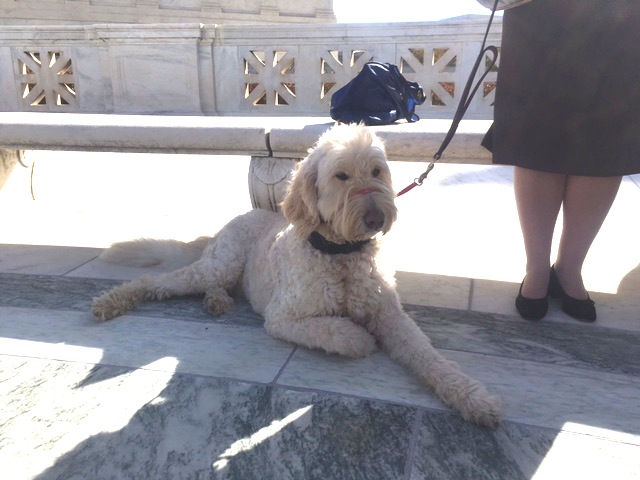
The most famous goldendoodle in America was outside the Supreme Court today, accompanied by some of his service dog friends. A Michigan school district’s refusal to allow Wonder, a trained service dog, to go to school with E.F., a student who was born with cerebral palsy and whose mobility is impaired, was the catalyst for the first oral argument of the day, in Fry v. Napoleon Community Schools. Stacy and Brent Fry, E.F.’s parents, filed a lawsuit in federal district court, arguing that the school district violated two federal civil rights laws – the Americans with Disabilities Act and the Rehabilitation Act – when they barred Wonder from E.F.’s school.
As I read the briefs, complaint, and now the analysis, the dispute seems to be less about whether the school was in the wrong (it was!), but whether the family had to go through the IDEA state administrative proceedings before suing in federal court for damages (related to significant emotional hurt caused by the exclusion of Wonder).

The reaction from the justices seems to have been generally in favor of the specifics of EF's complaint, but concerned about how to rule in such a way as to not allow just anyone to dodge the IDEA process by going straight to federal court.
If the justices’ quandary was how to draw a line that allowed “easy” cases like the Frys’ to go forward in federal court while ensuring that mine-run cases will begin with administrative proceedings, three possible solutions seemed to emerge. Roberts raised, and then Kagan returned to, the first possibility. You are making two arguments, she told Bagenstos, about why exhaustion of administrative remedies is not required in this case. The Frys are asking for damages for emotional distress, which are not available under the IDEA, and they are not alleging that E.F. was denied the “free and appropriate public education” to which she is entitled under the IDEA. In fact, Kagan noted, everyone agrees that E.F. did receive a FAPE. This is an “easy” case, Kagan hypothesized, because both these arguments are true. Roberts then chimed in, telling Bagenstos that a rule that exhaustion is not required if both criteria are met would address many of the potential problems with other cases. Bagenstos maintained that the Frys should prevail if either criterion is met, but he also readily agreed with Roberts that the Frys would prevail even if the court were to require that their case meet both criteria.
Breyer proposed two other possible rules. First, during Martinez’s argument, Breyer put forward what he seemed to regard as a simple rule: If it would be futile for a family to go through state administrative proceedings, then it would not have to. Martinez agreed with Breyer that the court could adopt such a rule. Or, Breyer suggested, courts could look at the gravamen of the complaint. If the heart of the complaint really focuses on the IEP, then a family will have to go through the administrative proceedings unless it would be futile to do so.
Here's my broad take - these procedural issues make navigating the special education system difficult for the most highly resourced families, and often nearly impossible for people in marginalized contexts. I have had people involved with Chicago Public Schools say to me, anonymously, that the entire edifice is based on people not knowing or demanding their rights, because the system just can't pay for it. We need to streamline the process, demand better remedies, and ultimately make it a federally funded rather than mandated (with some funding streams, I believe. I am not an expert on education policy as it's a huge morass).

So generally speaking, I want to make right more visible, processes of complaint more streamlined, and better protections for students put in.

Educators who make arbitrary decisions like banning service dogs must be held accountable professionally and financially (through suing the districts). 

Meanwhile, I was actually in DC for Halloween and am sort of bitter I missed a chance to meet Wonder and his family.

Image Description: Wonder the Goldendoodle on a leash, lying on stone outside SCOTUS.
Wonder's human appears only in shoes and a shirt below the knee. Photo via Amy Howe/Scotusblog

Friday, June 26, 2015

Obergefell v Hodges in the Scope of History

I have a new piece up with The Atlantic on the historic decision legalizing same-sex marriage nationwide. It argues that the history of marriage supports, even mandates, change as societies change.

We're ready. History is with us. Love wins.

Here's the piece, with thanks to Anise Strong and Ruth Karras.

---

UPDATE - Anise Strong gave me permission to repost these comments on Roberts' dissent:
Roberts: "As a result, the Court invalidates the marriage laws of more than half the States and orders the transformation of a social institution that has formed the basis of human society for millennia, for the Kalahari Bushmen and the Han Chinese, the Carthaginians
and the Aztecs. Just who do we think we are?"
Strong Writes:
Just for the record:
The Kalahari !Kung or San people (Bushmen being a frequently pejorative term) practice a limited form of same-sex marriage for inheritance purposes and probably have for tens of thousands of years. Also, their marriages are generally open with regard to sexual intercourse and can be freely and frequently divorced by either party.
The Han Chinese frequently practiced polygynous marriage and the primary functional practical relationship is mostly mother-in-law/daughter-in-law.
We don't know much of anything about the Carthaginian practice of marriage or family life, except that there's increasing evidence that they did sacrifice babies.
Aztec nobles were polygynous; Aztecs may have also practiced a form of same-sex marriage involving third-sex (intersex or "two-spirit)) individuals. Furthermore, Aztec wives had far more property and individual rights than most European and Asian women in the last 5000 years.
Or in other words: do your research.
And that is why I interviewed her for my piece.

Monday, April 6, 2015

Civil Suits Against Police Under Attack - The Waning Power of Civil Law to Counter Police Violence

I've been away over the weekend, so am a bit behind on stories to write. I try not to write when spending family time on vacation! Ahead this week - apologies, deaths by taser, death by gunfire, thoughts on undergraduate achievement. I'm also writing about the Middle Ages, the local Zoo, public intellectuals, and the Game of Thrones.

For Monday, though, I want to talk about civil suits. One of the reasons that Sheehan vs SF worries me (see my piece here) is that it may make it harder for civil suits against police to get in front of juries, and already lawyers don't want to take those cases. It's hard to sue police and win.

Here's an example from Richmond, VA.
In 2005 (the wheels of justice can grind exceedingly slowly) the police in Cambridge, Md., acted on a tip and found a small amount of marijuana residue in a trash can. At 4:30 a.m. on May 6, a SWAT team executed a search warrant on the apartment of Andrew Cornish. A jury would later find the commandos failed to knock and announce themselves properly. As they rushed through the apartment, Cornish came out of the bedroom with a sheathed knife in his hand. The police say he advanced on them. One of the officers shot Cornish twice in the head, killing him.

Elapsed time: about 30 seconds.
So we have a situation in which SWAT was found to have killed someone after not following procedure.
Cornish’s father sued, claiming the police used excessive force and violated Cornish’s constitutional rights. The first point was quickly dispatched with. (Lesson: Never bring a knife to a gunfight.) But as Balko points out in his Washington Post blog, on the second point the courts agreed. Not only that, “both the trial court and the appeals court that ruled against Cornish’s father acknowledge both that the police violated the knock-and-announce rule, and that they lied about doing so.”
Yet two out of three judges on the 4th Circuit panel (both George W. Bush appointees) decided nevertheless that Cornish bore all the blame for his own death. Other courts have reached similar conclusions in similar cases, you see — so that must make it OK: The police can break into your home unlawfully and shoot you dead, and nobody is at fault for that except you. Not only that, according to the court majority “no reasonable jury could have found that the Officers’ knock-and-anounce violation proximately caused Cornish’s death.”
That is irrefutable, in the same way the no-true-Scotsman fallacy is irrefutable. If I say to you, “No Scotsman would shave his beard,” you can show me countless cleanshaven Scotsmen. Rather than concede I was wrong, I can say, “Well, no trueScotsman shaves his beard!” The revision renders all your counterexamples irrelevant by definition. So while it’s easy to imagine plenty of juries that might blame the police for Cornish’s death, the court can simply write them all off by contending no reasonable jury would.
I think the "reasonable" jury and "reasonable" officer standard is dangerous.  In the Sheehan case, the city is arguing a reasonable officer might have concluded that Sheehan had a gun, had hostages, was making explosives, or could escape out the window. In fact, none of these things were true. In fact, neither officer at the scene believed these things to be true according to initial reports. But a reasonable officer could have, says the city, so the suits should be thrown out.

This writer ends:
The courts, including the Supreme Court, have granted wide latitude to police officers, partly because — they say — officers who exceed the scope of their authority can be held responsible through lawsuits.
And if they can't be held responsible, we lose that very important check on police authority.

Monday, March 23, 2015

Sheehan vs SF: Waiting on Transcripts

Oral arguments for Sheehan vs San Francisco will begin at the Supreme Court in a few hours (it's the
second case of the day). It will provide the opportunity for the court to do a number of things.

Here are the questions before the court:
Whether Title II of the Americans with Disabilities Act requires law enforcement officers to provide accommodations to an armed, violent, and mentally ill suspect in the course of bringing the suspect into custody; and
Whether it was clearly established that even where an exception to the warrant requirement applied, an entry into a residence could be unreasonable under the Fourth Amendment by reason of the anticipated resistance of an armed and violent suspect within.
What might the court do? They could ...


  1. Affirm or severely limit the protections of the ADA for people with disabilities as they apply to policing.
  2. More clearly define the limits of qualified immunity (the Fourth Amendment issue).
  3. Carve out a narrow ruling that sends the case back to the Ninth Circuit and doesn't establish wide precedent either way.
Three, I think, is the best we can hope for. I am not a lawyer nor a Supreme Court expert, but I did talk to a lot of lawyers, though, previewing the case for Al Jazeera America yesterday. I argued: "This case will determine to what extent police can be held accountable to the best practices of their profession." Please consider reading and sharing my piece.

There are best practices. The police did not follow them. Their claims as to the "public safety" risk that Sheehan presented consistently run counter to the facts, but the law in fact allows them to make up what a "reasonable officer" might have imagined, even if neither officer at the time believed it. 

Here's a very useful preview, especially in its summary of the US Government position on the ADA. My emphasis:
The United States’ ADA argument asks the Court walk a line between the Petitioners’ and Respondent’s arguments. Title II requires officers to provide reasonable accommodations during the arrest of mentally disabled individuals. Yet, if objective evidence causes concerns about public or police safety, then it might not be reasonable for police to provide accommodations (i.e., delay immediate entry to arrest). In those situations, safety can outweigh accommodations. And despite the importance of safety, the United States refused to make the safety exception ironclad, arguing that a plaintiff “should remain free to show that special circumstances rendered a modification reasonable.” (U.S. Amicus Br. 7.) For this case, the United States asked the Court to pass on rendering judgment on the reasonableness of the officers’ actions by instead remanding the case to the Ninth Circuit to determine whether Respondent, who would bear the burden of proof establishing that “special circumstances” were present, was owed reasonable modification despite the safety risks she posed.
In terms of the ADA, that's pretty much what I hope for. That the court affirms the right of a person like Sheehan to argue that she was owed a reasonable accommodation. I'd prefer a much stronger position from the government and for the court to enhance the power of the ADA, but I don't expect that.

More later once the transcript is up. Also, I continue to maintain it is ludicrous that SCOTUS isn't live-streamed.

Sunday, March 22, 2015

Sheehan vs SF at SCOTUS

I have a new piece out today at Al Jazeera America on the upcoming Supreme Court case - Sheehan vs San Francisco. I write:
Twenty-five years after the passage of the Americans with Disabilities Act (ADA), people with disabilities are regularly dying at the hands of police officers across the country. In just the last few weeks, four such deaths have made national news: Kristiana Coignard in Texas, Antonio Zambrano-Montes in Washington, Lavall Hall in Florida and Charley Robinet in California. According to the American Psychological Association, some officers spend more time “responding to calls involving mental illnesses than they do investigating burglaries or felony assaults.” Too often, these encounters turn violent. Our best guess is that about 50 percent of killings by police involve psychiatric disability of some sort.
On March 23, the Supreme Court will have a chance to address this national crisis. The case of Sheehan v. San Francisco offers the justices the chance to clarify how the ADA applies to law enforcement — an important step that could strengthen the broader movement for police reform. This case will determine to what extent police can be held accountable to the best practices of their profession.
I read hundreds of pages of briefs, talked to lawyers on both sides, consulted an ACLU expert on these issues, and also talked to Seth Stoughton, a police law expert I often rely on. You might also read this argument summary from SCOTUSblog. Here's my summary:
In August 2008, Teresa Sheehan, a resident of a group home for people with psychiatric disabilities, threatened a social worker with a kitchen knife. The social worker called the police. Two officers arrived and entered Sheehan’s room but retreated when she threatened them as well. They called for backup. Instead of waiting, they re-entered the room. Sheehan came at them with the knife, and they shot her repeatedly. Luckily, she survived. A hung jury resulted in a partial acquittal of assault charges against her.
The lawsuit focuses on the legality of the second entry into Sheehan’s room. She sued the officers under Title II of the ADA, arguing that by not waiting for backup, the officers did not reasonably accommodate her disability. Furthermore, her attorneys argue that the violation of the ADA exempts the officers from qualified immunity, a doctrine intended to protect police from lawsuits unless it’s clearly established that the officers violated the Fourth Amendment’s prohibition on unreasonable search and seizure. At issue is not whether the police were wrong to enter the room the second time but whether it’s allowable for Sheehan’s lawyers to argue that they were wrong before a civil jury.
I am concerned, honestly, although I tried to set the stakes and make an argument, rather than gnash my teeth and worry in the AJAM piece. The Teresa Sheehan case is so compelling, on the facts, that if she can't win her right to sue (which is not the same as winning her case), then the line has been drawn so even farther in law enforcement's favor.  The officers knew, absolutely knew, that Sheehan was in mental health crisis, had psychiatric disabilities, was along in her room (it's a small room), did not have a fire escape out the back (the fire escape was on the front of the building, where any law officer could have seen it entering the building), did not have a firearm, had no hostages, etc. And yet they charged in the second time anyway, and Sheehan got shot. She has the right to sue them and let a jury decide culpability.

Please read and share the original Al Jazeera piece, if you can. We need the country to understand the stakes here.

Tuesday, December 2, 2014

Sheehan vs San Francisco

On the Wednesday before Thanksgiving, the Supreme Court (SCOTUS) took the case of Sheehan vs San Francisco.

In 2008, Sheehan, who has schizophrenia, threatened her social worker with a knife, then threatened the two police officers who came after. They called for backup. Before backup arrived, the police broke into her apartment, pepper sprayed her, then shot at her 5 or 6 times. Sheehan survived and was charged with assault, but sued the police department and the city under the Americans with Disabilities Act, claiming that the decision to go in without backup was not reasonable given her disability.


A federal judge threw out the case (he's the brother of Justice Breyer, who will recuse himself), but the 9th Circuit said it should go to a jury. Now SCOTUS will rule.

Here's what I wrote for CNN in August about police violence and disability:
In cases like these, we need to stop talking about mental illness and start thinking through the implications of psychiatric disabilities. We also need police whose first instinct is to de-escalate tense situations whenever and however possible, and, when necessary, solve confrontations with the absolute minimum amount of force.
"Psychiatric disability" refers to mental illness that "significantly interferes with the performance of major life activities," a category that clearly applies to people whose "erratic behavior" got them killed by police.

The distinction matters. In America, being disabled comes with certain civil rights protections. While we generally try to eradicate illness, we are required to accommodate disability. So how does a police officer accommodate someone behaving erratically and holding a knife?
So now SCOTUS is going to rule, more or less, on that question. I am not optimistic, but I am not a SCOTUS expert or a legal scholar or a lawyer. I have no real idea how this question will fit into the general legal opinions of the various justices.

But I am glad the argument is getting its day in court. I'll hope that at least someone writes a pro-accomodation opinion that I can use, even if it's a dissent. We need to shift the rhetoric.

I'm going to try and go to DC to hear the arguments in the spring and will report back.

UPDATE: Think Progress has a good summary of the case here.