Showing posts with label disability and police. Show all posts

Thursday, September 1, 2016

Disability and Policing: Leroy Duffie (double amputee, black) and the #CultOfCompliance

A double amputee (legs) not matching the description of a robbery suspect was told by police to get out of the car with his hands up. 8th Circuit Court has reversed a district court granting "qualified immunity" to the police in question.

I'm going to be referring to this case a lot as it embodies the dangers of the compliance-based policing to disabled civilians. Key summary:
  • The officer was looking for a young black man with braided hair. A van was involved.
  • The driver, Leroy Duffie, was in his 50s and bald. The officer couldn't see well though so decided he had probable cause to stop, "Based on the match of the driver's race and gender and the similarity of the van description."
  • The officer (and backup) were concerned the civilian had a firearm, so approached the van with their own weapons drawn and demanded the driver exit immediately.
The officers exited their vehicles with their sidearms drawn and remained shielded behind their opened doors. Officer Kaiser ordered the driver "to turn off the vehicle, place his hands in the air, open the door, and slowly step out of vehicle." The driver did not immediately comply. The officers began cautiously approaching the vehicle with their sidearms drawn toward the van, while continuing to shout commands for the driver to exit the vehicle. The driver explained his apparent noncompliance. He attempted to inform the officers that he was physically unable to exit his vehicle with his hands in the air. The officers responded by ordering him to put his head back in the vehicle and get out with his hands in the air. Eventually, the driver opened his door and turned his body to exit the vehicle but immediately fell face-first to the pavement.
I feel for Duffie, here, who must have been terrified he was about to be killed for noncompliance, even though he couldn't comply.
  • So far, it's problematic, but hard to legally fault the officers. They mis-ID'd the van, they forced the driver to humiliate himself and fall to the ground out of the vehicle or risk being shot. But at this point they discover instead of an abled teen with braids, it's a bald man in his 50s with two prosthetic legs. So what do they do? Handcuff him, search him, search the van, find no one else in the fan, but leave him face down on the pavement for five to ten minutes.
The driver, later identified as Duffie, is a double amputee with two prosthetic legs. He could not safely exit the vehicle in the manner that the officers commanded. The fall caused one of Duffie's prostheses to become detached. Duffie's prosthetic legs were ill-fitting due to weight loss from cancer treatments. Duffie remained on the ground for the remainder of the traffic stop. After finding no one else in the van, the officers handcuffed Duffie, still face down on the pavement, searched him for a weapon, and then removed the handcuffs after five to ten minutes at Duffie's request. The officers told Duffie that they stopped him because his vehicle matched the description of the van from the incident at the convenience store. By this point, the officers knew that Duffie did not match the description of the young man at the convenience store. Duffie was not a young man in a tank top with braids; at the time, he was a bald, 58 year-old double-amputee.
It's one thing for police to not expect the presence of disability - that's normal, if problematic. It's another thing for continuing to treat Duffie as a potential suspect even though there's no reasonable evidence that he was involved. The courts, as I read the decision, agreed.
 Darkness limited Officer Kaiser's vision; nonetheless, an objectively reasonable police officer would not mistake a 58-year-old bald man for a young adult with hair. Officers may not turn a blind eye to facts that undermine reasonable suspicion. 
Yes, the irony of the disability metaphor is not lost on me.

You can find the decision here.

Update: Leroy Moore, a major activist on policing and disability, sent me this link of local coverage, including a picture of Duffie.

Thursday, July 21, 2016

Charles Kinsey: Cops shoot Black Therapist Protecting Latino Autistic Client

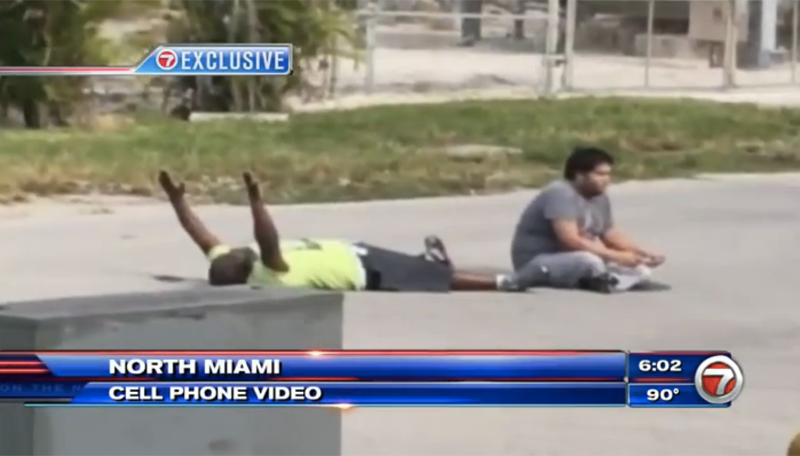
Last night, a new story in the ever evolving evidence for the #CultOfCompliance and the dangers it poses to marginalized people when they encounter police went viral. A police officer in the Miami area shot a black man lying on his back with his hands in the air. The man, Charles Kinsey, is a mental health professional who was trying to keep his client, a Latino autistic man (Arnaldo), from being shot. There's both audio and video. Kinsey is going to be ok.

Note that Arnaldo's ethnicity has not been identified and I am making assumptions.

News coverage with video, from the local station (ABC 7) that broke it:

My tweetstorm starts here:
Here's how I parse this incident.

1. "Someone" calls police because there's a big Latino guy with a gun contemplating suicide.

But the man was in fact just out in the street with a toy train.

2. Kinsey, a mental health professional, knows this is potentially a deadly situation for the autistic man, because a) police are likely to perceive brown-skinned people (especially but not exclusively) with disabilities as not complying properly in the face of police commands* and b) police are trained to take non-compliance as a threat.  So he goes to his client and lays down on his back, raising his arms in the air, both as a signal to the officer AND as a way to show Arnaldo** what to do to survive this.

*Sentence edited lightly for clarity that this is about police perceptions. 7/21 8:20 PM CST.
** Correction: The individual's name was widely reported as Rinaldo, but is now reported as Arnaldo Rios. Changed in this and previous posts. 

But also the officer comes in loaded with stigma that people with disabilities are unpredictable and dangerous, likely to lash out. 

3. And then the officer shoots Kinsey. Kinsey asks why and the officer says he didn't know, and that's likely to provide some legal accountability in this rare case, as the officer won't be able to retroactively claim he felt reasonably threatened (esp with video and audio).

And then what lessons will we learn? Unless this is a pathway to reconsider compliance-based policing as a norm, nothing will change except for getting one officer off the street.

4. After shooting him, Kinsey was put in handcuffs. Why? I have no idea - is it policy to put people you accidentally shoot in handcuffs to see if later you can construct a scenario in which shooting him was reasonable? Here's where the "threat" argument will go:
Police said the autistic man had something in his hand, but Kinsey's lawyer said it was a toy fire truck and could not be mistaken for a gun.
"It is not silver. It is not shiny. It is not black. It doesn't look like a gun," Napoleon said. "In fact, you can see the autistic guy playing with it."
5. The language around autism itself in this is pretty indicative of the ways that Arnaldo was pre-emptively constructed as a dangerous threat:
Clint Bower, who runs the group home, told Local 10 News that Kinsey was shot three times in the leg and that the man he was caring for is non-verbal and has "relatively low function."
Function-discourse is a problem. But also this from the cops:
“Arriving officers attempted to negotiate with two men on the scene, one of whom was later identified as suffering from autism,” said North Miami Police in a statement. “At some point during the on-scene negotiation, one of the responding officers discharged his weapon, striking the employee.”
Arnaldo does not "suffer" from autism. He was suffering from police officers threatening him.

From Gawker's coverage, here's a still of the video. It shows a black man lying on his back with his arms in the air next to a man dressed in grey clothing, sitting cross-legged. Critically, no one is near them. As near as I can tell, there's no reason for the officers to even have their weapons drawn, though clearly I don't have a sense of the whole tactical situation.

See above for image description

This is not like any case I've seen before in its specifics. I've never read about police shooting the mental health professional who was clearly identifying himself AND telling the officers that the client didn't have a gun. But the generalities, the ways in which the #CultOfCompliance feeds into this incident, those I read about every day. 

Follow the "cult of compliance" tag at the bottom of the post for more.


Tuesday, July 12, 2016

Disability and Policing: Knives and the Myth of the 21 Foot Rule

Reminder for Chicagoans: Tonight at 5 at Truman College - testify about police killings of people with disabilities. Stephon Watts; Laquan McDonald; so many more. Facebook event page here.

------------------------------------

NOTE: Post below has been edited for tone and clarity (9:30 7/12)

Police killed a man armed with a knife in Sacramento on Monday. It's the kind of daily killing of a person with a disability that I've been tracking for years now. On average, there's one or two nationwide every day. Sometimes, probably mostly, the officers perform admirably but still have to use lethal force. Sometimes the officers perform poorly but legally and use lethal force. Sometimes the officers perform poorly and illegally - though they may not be held accountable - and use lethal force. I do not know the details of this case, yet.

Here's the story. I want to just focus on our language around knives.
William Portanova, a Sacramento defense attorney and former state and federal prosecutor, said officers confronted with deadly force such as a knife are "immediately authorized" to use deadly force.
Someone with a knife even 20 feet away can quickly close that gap, he said, while less-lethal alternatives like a nightstick or Taser only work at such close range.
"Both require being closer than might be safe and neither one of them is guaranteed to stop the threat," said Portanova, who has previously represented officers involved in shootings. "The choices that an officer has to make in this situation are made in fraction of a second and examined, potentially, for years."
[Edited] This statement that the presence of a knife within 20 feet automatically justifies the use of lethal force emerges from the "21-foot rule." It turns out that according to many experts in use of force, it's not a rule at all.

Developed in the 80s, the 21-foot rule proposes that a person with a knife  can travel 21 feet and stab an officer before they can draw their gun and fire.

[edited] Although certainly true in specific cases, it's not a rule. What it is,  according to numerous police experts, is it's a myth, a myth, and a myth. Sometimes you need more than 21 feet to be safe. Sometimes, you need no distance at all to be safe. It's all situational. Moreover, I've been seeing the 21-foot "rule" applied to other weapons too: a camera, handcuffs, a radio, a flashlight, pen-knives, a screwdriver, and so forth.

Quotes from the above articles (all from law enforcement writers):

From PoliceMag:
Actually, there are no forensically proven facts that I am aware of that specifically verify or conclusively establish that a suspect armed with an edged weapon will more likely than not be able to seriously injure or kill an officer armed with a sidearm on all occasions and circumstances. The truth is that the 21-Foot Rule should not be considered to be an absolute rule at all because there are too many variables involved at this point to call it a "rule." Let's discuss them.
From Cop in the Hood: (CW: Ableist language)
Here's the thing: most people police face with knifes are not well trained in "edged-weapon combat." They are A) crazy or B) cutting up their loved one. Sometimes both. But police rarely if ever face a trained evil ninja out to assassinate a police officer caught unaware (honestly, there are far easier ways to assassinate a police officer, if you so choose). So basically you have this whole police paranoia based on a situation thatnever happens.

I checked Officer Down and, since 2000, could find just four officers on patrol killed by an assailant with a bladed weapon: one domestic, one EP (aka: EDP or mental case), and two fatal fights after a foot pursuit. As you might guess, not one of these assailants was an a trained stealth ninja.
From PoliceOne:
The 21-Foot Rule was formulated by timing subjects beginning their headlong run from a dead stop on a flat surface offering good traction and officers standing stationary on the same plane, sidearm holstered and snapped in. The FSRC has extensively measured action and reaction times under these same conditions. Among other things, the Center has documented the time it takes officers to make 20 different actions that are common in deadly force encounters. Here are some of the relevant findings that the FSRC applied in reevaluating the 21-Foot Rule:
Note - this last piece emphasizes that sometimes you need MORE than 21-feet. It's a very pro-cop site helping cops learn how to justify the use of lethal force. But even it debunks this myth.

The presence of a knife, on its own, cannot justify the use of lethal force. It's one of the most common ways in which people with disabilities are killed, rather than stunned, disarmed, talked down, given space and time to calm down, or otherwise engaged in a non-lethal way.

The 21-foot rule is a myth that gets disabled people killed.