Showing posts with label charles kinsey. Show all posts

Wednesday, May 17, 2017

Arnaldo Rios - His trauma matters

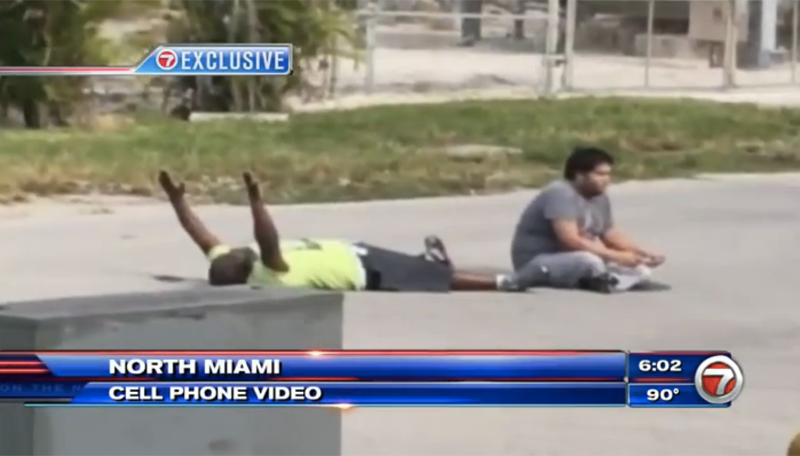
Arnaldo Rios is the autistic Latinx individual who was shot at by a cop when he was sitting still in the street holding a toy truck. The bullet struck Charles Kinsey, his therapist, who was lying on the ground next to Rios raising his hands in the air. Kinsey has recovered physically. Rios is now institutionalized as a result of the trauma.

The cop who shot Kinsey and shot at Rios was charged with attempted manslaughter, but initially just for shooting Kinsey. Rios' experience was erased from the charging documents.

That's been fixed.
After months of investigation, prosecutors concluded that Aledda was not justified in shooting from more than 150 feet away. Among the reasons: Other officers had already radioed out that Rios did not have a weapon, and two cops within 20 feet did not fear for their lives.
In arresting Aledda, prosecutors initially charged him with one felony count of attempted manslaughter and one misdemeanor count of culpable negligence. During the Friday hearing, they officially filed two felony counts of attempted manslaughter, one for Kinsey and added one for Rios. The autistic man was not hit, but the shot fired at him “could have resulted in death,” according to the formal charges.
Emphasis mine. See more coverage of the case in the site tags.

Thursday, April 13, 2017

The man who shot Charles Kinsey

It really shouldn't be surprising when that the cop who shot a black man lying on the grounds with his hands up, urging his Latino autistic client to do likewise, was charged. It is surprising. We're not used to even this first step towards accountability happening.

But Officer Jonathan Aledda was arrested and charged with attempted manslaughter.

More on Charles Kinsey and Arnaldo Rios here and here.

Tuesday, August 2, 2016

Four Essays by People of Color on Disability and Policing

The shooting of Charles Kinsey and the subsequent disclosure that his client, Arnold Rios Soto, was being kept in a psychiatric ward in the hospital, sparked some very good writing. Here's four related pieces by people of color that should get more attention.

First, Finn Gardiner, Manuel Díaz, and Lydia X. Z. Brown wrote: "Charles Kinsey's Story Is About Race. It's Also About Ableism" for Sojourners:
As autistic people of color — and specifically, as a black autistic person, a Latino autistic person, and an East-Asian autistic person — this incident strikes us particularly hard. We have largely been erased from media coverage, which has instead highlighted perspectives of white disabled people, or non-disabled black and brown parents of disabled children, at our expense.
This is personal, and so, unavoidably, political. What happened to Rios-Soto and Kinsey is a story about race, anti-blackness, and white supremacy. But it is impossible to contextualize this racism without also understanding the ableism that informs it.
There's just a lot of basic work to do convincing people that ableism is a real thing and that we need to be concerned about it, like we are with other forms of individual and structural discrimination.  It's not the same as racism, sexism, homophobia, etc., but it is real and we must confront it.

Leroy Moore, who has been working on police violence and disability for decades, interviewed Matthew Dietz, the lawyer representing the Rios family.
2) Leroy Moore: For more than 15 years I've been following cases of police brutality involving people with disabilities and it is the same one answer avenue and that is the call for more police training. Is the issue of training central to this case and if so, how? What are other avenues cause it seems in this case it is bigger than just training.

Matthew Dietz, Attorney for the Arnaldo Rios Soto,: This case is more than about training. Even though it was obvious that Mr. Rios was a person with a disability and that they were told that he was a person with a disability, this fact was ignored because of a lack of training. However, after it was known that Mr. Arnaldo was a person with a disability, the police representative had the audacity to say that they did not intend to shoot the health care worker, but instead intended to shoot the autistic man. To me, this demonstrates deliberate animus against persons with disabilities.
"Deliberate animus" is a good phrase. I'd like to hear it argued more often.

At the Washington Post, Matt Ramos, a Latino father of an autistic child wrote about teaching his kids to comply with all police demands as a matter of safety, but what about his autistic child?
Comply, comply, comply was what I was taught, and it’s what I’ve been teaching my sons, to the point that they can probably repeat the speech my father gave me. But how am I supposed to teach those words to someone who doesn’t understand language the way I do? How am I supposed to warn my son about the dangers facing those who look like him when he can’t even conceptualize those differences?
As I wrote, asking Rios to comply in the context of the shooting was asking him to not be disabled, to be something other than what he is. It's not possible. Policing cannot demand this.

Finally, not specifically on the North Miami shooting, "The Black Autist" writes about #BlackDisabledLivesMatter vs #AllDisabledLivesMatter, working through the same issues as the larger Black Lives Matter movement as it applies to disability. TJ has been working hard on raising awareness about black disabled victims of police violence in Chicago lately, and writes:
#BlackDisabledLivesMatter actually reads Black Disabled Lives SHOULD Matter, not Only Black Disabled Lives Matter and F*** Everyone Else. Black disabled people affected by violence are seldom mentioned in the media, or they are mentioned only by name but without any mention of their disability (there are instances that the disability is reported afterwards). The black disability community, including myself, are scared for our lives. Recent victims of police brutality, such as Laquan McDonald, Sandra Bland, and Freddie Gray, were not only black but also had a disability of some sort. Certain police officers can get away with murdering black disabled people; just take a look at the two officers who got away with murdering Stephon Watts in cold blood. We are also subjected to bullying, filicide, murder, sexual assault, emotional/psychological abuse, child abuse, theft, police profiling, and manipulation from negative influences daily.

To make matters worse, our own black community is inaccessible and doesn’t have many resources to go to. African-American culture seems to have been fearing disability for centuries; starting with slavery when the disabled slaves were discarded or killed because they were unfit to perform on the plantation. That fear still carry on to today’s world, where disability in the black community is taboo (especially mental disabilities). We are either viewed as angels or devils, not just mere humans who want to explore the world and enjoy life just like abled-bodied and neurotypical people. Also add these following things to the mix of things that plague our community: lack of disability awareness/acceptance, underfunded public special education programs, lack of adequate services for the disability community, extreme unemployment/underemployment, and a scarce amount of black disabled role models.
As always, claiming one marginalized group's lives should matter does not mean that other people's lives don't.

Read all these pieces! 

Saturday, July 23, 2016

The Abuse of Arnaldo Rios - #CharlesKinsey Shooting

Content Notes: Abuse of an Autistic Individual

On Monday, a police officer shot Charles Kinsey, a black therapist who was trying to help his client - a young Latino man named Arnaldo Rios - not get shot. Rios had walked away from his group home and someone called 911, claiming that a man was suicidal and armed with a gun. Rios, in fact, autistic not suicidal, and was carrying a toy fire truck.

Kinsey got to the scene around the same time as the cops, lay on his back with his arms in the air to show the police he wasn't threatening, and was trying to get Arnaldo to do the same when the police shot him. That's the story we've known. I covered it here for CNN and in two blog entries.

Now here's some new information. UPDATE: Important piece from Miami Herald based on interviews with Rios' family.

First  - The officer was identified and his commander suspended for trying to falsify evidence. No further details yet available.  Notice this rhetoric though, as one of my friends on Facebook pointed out:

Second - The Rios family has a lawyer, disability rights expert Matthew Dietz, who shared a picture of Arnaldo (below) and spoke to me over the phone. Dietz told me the following.

  • Rios left the home holding a truck and Kinsey, with whom he had a close relationship, followed to help.
  • After Rios saw Kinsey get shot, the police handcuffed Rios and put him in the back of a police car for THREE OR FOUR HOURS, handcuffed the entire time. Dietz told me that Rios, as is typical of many autistic individuals, calms himself by stimming - rocking his body and shaking his hands and arms. During those three or four hours, therefore, Rios was both upset at seeing his friend and therapist shot AND prevented from calming himself AND denied any immediate assistance despite everyone knowing they had taken custody of an autistic individual.
  • NOTE FROM ME: If you want to know more about stimming and the abuse of being kept from doing it, from an autistic perspective, read Julia Bascom's essay Quiet Hands. 
  • Rios was eventually taken to a mental health ward of a local hospital, where he remains, despite them being completely unequipped to address Rios' needs. Rios cannot return to the group home, as earlier attempts left him showing signs of trauma. There are no other suitable facilities in Miami-Dade County to Dietz' knowledge.
Here's the picture, which shows a smiling Latino man holding a teddy bear, sitting on a bed.


Friday, July 22, 2016

911 Call and Charles Kinsey

I have a new piece up at CNN on the shooting of Charles Kinsey, protected a Latino autistic man named Arnaldo Rios [Edit: See below for correction information] and the intersections of racism, ableism, and the #CultOfCompliance.
Kinsey later told reporters, "I was really more worried about him than myself. I was thinking as long as I have my hands up ... they're not going to shoot me."
Then they shot him.
While the specifics of this case are unusual, the general pattern is not. Compliance-based policing -- when police treat noncompliance with their instructions, on its own, as a threat -- puts everyone at some risk.
The piece is about racism and ableism, compliance-based policing like ask-tell-make, and exploring the broader pattern that led to the inexplicable specifics of the incident.

Two things are missing from my CNN essay. First, after I filed, the officer, through his union, has claimed he was shooting at Arnaldo to protect Kinsey. I do not think this is credible, but is rather an attempt to create an "objectively reasonable" standard from which to defend his actions. It's astoundingly brazen but again plays on the ableist idea that people with disabilities, especially non-white individuals, are erratic and prone to violence.

Look at this picture. It's just not objectively reasonable to conclude there was imminent danger and I hope both the department and the legal system agree with me.
Second, though, why did the police arrive at the scene believing there was danger? That's the 911 call which, according to our best information, claimed there was a person armed with a gun contemplating suicide.
  • We don't know who made the call, but we do know that Arnaldo is relatively non-verbal and was holding a toy truck when he wandered off from his home. 
  • Given those facts, how did someone decide he was suicidal and dangerous?
  • I'm guessing - and that's why I couldn't put it on CNN - that this 911 caller was afraid of a Latino acting "odd" who was holding something in his hand, so made the call. 
  • It's possible of course that they were maliciously trying to get someone killed
I don't know how we build systems to prevent this kind of 911 call. There's got to be protections so that callers are safe to phone in suspicions without fear of reprisal, but we've also got to protect civilians from being targeted like this because their race, disability, or other markers of identity make someone uncomfortable.

Reminder: Both John Crawford and Tamir Rice, to pick two names you know, were killed after 911 calls indicated threats where none existed (though Rice's called said 'probably fake').

Correction: The individual's name was widely reported as Rinaldo, but is now reported as Arnaldo Rios. Changed in this and previous posts. 

Thursday, July 21, 2016

Charles Kinsey: Cops shoot Black Therapist Protecting Latino Autistic Client

Last night, a new story in the ever evolving evidence for the #CultOfCompliance and the dangers it poses to marginalized people when they encounter police went viral. A police officer in the Miami area shot a black man lying on his back with his hands in the air. The man, Charles Kinsey, is a mental health professional who was trying to keep his client, a Latino autistic man (Arnaldo), from being shot. There's both audio and video. Kinsey is going to be ok.

Note that Arnaldo's ethnicity has not been identified and I am making assumptions.

News coverage with video, from the local station (ABC 7) that broke it:

My tweetstorm starts here:
Here's how I parse this incident.

1. "Someone" calls police because there's a big Latino guy with a gun contemplating suicide.

But the man was in fact just out in the street with a toy train.

2. Kinsey, a mental health professional, knows this is potentially a deadly situation for the autistic man, because a) police are likely to perceive brown-skinned people (especially but not exclusively) with disabilities as not complying properly in the face of police commands* and b) police are trained to take non-compliance as a threat.  So he goes to his client and lays down on his back, raising his arms in the air, both as a signal to the officer AND as a way to show Arnaldo** what to do to survive this.

*Sentence edited lightly for clarity that this is about police perceptions. 7/21 8:20 PM CST.
** Correction: The individual's name was widely reported as Rinaldo, but is now reported as Arnaldo Rios. Changed in this and previous posts. 

But also the officer comes in loaded with stigma that people with disabilities are unpredictable and dangerous, likely to lash out. 

3. And then the officer shoots Kinsey. Kinsey asks why and the officer says he didn't know, and that's likely to provide some legal accountability in this rare case, as the officer won't be able to retroactively claim he felt reasonably threatened (esp with video and audio).

And then what lessons will we learn? Unless this is a pathway to reconsider compliance-based policing as a norm, nothing will change except for getting one officer off the street.

4. After shooting him, Kinsey was put in handcuffs. Why? I have no idea - is it policy to put people you accidentally shoot in handcuffs to see if later you can construct a scenario in which shooting him was reasonable? Here's where the "threat" argument will go:
Police said the autistic man had something in his hand, but Kinsey's lawyer said it was a toy fire truck and could not be mistaken for a gun.
"It is not silver. It is not shiny. It is not black. It doesn't look like a gun," Napoleon said. "In fact, you can see the autistic guy playing with it."
5. The language around autism itself in this is pretty indicative of the ways that Arnaldo was pre-emptively constructed as a dangerous threat:
Clint Bower, who runs the group home, told Local 10 News that Kinsey was shot three times in the leg and that the man he was caring for is non-verbal and has "relatively low function."
Function-discourse is a problem. But also this from the cops:
“Arriving officers attempted to negotiate with two men on the scene, one of whom was later identified as suffering from autism,” said North Miami Police in a statement. “At some point during the on-scene negotiation, one of the responding officers discharged his weapon, striking the employee.”
Arnaldo does not "suffer" from autism. He was suffering from police officers threatening him.

From Gawker's coverage, here's a still of the video. It shows a black man lying on his back with his arms in the air next to a man dressed in grey clothing, sitting cross-legged. Critically, no one is near them. As near as I can tell, there's no reason for the officers to even have their weapons drawn, though clearly I don't have a sense of the whole tactical situation.

See above for image description

This is not like any case I've seen before in its specifics. I've never read about police shooting the mental health professional who was clearly identifying himself AND telling the officers that the client didn't have a gun. But the generalities, the ways in which the #CultOfCompliance feeds into this incident, those I read about every day. 

Follow the "cult of compliance" tag at the bottom of the post for more.