Thursday, December 5, 2013

Cult of Compliance: Times Square Edition

In September I wrote about a mentally-ill man who was shot at by police for not listening. He ran into traffic in Times Square so they shot at him.

Well, today he was charged as responsible for the people that the police shot.
“The defendant is the one that created the situation that injured innocent bystanders,” said an assistant district attorney, Shannon Lucey.
The two police officers, who have not been identified, have been placed on administrative duty and their actions are still under investigation by the district attorney’s office, law enforcement officials said.  They also face an internal Police Department inquiry.
Mr. Broadnax’s lawyer, Rigodis Appling, said Mr. Broadnax suffered from anxiety and depression and had been disoriented and scared when the police shot at him. He was reaching for his wallet, not a gun, she said. “Mr. Broadnax never imagined his behavior would ever cause the police to shoot at him,” she said.
So here we have someone who didn't comply and "forced" the police to start shooting. They missed, but have charged him with forcing them to shoot at him.

I've talked a lot on this blog about the criminalization of non-compliance, starting here, but you can follow the tags. It's not a problem that's going away. It needs to be understand on this meta-level of a veneration of compliance and a fury at those who will not bow down. Then, we need to act on the specific level - precincts, principals, politicians, victims, and so forth. But the meta-level is critical.

And in the meantime, this feature on my blog will continue.


Sunday, December 1, 2013

6 week hiatus

I have posted an entry for about 185 days (a few times I double posted). I am now taking a 6 week break to finish a book. I'll see you next year!

Ok, I lied. I'm totally going to post from time to time, but less regularly until the book is out the door.

Part of work/life integration is knowing when you let something go for a bit. You can always pick it up later. For me, later is mid-January.

Saturday, November 30, 2013

Gender and Bullying at 30,000 feet

Today, a set of tweets from the producer of The Bachelor, Bachelorette, and other programs contributing to the inanity of American culture and transmission of limiting gender norms has gone at least semi-viral.

According to this author at Huffington Post, he's a hero for standing up to an annoying airline passenger. And she does sound annoying.

But if you read the tweets, slowly but surely, the narrative for me shifts. Instead of being a story of chiding someone for being rude and self-centered, it's about a celebrity male bullying a woman, telling her to "eat her dick," provoking her, then using his media presence as a source for shaming.


I don't care how annoying "Diane" was. This isn't justified and it wouldn't have happened if Diane were a man, particularly a big man.

This is gendered. It is not heroic. It is bullying.

Friday, November 29, 2013

How we make Turkey

It's called the Thompson Turkey and most of the recipe is here. We've been making it in our family for a long time.

It involves three bowls for the stuffing - one of meat and bread, another spices, a third fruit, then mixing. A mustard paste coats the turkey. You turn it while cooking towards the end. You baste every 15 minutes for 5 hours.

I'm posting this recipe because I discovered a comment from 2009 at the bottom of the page.
This has been a tradition in my family since 1946. My mother discovered this recipe at the end of a short story in a book that she was editing for the GI's in WWII. The story was "Joe the Wounded Tennis Player," but the recipe was a non sequitor that was probably taken from his father's chef from the Saratoga Inn. My father thought it was a joke. But my mother claims that the second thing they did after he returned from Europe, was to go to Macy's to buy the ingredients for the stuffing. As a side note, this was the turkey that the Guthries: Arlo, Joady, Nora, and their mother, Marjorie, had at our house in Stockbridge, MA, on Thanksgiving in 1960. I've never tasted a turkey that came close to this one. It's simply the best and worth the effort.
It is the best. There are others that are also the best. But I'm sure this one is the best.

Also, this is clearly someone from my family. My mother claims it isn't her. Any volunteers?

Traditions matter. Off to play with the kids.

Thursday, November 28, 2013

Thanksgiving and Genocide

Happy Thanksgiving.

As my children came home from school with paper pilgrims' hats and "Indian" headbands with feathers, I winced, I groaned, and I kept silent. They are 4 and 6. It's not time yet.

But here's a serious question, asking as both historian and parent, in lieu of a longer post on this busy day:

Can you talk about the origins of Thanksgiving, to children, without discussing genocide?  What about the religious bigotry of the early Protestant settlers?

I'm not so sure.

Wednesday, November 27, 2013

P.S. I'm Jewish


The following is a genuine email exchange. Names and locations have been changed as appropriate.

--------------------------------------------------------------------
From: J. [NAME@hotmail.com]
Sent: Tuesday, November 26, 2013 11:52 AM
To: Perry, David
Subject: Your beautiful article on pope Francis on cnn.com

Thanks David for a very well written article on the pope.

First big surprise: It is written in correct English, a first for CNN!!!

Second big surprise: It is written by a person who does not have a non-believer perception of papacy, and of the catholic church.

While pragmatic and devoid of emotion, your article scored a few direct hits with me, and I thank God that you wrote it as you did. I do find Francis' attitude, his behaviour, to be very refreshing, while at the same time, not deviating from Christ's core teachings and those of the church. I do think that Francis, over the course of his papacy, will have brought a large number of people to the catholic church, or at least to Christianity as a whole.

Thanks again David, and may God bless you!

J.
Somewhere
Canada
-------------------------------------------------------
Dear J,

Thank you so much for writing. It means a lot to me when people read my work, think it makes sense, and reach out to let me know. So much of the discourse on the internet is hostile or otherwise just noise and shouting, rather than conversation.

That said, your comments have provoked a few thoughts that I thought I might share with you. I would be very careful making assumptions about the relationship between identity, especially public identity, and truth. I do try to write in a pragmatic, careful, way, making only what claims I feel I can support, as a way of building a case for my perspective.

But while I don't wear my religious identity in public, plenty of CNN writers do, so I think you're wrong there to see some kind of CNN anti-Catholic bias. They employ John Allen Jr., of National Catholic Reporter, one of the great writers on the papacy in the English-speaking world. He's on CNN all the time, including today, to talk about Francis' latest encyclical (which is quite something!).

More to the point, CNN also gives a platform to Bill Donohue, the arch-conservative Catholic who has built a message of division and rigidity into a highly profitable media profile. In fact, CNN published an essay of Donohue's right next to mine, in which he argued that Francis' papacy has a new tone but no new message. I disagree with Donohue. I wonder sometimes how he can justify his positions and his profits in light of Scripture, but I was glad CNN put our essays opposite each other.

At any rate, I just wanted to suggest that message and identity might not always be as linked as they appear, nor do I see evidence of anti-Catholic bias in CNN opinion selections.

But I really do thank you for writing. I am filled with joy when people read my essays, consider them, and respond positively. It's why I am a writer.

Sincerely,
David

P.S. I'm Jewish

Tuesday, November 26, 2013

Girls, Goldieblox, and the Perils of Princess Culture

I think about toys and gender a lot because of the ways that early experiences shape our brains. My daughter gets invited to a lot of parties - because almost every kid in her pre-school invites all the other kids in their class if they have a party. Well, not every kid. One girl invited all the girls to a "princess party." Come dressed as your favorite princess, the invite read. We skipped it. Our first instinct was to disrupt, to send Ellie as a Valkyrie or Pirate princess, but we can't force Ellie to match our agenda. I can't make Ellie the Trojan Horse (borrowing a metaphor from the blog I discuss below) of my feminist values. It's not Ellie's /job/ to be the agent of subversion, as much as I want her to do that. Her mom and I, our friends, our community, can just try to provide strong counter-models and offer her the tools to write her own narratives.

But princess culture everywhere. Lego offers girls "friends." If you eat McDonald's, and we do sometimes (it's a place Nico is happy to play on the slides while not eating anything they serve), they will ask for "boy" vs "girl" toy, even though they are not supposed to do so (according to unenforced corporate guidelines). Girl toys are pink, purple, and passive. Boy toys are multi-hued and active (cars or violent action figures). This is a problem for both genders, though in different ways.

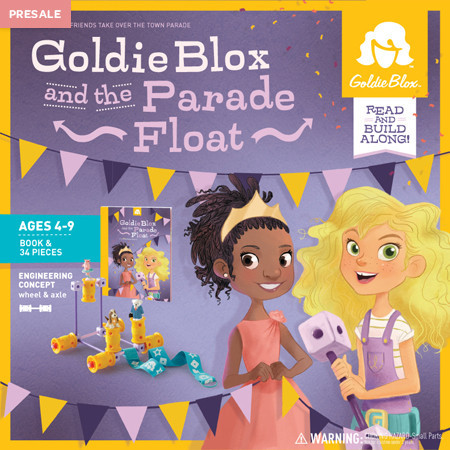
All of which brings me to Goldieblox, also known as "Engineering toys for girls." They recently unveiled their newest toy. Not a spaceship. Not a car. Not a computer. Not an engineering lab. Not an underground lair. It's a parade float. With a crown. She's a daydream believer. She's the homecoming queen.


And the feminist blogosphere is in turmoil. 

A lot of friends sent me this fairly awesome ad (which parodies a sexist Beastie Boys song, itself derivative of "Shout," called "Girls," and has engendered a fairly hypocritical response from the Beastie Boys and a lot of bad publicity for them from hip maker types who have otherwise stayed loyal).

Here's the ad. It's definitely fun and you should watch it and then read the lyrics. Then I'll offer some thoughts with the help of a thoughtful post from @@deborahgirlwpen (Deborah Siegel).

So that's fun. Here are the lyrics, directly critical of princess culture.


Girls, you think you know what we want
Girls, pink and pretty's it's girls
Just like the fifties it's girls

You like to buy us pink toys
And everything else is for boys
And you can always get us dolls
And we'll grow up like them, false

It's time to change
We deserve to see a range
Cause all our toys look just the same
And we would like to use our brains

We are all more than princess maids

Girls, to build a spaceship
Girls, to code a new app
To grow up knowing
That they can engineer that

Girls, that's all we really need is girls
To bring us up to speed, it's girls
Our opportunity is girls
Don't underestimate girls

Note the direct critique of "princess" and "pink." Goldieblox is lavender and yellow. It focused on STEM, which I guess is fine, but I'm interested in creativity, not one special brand of creativity. But it definitely counters that Lego "friends" toy with which I started this essay. It's also sparked a real debate among feminist writers. Siegel has a round-up of some of the critiques, though I note everyone seems to think the advertisement and the subversion of the sexist song about "girls-as-objects" is pretty great. My emphasis below:
I’m in partial agreement with my feminist colleagues who are in outrage over the fact that GoldieBlox is selling a princess-themed toy. Many had been rooting for the start-up toy company, which started on Kickstarter, with a full on mission to spark a love for STEM in girls. They feel rightly let down that the sequel to the original product (a building toy, with a narrative story) features a princess tale. They critique the manufacturer’s market-straddling approach. Writes media studies scholar Rebecca Hains, “GoldieBlox is having it both ways: appealing to parents with anti-princess rhetoric and then, in stores, selling girls on a princess-themed toy.”...
Melissa Atkins Wardy (whose new book, Redefining Girly, will be published on January 1), perhaps says it best: “[W]hen we use princess culture, pinkification, and beauty norms to sell STEM toys to girls and fool ourselves that we are amazing and progressive and raising an incredible generation of female engineers we continue to sell our girls short. It is the equivalent of covering broccoli in melted processed cheese and thinking we’ve very served a healthy meal.”
Wardy is asking - Do we have to use princesses and pretty to sell products to girls?Can we trust girls to buy toys not covered in lavender?

I have to say that I find these critiques persuasive. I have tried, personally, to re-brand Disney princesses (gifts to my daughter. Please don't get us anymore, if you're reading this blog. Although I appreciate the thought! And Barbie is out too), as "Norns," or other powerful queens of the universe riding their three-headed Dragon (it's a cool puppet) and otherwise being active. Am I trying to "boy" Ellie in this? I'm definitely trying to de-princess her toys and make them strong. I'm trying to work against the grain, as always, knowing that the larger society will give her plenty of ideas that run counter to mine. And if you're horrified, don't be, because I'm totally failing. The ubiquity of princess culture means that my micro-efforts are almost irrelevant. At best, as I said above, I might be giving her the tools to I generate counter-narratives should she want to do so. 

Because there's nothing wrong with choosing to play as a princess, so long as the choice is made in an array of other choices, not pushed there by default and the pressures on our sub-consciousnesses to conform.

So if Princess culture can't be escaped, then what do we make of Goldieblox and their ad (in contention for the Superbowl). Siegel suggests that maybe what Goldieblox is doing, by selling out to girls with princess toys, might not be so bad. It's sneaky. It's subversion. And we should recognize that it creates a pathway into the homes, hearts, and minds of people who are not feminists or even anti-feminists.
I’m not convinced the ad isn’t progress. I’ve watched every video GoldieBlox has produced and have gotten teary over every one. I’ve played with the original toy in the Marbles store with my 4-year-old daughter (no princesses in that one) and am still considering it as a Hannukah gift. I’m a sucker, perhaps, and an easy target. But let’s put personal reaction aside.
I believe in evolution, as well as revolution. I’m a writer who wrote a book on feminism and let her publisher slap on a hot pink cover. I wanted people–and young women in particular–who wouldn’t necessarily pick up a book on the women’s movement to read about it. And they did.
I find Siegel's thoughts persuasive as well. In other words, I'm torn.

But here's a deeper question. Is this a divide between waves of feminism? The feminists of the 70s and their children grew up in a world of browns, yellow, greens, and de-stablized gender norms in child-related marketing. The millenial feminists and those slightly older, just having children, seem just as wedded to causes of equality and the battle against patriarchy, but are often seemingly less concerned with the color pink and all its ilk. This is just an impression of mine, not based on data, but it's an impression I have re-confirmed all the time as I survey feminist discourse across generations.

That doesn't mean that the new waves are correct, but in Goldieblox we have an interesting test case to see how it sells, see what kind of messages it encodes, and to see, ultimately, if our kids play with it by choice.

Maybe I should go shopping for presents now.

Monday, November 25, 2013

Motherhood: Not the most important job, because "job" metaphors devalue.

Earlier in the week, the Australian writer Catherine Deveney published a piece on motherhood and discourse in The Guardian. It mirrors some of my own arguments about the ways that our emphasis on motherhood is bad for women and men, albeit in different ways.

She opens by talking about the line, "Motherhood is the most important job in the world," writing (emphasis mine):


For any woman who uses that line, consider this: if this is meant to exalt motherhood, then why is the line always used to sell toilet cleaner? And if being a mother is that important, why aren’t all the highly paid men with stellar careers not devoting their lives to raising children? After all, I never hear "being a father is the most important job in the world".
Now the commercial use of things we allegedly value is a much bigger topic. One could talk about the way we market the armed forces then use patriotic symbols to sell everything from cars to cereal, or the way fatherhood is likewise marketed (man strong!), or the small family farm, or whatever. But it's true, on a marketing level, the "mom" is used to sell household cleaning products and products related to child-rearing.
The deification of mothers not only delegitimises the relationship fathers, neighbours, friends, grandparents, teachers and carers have with children, it also diminishes the immense worth and value of these relationships. How do gay dads feel about this line, I wonder? Or the single dads, stepdads or granddads? No matter how devoted and hard working you are, fellas, you’ll always be second best.
And yes, that pisses me off. I work damn hard as a caregiver, and somedays I succeed better than others, I get irritated when I hear, "well, sometimes it just takes a mom to ..." My internal response is always, "You have no idea how we order our lives." Sometimes, perceived traditional gender roles to make the most sense for a given period or situation, but only sometimes, and always intentionally. We try never to let society's sense of who should and can do what dictate our systems of parenting.
 Or is a "mother" simply a term to describe an expectation to care for children without payment? Is this empty slogan used to compensate women for gouging holes from potential careers by spending years out of the workplace without recognition?
Enabling this dogma devalues the unpaid labor of rearing children as much as it strategically devalues women’s worth at work. If being a mother were a job there’d be a selection process, pay, holidays, a superior to report to, performance assessments, Friday drinks, and you could resign from your job and get another one because you didn’t like the people you were working with. It’s not a vocation either – being a mother is a relationship.
 And here is the really important point from this piece to me. As soon as we construct motherhood as "job," our analysis has to fall into all the complex issues related to labor and value. That's fine if you live in a privileged prestige economy, but most people don't. Employers treat their workers as disposable, or as the enemy to underpay and exploit to the extent the law and market will bear (all while lobbying to keep the law on their side). Employees are forced to choose between work and family, pushed away from integration into a whole. "Job" is not a value-added term in our lexicon, at least not for most people who need jobs or are trapped in one or underemployed etc.
It really is time to drop the slogan. It only encourages mothers to stay socially and financially hobbled, it alienates fathers, discourages other significant relationships between children and adults and allows men to continue to enjoy the privileges associated with heteronormative roles in nuclear families (despite men sucked into this having their choices limited as well).
Turning back to men, Deveney makes the points that I want to make as well: Fathers are alienated, benefit from perceived traditional roles, but - and it's far more than a parentheses for me of course - are severely limited in how they can express themselves as man or father.

Father. Mother. Working. Stay at home. Tag-team. These are choices. Relationships. Trade-offs. Not jobs.

Speaking of jobs, can we fix those other labor issues too while we're at it?

Sunday, November 24, 2013

Sunday Roundup

Some weeks, when I look back at my posts, I admit to myself that I leaned heavily on other writers, linked to them, and provided little new content of my own. But this last week was different, if I may say so myself. I write these round-ups in hopes of catching a few more readers for some of the better pieces and I think there were a number of important issues that emerged over the week. Please read. Please share if you like something. Maybe your friends will too.

  • Monday: I took on Autism Speaks, citing two powerful essays that critique the popular, well-funded, and well-meaning charity (it's the Komen foundation of Autism Charities) for 1) Not having anyone with autism actually "speak" for the organization. 2)  Their war metaphors.  Read this and share it, as you know people who are donating to Autism Speaks. I recommend the "Autism Self-Advocacy Network." Their motto is "nothing about us without us." I'm in.
  • Tuesday: I took on academic conference interviews as an issue of economic justice. This piece was widely shared, for which I am grateful, and contested politely, for which I am also grateful. I like pushback and counter-opinions, and I don't pretend this issue is simple. But I do think I'm right. And on Wednesday I expanded on the first essay to explain why.
  • Thursday: More academia. The founder of Udacity, a big for-profit MOOC maker, packed up his toys and went home. I rely on a few smart commentators to parse the fallout and what comes next.
  • Friday: Inclusion is not same-ness, holiday version. I explore Ellen Lonquist's thoughts on holidays for families with special needs.
  • Saturday: Another chapter in the cult of compliance, this time in a Miami Gardens convenience store.
  • Sunday: And earlier today, the highlight of my week, Nico's holiday show and more on inclusion not being same-ness, this time with super awesome cute video.
Thank you for reading.

Inclusion not Same-ness: Nico's holiday performance


As promised on Friday, here's a video of Nico's fall performance that illustrates my principle of "inclusion, not same-ness." Inclusion is complicated. We demand reasonable accommodations, and we sometimes get them without litigating "reasonable," but inclusion requires thoughtful, intentional, good-will from all parties.

Sometimes inclusion means bringing someone into a group and enabling them to do the same thing as everyone else through some clever means. Sometimes they need to be included by sitting on the edge or the fringe, present but not in the group. Sometimes, inclusion means creating space for an entirely different expression of self or participation in an activity or class. Inclusion requires creativity and highly individual solutions to problems.

Inclusion also operates in the passive voice. A person is included. The action comes from the rest of us in this construction. But in fact inclusion requires action from everyone, and that's what I love about this video. The whole first grade, the special ed program, the music teachers, and really all the kids and parents, created a space for Nico to be included. Then Nico included himself by taking center-stage. There are three songs and they get better, with the third Nico acting as "junior band-leader," holding up signs that say "Boys" and "Girls," helping the music teacher direct who gobbles at any given time.

It's also a sign of growth, as during the last two years he really refused to participate during the performances, overwhelmed by noise and so many people.

So congrats to Nico and to his school for creating a space for Nico and for understanding that to be included, he'd need a different space than everyone else. He cannot stand on a riser and sing like the other kids, so what to do? Watch and smile.