Wednesday, July 15, 2015

#CultOfCompliance - "Intimidating Stare" Leads to Prison

From the Huffington Post:
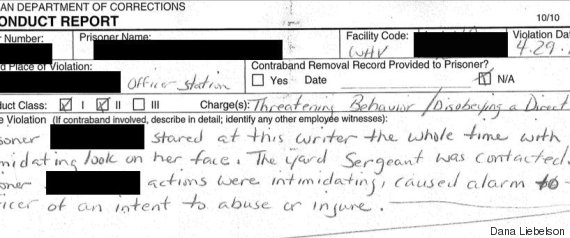
Text reads: stared at this writer the whole time with intimidating look on her face.
The yard Sergeant was contacted over XXXXX actions were intimidating, caused alarm to
officer of an intent to abuse or injure.

A child was sent to prison under a sentence that would expunge her record once served. Instead, due to improper compliance, she was sent to adult prison. Her additional crime? - An intimidating stare.
Jamie, as we’ll call her, was initially sentenced to two concurrent six-month sentences for a fight with a family friend. She was given a special youthful status that allowed her record to be scrubbed clean, as long as she met certain good behavior standards. But she was sent to an adult prison to serve her time, and while there, she lost that status and was given a longer sentence for the same crime. Jamie’s saga was part of a recent HuffPost Highline investigation into the treatment of children in adult prisons.
The problem is pervasive.
“Two guys come in front of you for stealing your car, and one of them came in with a suit and tie on and had both parents there, and you're in school and everything else,” he said, “and the other one comes in with an old raggedy T-shirt with an attitude like, ‘Screw you, judge’ -- they have sentencing guidelines, the guidelines for each of those people because of their prior record, or lack of it, would be the same -- but as a judge would you treat them the same?”
Advocates contend that this case only shows that teenagers are not adults -- and adult prisons are not equipped to deal with them. "At 17, you are literally still going through puberty and hormones are changing," said Kristen Staley, associate director of youth justice policy at the Michigan Council on Crime and Delinquency. "Moreover, factors such as early trauma or mental illness can stunt this growth ... MDOC staff is not thoroughly trained to handle teenagers and this [incident] is a clear indication of that."
I wrote before about a 14 year old attacked by  an officer for a "dehumanizing stare." This is the Cult of Compliance.


Tuesday, July 14, 2015

Disability as Identity - 1988 Edition

With the 25th Anniversary of the ADA coming up, I've been doing some disability history writing, some of which I'll get to make public in a few weeks. Here's the latest gem from my research.

A 1988 Washington Post editorial on disability identity.
Jill Robinson watched the televised images of Gallaudet protesters and thought excitedly, "These students are fighting my fight."
Robinson, an Arlington attorney, is not deaf. But she uses a wheelchair and knows a lot about the barriers thrown up to people with disabilities, about the patronizing attitudes of others, about the desire to show everyone, as the Gallaudet students did, that "I can be who I am and make it in the world." The Gallaudet protest week made Robinson a "TV news junkie, flipping the channels up and down" to catch scenes -- over and over -- of Gallaudet students signing, en masse, for a "Deaf President Now." "It was," she says, "one of the most poignant moments of my life."
Like Robinson, millions of Americans who can't hear, see, walk or who have other impairments are coming to view themselves as members of a common minority group. A 1985 poll by Louis Harris and Associates found that 74 percent of disabled Americans say they share a "common identity" with other disabled people and 45 percent argue they are "a minority group in the same sense as are blacks and Hispanics." Taken together, people with disabilities would make up the country's largest minority. There are 37 million Americans with physical disabilities, according to the U.S. Census Bureau.
Three notes.

1. The critique of "supercrip" is great (think Inspiration Porn)
2. The piece says - "There is no Martin Luther King or Betty Friedan of the disability rights movement. " Which is just untrue. Roberts, Dart, Heumann to name three I've been writing about lately, but there are lots more.
3. There is, as my friend Kelly notes, zero mention of intellectual disability.

Still, a good piece and worth looking at as we rush towards the 25th anniversary.

Sunday, July 12, 2015

The Golden Rules of Being an Ally

I am a white, cis-male, abled, tenured, upper middle class, married, American. I write about disability, gender, parenting, children, poverty, state violence, representation, feminism, and other topics related to inequality and social justice. In almost every context, I represent the privileged side of whatever power dynamic I'm exploring. Over the past few years, therefore, I've been thinking about how to be a good ally, and have developed some basic rules of conduct. Here they are, with some explanations to follow.
  1. Listen.
  2. Remember it’s not about you.
  3. Remember it’s sometimes about you.
  4. Mostly, though, it's not about you, so center the conversation where it belongs.
  5. Don’t expect gratitude; instead, accept criticism graciously.
Let's unpack.

1. Listen. The first step is to listen. The last step is also to listen. In the middle though, it's important that you speak. Nothing else can happen without long periods of silence hearing the voices of people who belong in the center.

2. It's not about you. As a male feminist, I attract attention like shit attracts flies. A man can say the most simple platitude about equality and be swarmed by media attention, opportunities to write, and even paeans of praise from female feminists who are just thrilled to find an ally. I call this the Clymer/Schwyzer Phenomenon. Don't be that guy. It's happened recently in discussions around the Confederate Flag, where white southern denunciations have over-taken black southern denunciations. 

A few years ago, I wrote: "Yes, our patriarchal system causes lots of for problems men, but when people are discussing patriarchy and its discontents, don’t make it about you. You win no points for derailing a conversation about the oppression of women to how men have it bad, too."

Remember if you are the center of one conversation, you may not be in another. That's the needed intersectional lens. I have seen many white cis-female feminists fail to de-center themselves when the conversation shifts (see #SolidarityIsForWhiteWomen). Or physically disabled overspeak the intellectually disabled. Unless it's really about you, it's totally not about you.

3. Also, sometimes it's about you.

Men need to talk to men about rape. Whites need to talk to whites about racism. At the beginning we listen, at the end we listen, in the middle we say - not in my name. It's a brief moment in the discursive flow, but a critical one. 

4. Keep the conversation centered where it belongs.

Read the smartest people at the core of the movement you can find, and when you get a media platform, a quote, or make a tweet, or otherwise engage, remember it's not about you, and direct the conversation where it belongs. In my journalism, you'll see I am consistently trying to direct readership towards experts within rights' movements. If the conversation becomes about me, I've failed. And I do fail sometimes.

5. Don’t expect gratitude; instead, accept criticism graciously.

When you have privilege, sometimes people will get angry at you and be rude to you. They will want you to shut up. It will feel unfair. It may be unfair. You're one of the good ones, after all! You will REALLY REALLY want to insert yourself into the conversation, to show that you are a great ally, that you really get it, that  #notallmen are bad, and that maybe you even understand <issue> better than lots of other <directly affected group>.

Instead, be gracious. 

Accept the criticism. Try to learn from it. Think about the context in which its delivered and how you might help work on that context. Mostly, see rule #1. It's time to listen again.

I fail at these rules all the time. But they are my guides as I navigate the complex waters of being an ally. 

All of us, if we engage in intersectional social justice movements or ever veer outside our own homogenous groups, may find ourselves in the positon of needing to be an effective ally. Being an ally is hard, it's just not as being the target of abuse, hate speech, systematic inequality, or discrimination.

And you're not sure what to do in any given situation, just keep going back to rule #1. 

Friday, July 10, 2015

Summer Camp and Exclusion at the YMCA

This spring I wrote about Inclusion at Zoo Camp for my son Nico (and many other kids, of course). He goes in a few weeks and we're all very excited.

Here's a less happy story about summer camp.
An Ohio mother is suing a YMCA she says won't accept her son into its general summer program, only offering the boy with Down syndrome a spot in its camp for kids with disabilities.
In addition to refusing to make reasonable accommodations for 6-year-old Steven Heffron, the Great Miami Valley YMCA uses him "as a poster child for its programs with the tag lines 'Providing Opportunities for Everyone,'" the federal lawsuit, which includes photos of YMCA promotional material featuring Steven, says.
"Each time they just said no, that it wasn't safe, the environment wasn't safe," she told NBC News. "It's more like he's a liability, but that's not my fault."
Later:
The YMCA's response, he said, was that it didn't have sufficient staffing or training to make sure Steven was safe in its general summer program, but said it welcomed him at Camp Campbell Gard — which Watts maintains is for disabled campers.
If that's true, it is a violation of the Americans with Disabilities Act, according to Kevin Truitt, an attorney with non-profit Disability Rights Ohio.
"The child has a right to be in an integrated program. They can offer what are called segregated programs, which is just children with disabilities, but he has the right to be in an integrated program for children without disabilities," Truitt told NBC News. "They have to accommodate his needs to ensure he has the same access to this program as any other child."
With the YMCA not budging, Watts will send Steven to the camp for special needs so he doesn't spend the summer cooped up in their apartment. The lawsuit seeks for accommodations to be made for Steven at all of the YMCA's programs, plus unspecified damages.
The lawsuit is the right move. The YMCA is using "safety" to justify segregation. It's a total cop-out. It's one with which we're very familiar.

I believe the YMCA doesn't have staffing or training - so go call the National Inclusion Project, hire more people, and train everybody.

Thursday, July 9, 2015

Conferences and Accessibility.

Really proud about this piece on accessible conferences. It could have been 5000 words longer, with all the stories of inaccessibility that I collected.
We know academic conferences matter. When they are affordable and meaningful, they provide opportunities to network, improve our CVs, and allow those of us mired in teaching and bureaucracy to reconnect with our scholarship. But not if you are disabled, in which case the barriers to full participation are many, stubbornly hard to remove, and likely not even visible to conference organizers.

The core problem here is that conferences involve a set of normative activities that most academics take for granted and feel are mandatory to the enterprise. We go to new spaces, whether campuses, hotels, or convention centers, and learn to navigate them quickly in order to find exhibit halls, presentation spaces, food, lodging, and restrooms. We often must move quickly from location to location. In sessions, we sit in rooms often with bad lighting (either very dim or extremely bright). We listen to talks, process information aurally, and look at images. We engage in both planned and impromptu social networking, often over food or drinks, making our way through loud and crowded reception areas.
Here's my tl;dr
It may take some creativity to make your conference accessible, but the first two steps are easy:
  • Make it known that accessibility is a priority.
  • Then listen when disabled people tell you what they need.

Wednesday, July 8, 2015

Live Music and Accessibility

I believe today I will have a piece at Chronicle Vitae on accessibility and academic conferences. When we don't make our events accessible, when we don't broadcast that we are open to discussions about accessibility, we're making powerful statements about our values. As an analogy, here's an outstanding piece about the ways that live music venues exclude people with disabilities.
Several years ago, I attended an outdoor music festival with a friend. I have a physical disability, cerebral palsy, that makes it difficult for me to walk long distances, and so we pulled up near the entrance to ask a parking attendant where the handicapped parking was located. Nowhere, we were told: There were no spots. Seeing as we were stopped near several rows of vehicles, we asked if we could just park there, as it was close to the front gate. That wasn’t an option, either: We could, but we ran the risk of being towed–and considering the festival was in an out-of-the-way location, in a state in which neither of us lived, that didn’t seem like a good option either. Luckily, because I’m a journalist, I had a contact at the festival that I could call. This person proceeded to find us, chew out the parking attendant for not allocating spots for handicapped parking–which was illegal, he was reminded–and led us to an area that was safe and close enough for me to get in and out with no problems.

While this was an extreme case of discrimination, it wasn’t the only time my disability unexpectedly became an issue when I was going to see live music. There was the parking lot attendant at another venue who asked me and my husband, “Do youneed to use the spot?” when we asked about parking in the handicapped space we knew was near a door. (Um, why else would we be asking to park there?) Another time at an old theater, an employee looked skeptically at me when I asked to use an elevator to get up to the top level where my seats were, as if I didn’t necessarily need to. (Again, why else would I be asking?) And while attending SXSW some years ago, I had a bar actually tell my group we had to vacate the table and chairs at which we were sitting, as they had to be removed for the late-night shows that were scheduled to begin–which would’ve been fine had there been other chairs in the venue, but there weren’t. (Needless to say, we left and went elsewhere.) And these are just a few of the things I’ve experienced, as someone who’s been an avid concert-goer for nearly two decades.
Zaleski continues to talk through her experiences, the messages they send, and why and how to change it. Most of what she says could apply to other kinds of gatherings as well.

Tuesday, July 7, 2015

New Media Attention on Police Violence and Disability

On July 1, the Washington Post published a major piece on mental illness and police violence. It's incredibly important; it's also important that the conversation moves forward and moves OUT of the illness/CIT conversation and into a disability/accommodation conversation.

CNN wrote a followup piece. It quotes me.
While CIT is working in some communities, some experts remain skeptical that the program can be a perfect solution.
"CIT provides police with all kinds of useful resources. And when combined with adaptive strategic thinking, access to mental health professionals, and good leadership and good culture around applying the lessons of CIT, it can save lives," said David M. Perry, an associate professor of history at Dominican University in Illinois and a journalist who has written about police violence and disabilities.
But CIT solves the problem only if police can recognize the mental illness in advance and the situation unfolds in a predictable way.
"A lot of these tragedies are where people are suddenly surprised," Perry said. "They don't even know it involves disability until afterward."
In other words, CIT is a medical-model solution. A useful piece. But needs to be a first step, not the last step.

Here's another piece. This one by the National Council on Disability's Rebecca Cokley and  Lawrence Carter-Long.

So the conversation is happening. Now can we make sure that it moves in a good direction?

Monday, July 6, 2015

Spoiler Alert - GOOOOOOOOOAAAAAAAAAALLLLLLLL!

So I briefly became a TV Critic this spring. It was fun and I plan to cycle back to it once BIG PROJECT slows down (did I mention I have a BIG PROJECT over the next few weeks? Expect shorter blog posts). Being critic made me ground zero for a lot of spoiler-rage, especially as a few of the titles seemed too spoiler-y for some readers. I don't write my own titles, but I stand by my editors and the delicate dance of luring readers in without revealing too much.

Mostly, though, I am legitimately baffled by spoiler alerts. Oh, I get east coast shows vs west coast shows, for example, but once a show has aired, I am not very sympathetic. To me, the decision not to watch something but to go on the social internet is a choice. It may be a very heavily contingent choice (based on work hours or energy level at night or any number of other factors that might be out of your control), but still a choice.

And it's entirely arbitrary what we consider spoilers and what not. Yesterday I was not able to watch the World Cup final. My sister was arriving from out of town and I needed to grill spatchcocked Cornish Game Hens (my instagram account is mostly food porn), eat dinner with my family, and then clean up. These are choices I made and they led me to two options: First, stay offline. Second, accept that the internet would tell me the game results (as happened).

Not a single person tweeted: Spoiler alert - GOOOAAAALLLLLLLL!!!!!!!!

And I don't understand why not. What makes the finale of Game of Thrones more important not to spoil than a live sporting event? Both are just entertainment.

I continue to try and respect spoilers in my writing and certainly follow the conventions as a critic. I just don't get it.

Anyway, GOOOAAALLLLL! (This one made me cackle with glee, even though I watched it 5 hours after the live event once everyone else in my house was asleep).


Friday, July 3, 2015

ADA and Transit: Uber vs Taxis vs Google

Uber: The ADA doesn't apply to us.

Philly: We have wheelchair accessible taxi-cabs.

Google: Someday our accessible cars will just drive themselves and revolutionize accessibility for wheelchair users.

But not today. So right now, let's just push Uber to respect the ADA.

Thursday, July 2, 2015

Disability Protests in the UK

Don't miss this story. These kinds of actions will continue, and must continue. Independence is at stake. Lives are at stake.