Sunday, June 21, 2015

Sunday Roundup: #FathersDay and Working Dad Edition

Happy Father's Day! Let's fight the patriarchy. Here's just one issue out of many in a new piece from Al Jazeera America.
I am hardly alone in needing to find a way to make a lot of moving parts fit together. Working dads are so normal that we don’t even talk about it. A Google search for “working mom” or mother versus “working dad” or father comes out at a 10:1 ratio. Bing turns up a 20:1 ratio. A Google books search for “working mom” shows at least 15 times more results than “working dad,” and “working mother” breaks the chart.

Our silence on issues facing working dads is bad for men. It’s worse for women, because the idea that women are the default parents leads to all kinds of discrimination. In fact, it affects all caregivers, not just parents, but also those caring for spouses, parents, or a sick loved one. It’s even bad for people without children. Fundamentally, the “working-dad problem” is about patriarchy. Men and women get confined to definite gender roles and punished, or at least pushed back, whenever they transgress or transcend those norms. On the one hand, working dads lack the vocabulary to talk about the challenges of work-life fit. There is no neat, culturally accepted, set of norms from which working dads can integrate the various aspects of their lives. Often we’re just workers, not dads.
I have been thinking about this essay for awhile and tracking these stats. Basically, no change in the last two years.

Two other published pieces this week:

And then these blog posts:

Friday, June 19, 2015

Public Shaming Has a Body Count - Confirming vs Reinforcing Hierarchies

As I watched the finale of Game of Thrones, I spent a lot of time thinking about sexualized shame. We're in a kind of ongoing conversation about internet shame lately, with much of the drama focused on white people who feel really uncomfortable being taken to task by historically marginalized groups (people of color). The status quo is so worried about these white folks that Jon Ronson wrote a whole book about them, and keeps taking to the internet to tone police us.

Me, I'm worried about when shame interacts with power, rather than when people without power collectively use shame. One way is to think about punching up/punching down, but first of all - I don't like punching. Second, I think the simple verticality of power spectra is almost never clear (this is true for comedy).

Instead, I recommend thinking about whether a given situation undermines hierarchies and stereotypes or replicates them. When Tim Hunt is called out for his sexism, the collective action undermines hierarchies. When Adria Richards was harassed out of her job, the collective action replicates and reinforces hierarchies.

Recently, Jeb Bush's 1995 call for more public shaming came to light. His actions as a governor reinforcing that shaming mentality did likewise. In fact, the public shaming of women for their sexual choices has a long history and remains a fully modern aspect of our society today.

In Salon, I wrote about the 13-year-old girl Izabel Laxamana, who killed herself after her father shamed her for sending a selfie. I wrote about Jeb Bush. I used Cersei Lannister as a jumping off point, because too many responses to that pointed at the scene as a kind of thing "other people" do. It's not. It's us.
And then we come to Bush’s anti-choice credentials. At its core, the discourse of anti-choicers embraces the need to shame women for their sexual choices, functioning as what Amanda Marcotte calls “the sex police.” For single women in particular, the anti-choice movement wants their decision to have sex visible to the world, a warning sign to others. And Bush’s anti-choice credentials — again, drawing from his history as governor — are severe. In 2003, Bush declared himself the “most pro-life governor in modern times.” He fought to keep an intellectually disabled rape victimand, in 2005, a 13-year-old rape victim, from having abortions. He now says he is willing to consider a rape and incest exception to a ban on abortion, but that’s it. For all other women, in the views of Bush, the decision to have sex is a public matter.
Shame is a powerful tool. It can be used to shed light on prejudice and injustice, but the power dynamic between a state and a woman being shamed by the state is inherently abusive. When we take a scene like Cersei’s walk and justify it as a dramatic re-creation of a bygone era, or the kind of thing that only happens in other places, we miss the ways such dynamics continue to play out in our society. That’s not a criticism of “Game of Thrones,” but a criticism of us.
The public shaming of women in order to control female sexuality is not a medieval throwback or a fictional problem, but a major part of our culture today. It killed Izzy Laxamana. And it’s still being perpetuated by at least one man seeking to become the most powerful person in the world.
Public shaming has a body count.

Thursday, June 18, 2015

Mental Illness and Charleston

By now you know about the massacre in Charleston, perpetrated by someone reported to be adorned with white supremacist symbols [Update: It's clear that the killer was not wearing such symbols at the church, but on a separate occasion].

The temptation, especially from racism apologists, will be to explain away the violence by focusing on mental illness.

Let me say this - I don't care about the killer's diagnosis. I care about who inspired him to act. Who got him the weapon (we know this I believe). Who suspected and said nothing. And what we're going to do next. Meanwhile, the confederate flag flies high as a  symbol of South Carolina.

There may come a day to discuss the disability lens of this story. Today is not that day.

Wednesday, June 17, 2015

Neurodiversity, Colonialism, and the Cult of Compliance

Neurodiversity is a powerful concept, taking the ideas of intellectual and psychiatric disability and wrestling them into the diversity narratives. In the diversity narratives, we don't try to cure or fix, but to accept, understand, accommodate, assist, and hopefully eventually move to a place where we recognize same-ness in our differences. Bringing disability into the diversity conversation is good for disability rights movement, but it's better for the diversity movement, as disability is a universal aspect of the human condition. As my friend K. says - disability isn't a niche group; it's us.

Which brings me to this essay by Sean Donohue on neurodiversity (and pagan thought).
My senses take in torrents of information that sometimes overwhelm my capacity to process them, making me miss things that would seem obvious to most, but at other times (and sometimes simultaneously) make me aware of subtle presences in the world that elude others’ attention. My brain process processes information in non-linear ways that make it easy for me to perceive patterns and connections in the world but difficult to complete a step-by-step process like paying the electrical bill. I have a complex relationship with language — sometimes loquacious and poetic, other times completely non-verbal. When I speak in metaphor, people tend to take me literally, and when I speak literally people often assume that I am speaking metaphorically, because my baseline assumptions about the world differ from those of the vast majority of people around me, and they always have.
What this essay then does is explore the ways that colonialism attacks neurodiversity, what's threatening about autistic thought to the colonial mindset, and how to work against it. I think the writing is excellent and it's a very different approach to what I've been calling the cult of compliance.

Compliance is an important word in autistic discourse, because of a huge, and controversial, therapeutic emphasis on compliance training (finding ways to force autistic people into certain kinds of typical behavior). More on that another day. For now, it's focus on colonialism (I think you could write similarly about neoliberalism).
It follows that the remaking of the world requires a remaking of language — something the colonizers understood. Capitalism depends on commodification, the process of turning parts of the world into objects which can be traded in the marketplace. But you can’t commodify a forest or a mountain if people call it by a name which recognizes it as alive. Patriarchy depends on the enforcement of gender roles. But you can’t enforce patriarchal gender roles within a culture that has no words that denote gender, such as the Tlingit, unless you rob people of their language.
So the process of colonization requires either a process of forced conversion and inculturation — the liberal alternative — or a process of eradication. In both Ireland and North America, British capitalism, engaged in both. But forced inculturation was more cost efficient than mass slaughter and also left the colonizers with a labor force to extract value from stolen land.
 Worth reading, I think.

Tuesday, June 16, 2015

It's Too Easy for Special Education to Turn into Babysitting

I have a new piece up at Al Jazeera America about barriers to inclusions in US schools for children with disabilities.
I am in regular conversation with parents across the U.S. who are struggling through much more difficult situations, whether from abuse, mockery or just general resistance to meeting a child’s needs. Sometimes school districts are resistant to change, claiming they are not required to provide the best option for students, instead opting to offer the bare minimum to students with disabilities. It’s too easy for special education to turn into baby-sitting.
I talk about our experiences, the experiences of other parents, and the the history of inclusion in US schools. I finish with this powerful quote from a friend:
But schools too often balk at real inclusion. Despite evidence that inclusion enhances the quality of education for all kids, many schools offer only integration. “Integration works from the premise that, for the most part, it is the student with disability that needs to fit in,” Cátia Malaquias, an Australian inclusive education advocate and writer, said in a recent email. “Inclusion requires systemic change to accommodate all learners — that is, a system based on the methodology of universal design for learning, differentiated instruction and adapted curriculum.”
 In order to build a truly inclusive society, we have to break the idea that inclusion is something that can be measured out in percentages or limited numbers of hours per day. Inclusion requires total commitment and a radical shifting of mindset from policy makers, teachers, parents and all adults. And then we can make sure we teach it to our children.
So let's keep working.

Monday, June 15, 2015

The Death of Jermaine McBean - #CultOfCompliance and Hearing Loss

Police violence against people with hearing loss is a far too common occurrence and serves as a central evidence for the cult of compliance. These people are being killed not for being threats, but for not following commands promptly.

I am also interested in the ways that ear buds, cell phones, and those around other loud noises experience similar problems in police presence. Not because wearing ear buds are the same as those with hearing loss, but that in the moment of a police encounter, the function is similar. It's a way that the menace of the cult of compliance extends from the disabled to all of society, and making that argument is important, if we want change.

I wrote about the Deaf woodcarver, John T WilliamsPearl Pearson, a Deaf black man driving (the ACLU wrote about this case too). A Deaf boy tasered in Connecticut.  I wondered whether Andy Lopez was killed for wearing headphones (this was a case of a fake gun that looked real).

And then this longer post on three people - A Deaf Man, a man on a phone, and a man with earbuds, all killed within a few weeks of each other.

Here's a new story. "Earbuds, BB Gun at Play in Fatal Police Shooting in Florida" [my emphasis]
Broward Sheriff's Office deputies quickly arrived, saw McBean at the apartment complex and yelled for him to put the gun down. At first he didn't react — perhaps he couldn't hear because of his earbuds — then, as he began to turn around, he was fatally shot by Deputy Peter Peraza.
Now, nearly two years later, a Florida grand jury will investigate the McBean shooting. Homicide detectives have completed their investigation and turned the case over the prosecutors, who will soon present it to the grand jury. It's not exactly clear when those jurors will get the case, nor why it has taken two years, though in Florida police shooting investigations can often take years to complete.
The McBean shooting generated only modest interest in 2013 but is getting renewed attention because of a wrongful death lawsuit his family filed and the national conversation about how police treat blacks. McBean was black and Peraza is Hispanic.
Broward Sheriff Scott Israel said his detectives have done a "thorough and complete investigation" and he believes the shooting was justified. His officers even received a prestigious award for their actions that day, even though they haven't been cleared yet.
McBean's mother accuses Peraza and the sheriff of seeking to cover up the facts surrounding McBean's death, including lying about whether McBean was wearing earbuds, according to a wrongful death lawsuit she filed in federal court in May. The family's lawyer, David Schoen, said the deputies would have "beyond any question" noticed the earbuds after the shooting.
There will be more deaths like this.

Sunday, June 14, 2015

Sunday Roundup - TV Writing and Inclusion

This spring I unexpectedly became a TV writer for Vice.com

I've am trained as a critic, but had been writing mostly about hard news for CNN and Al Jazeera, and higher ed for the Chronicle. Still, I did think and write a lot about medievalism in modern media (news and entertainment) as well as representations of disability in culture, which put me on the path.

Last fall, when Marco Polo was announced by Netflix, I sent out pitches as presumably the only person with significant journalistic experience and scholarly expertise in 13th-century Venice, resulting in my first piece for Vice. Then Game of Thrones came back, and I had things to say about its medievalism and Braavos as Venice, then disability in Daredevil, feminism in Mad Max (and gender/comics for Salon). What had been a minor component of my writing career - cultural criticism -  has taken up a lot of my time this spring and summer. I hope you've enjoyed the results.

I had two Game of Thrones pieces published in the last few days. I'll have another one on Monday morning.
I also had my first Washington Post article this week - On inclusion. It all started with a flyer sent home reading, "Come one! Come all." Except that Nico was going to "participate as an audience member. Honestly, I'm still furious - for his behalf, but also for all the other kids who learn that exclusion is ok.
More to come on inclusion next week too, along with something special for Father's Day, and perhaps the history of marriage. There are some potential big projects on the horizon, too.

Here are blog posts from the week:
Thanks for reading. See you tomorrow.

Friday, June 12, 2015

Work/Life Fit, Gender, Parenting - Some search results

This is a resource post for an upcoming piece about work/life fit and our gendered discourse. I believe these results are a problem for everyone and will discuss it more fully. In the meantime, you too can open a search window and replicate my results. All searches from 6/12/15.

112000 results for "working dad."

134000 results for "working father."

920000 results for "working mom."

1040000 results for "working mother." Also no images here for reasons I can't explain.
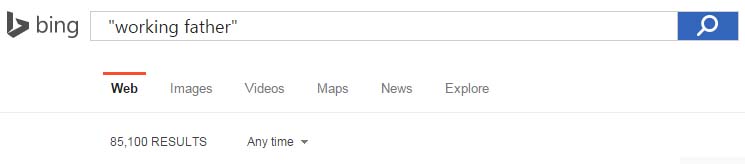
Bing's results are even starker. a 20:1 ratio.

90200 results for working dad.

85100 results for working father.

2040000 results for working mom

1950000 results for working mother.
General thesis: Men can't integrate; women can't separate. It's more of a problem for women, but it's a problem for everyone.


Speaking In, Speaking Out - Inclusion and Nico

Yesterday I wrote my first piece for the Washington Post  on a bad experience we've had with Nico and inclusion. It's not a terrible experience, but I worry a lot about kids whose families don't know how to advocate for their children, or those who do but feel alone.
“Nico will get to participate as an audience member.”
With those words, the teacher explained why my son, a second-grader with Down syndrome, wouldn’t be part of the end of the year performances. These were just little informal plays that emerged from reading groups, groups in which my son was supposed to be included. But the teacher had announced these end-of-the-year events with a flier cheerfully titled, “Come One, Come All.” There were 23 names on the flier, detailing who was in each play on a given day. Nico’s name was conspicuously absent.
Yesterday, my social media world featured an outpouring of support from the disability world in particular. It was, importantly, inter-disability, in that it came from people with both physical and intellectual disabilities, from parents, from educators, from caregivers, and so on. This kind of coalition building hasn't always been the case in our community - parents ride roughshod over the ID/DD discourse. People with physical disabilities want to make it clear that being in a wheelchair doesn't mean they are developmentally delayed but are "normal." Scarce funding makes us compete.

The intersectional approach to disability, like so much else, is the only way through the mire.

When I publish in high-visibility places like Washington Post, I'm hoping to reach beyond our communities, and to provide language to people in similar situations or a quick article they can print out and share. Especially because of this paragraph (written after I describe a great party):
But for how long? How many times does an authority figure have to signal that Nico is just audience, not participant, before the kids stop seeing him as a peer? How many times do parents have to decide to exclude Nico from social functions? He has been invited to exactly zero play dates by other parents this year. He has been invited to only two birthday parties. By the time he’s in high school, will he no longer be welcome in the loving community of peers that I witnessed last weekend?
That's what worries me. Not the teacher, but the other students and Nico himself too. We can't keep sending the message that Nico doesn't belong as a full member of the community.

Note to self: Next August, write - So you've got a child with disabilities in the classroom with your typical kid. Here's how to help.

Thursday, June 11, 2015

More on the New York Times Opinion Page and Higher Education

Last month, I wrote a widely-read blog post on what I found when reading 2 months worth of opinion essays on higher ed at the New York Times. I've been trying to get a publication interested having me write up what I find when reading a years' worth of essays, but so far no dice. It's a very inside-the-media sort of piece, perhaps without wider appeal. Still, I was troubled:
Over the past two months, there have been nine opinion essays published by the Times directly on Higher Ed that I've seen. A few Room for Debates have addressed higher-ed issues, and of course lots and lots of professors have written opinion essays during that time. I made a quick skim of two months of all the opinion essays with the word "professor" in them. I saw zero by community college or lower-status teaching school profs, zero by branch campus public profs, and a handful by top liberal arts schools (Smith, Dickinson) or lower-tier R1 publics (Colorado State, South Carolina). A friend (here's the tweet with the data, with permission) found about 300 mentions of community colleges to 12000 for just Harvard alone. It's a problem.
Today, over at Inside Higher Education, Macalester President Brian Rosenberg (note: I worked at Mac for one year as a visiting professor) wrote on a number of recent essays about college costs. Rosenberg writes:
The editorial pages of The New York Times seem to have become the destination of choice for people who want to say uninformed things about American higher education. Let me rephrase that slightly: They have become the destination of choice for people who want to say uninformed things that are designed to get readers angry at American higher education, which I presume is why The Times keeps them coming. In today’s America, anger sells.
I believe that the New York Times matters. It matters to people who have power, who read it every day, who especially read the editorials and opinion columns. It has a cultural impact, the power to shape conversations, that few other publications in the world can match. And so we have to pay attention.